






Joe Szewczak Ph.D.
Professor - Zoology
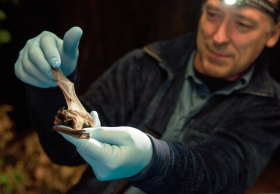
Although Joe grew up as a young naturalist in eastern hardwood forests, he followed his techie side to first earn a degree in engineering. After an early career as an engineer, he returned to his bio side to pursue his PhD investigating torpor physiology of bats. He now melds his two passions in his research pursuits.
Specialty Area
Comparative physiology, physiological ecology, ecological sensing and monitoring, especially of bats.
Education
BSE (1980) Duke University
PhD (1991) Brown University
Courses Taught
Animal physiology
Human physiology
Biology of the Chiroptera
Biological Applications of Physics
Research
My research has pursued the mechanisms and processes of how animals work and interact with their environment, and ways to investigate these interactions. Much of my lab’s recent focus has explored vocalizations of bats and birds and how we can use this information resource, and developing methods to access that information. I began my work with bats investigating physiologic processes of torpor and metabolism in bats: gas exchange, acid-base state, the control of ventilation, and other metabolic mechanisms. As the most aerobically intense, bats provide the optimum mammalian subject to explore physiological functioning at its limits from the cold depths of torpor to how they acclimatize and fly at high altitudes, and just survive as small and long-lived animals.
Publications
- Szewczak, J.M., and M.L. Morrison (2020) Use of Bioacoustics Monitoring Systems in Wildlife Research, in The Wildlife Techniques Manual, 8th Edition, N.J. Silvy [Ed.], Johns Hopkins University Press.
- Jackson, B. K., Stock, S. L., Harris, L. S., Szewczak, J. M., Schofield, L. N., & Desrosiers, M. A. (2020). River food chains lead to riparian bats and birds in two mid‐order rivers. Ecosphere, 11(6), e03148.
- Harris, L. S., Morrison, M. L., Szewczak, J. M., & Osborn, S. D. (2019) Assessment of the status of the Townsend’s big-eared bat in California. California Fish and Game, 105(3), 101-119.
- Meierhofer, M.B., H.H. Wang, W.E. Grant, J.H. Young, L.H. Johnston, L.K. Wolf, J.W. Evans, B.L. Pierce, J.M. Szewczak, and M.L. Morrison (2018) Use of Box-Beam Bridges as Day Roosts by Mexican Free-tailed Bats (Tadarida brasiliensis) in Texas. Southeastern Naturalist, 17(4), pp.605-616.
- Demere, K. D., Meierhofer, M. B., Morrison, M. L., Pierce, B. L., Szewczak, J. M., Evans, J. W. and Ammerman, L. K., 2017. Noteworthy Records for Six Species of Bats from 13 Texas Counties and the First Voucher Specimens from Sites with Pseudogymnoascus destructans. Texas Tech University Occasional Papers. Museum of Texas Tech University.
- Clerc, J., T.J. Weller, J.B. Schineller and J.M. Szewczak (2017) Minimally invasive collection of adipose tissue facilitates the study of eco-physiology in small-bodied mammals. Methods in Ecology and Evolution, 8(1):109-115.
- Long, A.M., M.R. Colón, J.L. Bosman, D.H. Robinson, H.L. Pruett, T.F. McFarland, H.A. Mathewson, J.M. Szewczak, J.C. Newman, and M.L. Morrison (2017) A before and after control–impact assessment to understand the potential impacts of highway construction noise and activity on an endangered songbird. Ecology and Evolution, 7(1):379-389.
- Rodhouse, T. J., Ormsbee, P. C., Irvine, K. M., Vierling, L. A., Szewczak, J. M., & Vierling, K. T. (2015) Establishing conservation baselines with dynamic distribution models for bat populations facing imminent decline. Diversity and Distributions, 21(12), 1401-1413.
- Kennedy, J. P., S. C. Sillett, & J. M. Szewczak (2014) Bat activity across the vertical gradient of an old-growth Sequoia sempervirens forest. Acta Chiropterologica, 16(1):53-63.
- Clement, M. J., T. J. Rodhouse, P. C. Ormsbee, J. M. Szewczak, and J. D. Nichols. (2014) Accounting for false-positive acoustic detections of bats using occupancy models." Journal of Applied Ecology. 51(5), 1460-1467.
- Arnett, E. B., Hein, C. D., Schirmacher, M. R., Huso, M. M., & Szewczak, J. M. (2013) Evaluating the effectiveness of an ultrasonic acoustic deterrent for reducing bat fatalities at wind turbines. PLOS ONE, 8(6), e65794.
- Rognan, C. B., Szewczak, J. M., & Morrison, M. L. (2012) Autonomous Recording of Great Gray Owls in the Sierra Nevada. Northwestern Naturalist, 93(2): 138–144.
- Rodhouse, T. J., P. C. Ormsbee, K. M. Irvine, L. A., J. M. Szewczak, and K. T. Vierling (2012) Assessing the status and trend of bat populations across broad geographic regions with dynamic distribution models. Ecological Applications, 22(4): 1098–1113.
- Tegeler, A. K., Morrison, M. L., & Szewczak, J. M. (2012) Using extended‐duration audio recordings to survey avian species. Wildlife Society Bulletin, 36(1), 21-29.
- Szewczak, J. M. (2011) Acoustic Deterrence of Bats: a Guidance Document. A report submitted to the California Department of Transportation, Sacramento, CA. Agreement No. 43A0219.
- Arnett, E. B., C. D. Hein, M. R. Schirmacher, M. Baker, M. M. P. Huso, and J. M. Szewczak. (2011) Evaluating the effectiveness of an ultrasonic acoustic deterrent for reducing bat fatalities at wind turbines. A final report submitted to the Bats and Wind Energy Cooperative. Bat Conservation International. Austin, Texas, USA.
- Szewczak, J.M. (2011) A call in the night. United Striates Fish and Wildlife Service Endangered Species Bulletin. 3: 42–43.
- Tegeler–Amones, A.K., M.L. Morrison, J.M. Szewczak, and C. Stermer (2010) Assessing point count sampling in montane Meadows. California Fish and Game. 96(3): 201–212.
- Arnett, E.B., M. Baker, M.M.P. Huso, and J.M. Szewczak (2010) Evaluating the effectiveness of an ultrasonic acoustic deterrent for reducing bat fatalities at wind facilities. An investigative report submitted to the Bats and Wind Energy Cooperative. Bat Conservation International. Austin, Texas, USA.
- Parsons, S., and J.M. Szewczak (2009) Detecting, Recording, and Analyzing the Vocalizations of Bats, in Ecological and Behavioral Methods for the Study of Bats, 2nd Edition, T.H. Kunz, ed. Johns Hopkins University Press (920 pp.).
- Redgwell, R.D., J.M. Szewczak, G. Jones, mad S. Parsons (2009) Classification of Echolocation Calls from 14 Species of Bat by Support Vector Machines and Ensembles of Neural Networks. Algorithms. 2:907-924.
- Rognan, C.B., J.M. Szewczak, and M.L. Morrison (2009) Vocal individuality of great gray owls in the Sierra Nevada. Journal of Wildlife Management. 73(5):755-760.
- Parsons, S., and J.M. Szewczak (2009) Detecting, Recording, and Analyzing the Vocalizations of Bats, in Ecological and Behavioral Methods for the Study of Bats, 2nd Edition, T.H. Kunz, ed. Johns Hopkins University Press (920 pp).
- Szewczak, J.M., and E.B. Arnett (2007) Acoustic Monitoring of Bats, in Methods and Metrics for Studying Impacts of Wind Energy Development on Nocturnal Species (Birds and Bats), T.H. Kunz, ed. National Wind Coordinating Committee (NWCC). Journal of Wildlife Management 71(8):2449-2486.
- Szewczak, J.M. (2004) Advanced analysis techniques for identifying bat species. Proceedings of the Bat Conservation International Echolocation Symposium, Austin, TX, April, 2002. Published by Bat Conservation International.
- Szewczak, J.M. and F.L. Powell (2003) Open-flow plethysmography with pressure-decay compensation. Respiration Physiology. 134:57-67.
- Sullivan, S.G. and J.M. Szewczak (1998) Apneic oxygen uptake in the torpid pocket mouse, Perognathus parvus. Physiological Zoology. 71(6):624-632.
- Szewczak, J.M., S.M. Szewczak, M.L. Morrison, and L. Hall (1998) Bats of the White-Inyo Range. Great Basin Naturalist. 58(1):66-75.
- Szewczak, J. M. (1997) Matching gas exchange in the bat from flight to torpor. in: Comparative Aspects of the Control of Arterial Blood Gases: Ventilatory and Cardiovascular Perspectives. American Zoologist. 37:92-100.
- Szewczak, J.M. and D.C. Jackson (1992) Apneic Oxygen uptake in the torpid bat, Eptesicus fuscus. Journal of Experimental Biology. 173:217-229.
Graduate Students
Current:
Ashley Abitz, Amon Armstrong, Zeinab (Rose) Hadar, Jason Holmes, Christina Walker
Former:
Amy Amones
Assessing monitoring techniques for bird populations in Sierra Nevada montane meadow and aspen communities.
Alyson Brokaw
Structure, variability, and behavioral responses to social calls in North American bat species.
Daniel Burrell
Patterns of nocturnal flight calling over four sites in northern California and southern Oregon.
Ryan Byrnes
Assessing Bioacoustic Techniques for Inventory and Monitoring of Forest Owls in the central Sierra Nevada, California
Jeffrey Clerk
An investigation of tree bat migration ecology using fatty acid signatures.
Aaron Corcoran
Automated acoustic identification of nine bat species of the eastern United States.
Kiera Freeman
Roosting behavior of a maternal colony of Townsends Big-eared bat, Corynorhinus townsendii.
Jean-Paul Kennedy
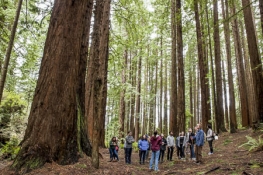
Bats of the northern California old growth redwood forest: The interaction of bats and old growth redwoods across a vertical gradient.
Zachary Loman
Response of a North American Wood Warbler, the Golden-cheeked Warbler (Dendroica chrysoparia) to Anthropogenic Noise
Gabe Reyes
The behavioral function of social calls in the migratory hoary bat Lasiurus cinereus.
Cameron Rognan
Bioacoustic techniques to monitor populations of Great Gray Owls (Strix nebulosa) in the Sierra Nevada.
Danielle (Skye) Salganek
Autumn roost selection by male hoary bats (Lasiurus cinereus) in northern California.
Amy Amones
Assessing monitoring techniques for bird populations in Sierra Nevada montane meadow and aspen communities.
Aaron Corcoran
Automated acoustic identification of nine bat species of the eastern United States.
Jean-Paul Kennedy
Bats of the northern California old growth redwood forest: The interaction of bats and old growth redwoods across a vertical gradient.
Cameron Rognan
Bioacoustic techniques to monitor populations of Great Gray Owls (Strix nebulosa) in the Sierra Nevada.
Kiera Freeman
Roosting behavior of a maternal colony of Townsends Big-eared bat, Corynorhinus townsendii.