Annual Comparison, Lumber-Based Manufacturing Index Vs. Board Feet Produced in Humboldt County
Each month, a local sample of large lumber manufacturing companies report to the Humboldt Economic Index. This sample provides the Index with statistics used to create the lumber-based manufacturing sector. A weighted average is used to derive the lumber-based manufacturing index value. Seventy percent of this weighted average is based on board feet produced. Industry sources indicate that payroll represents thirty percent of the cost of goods sold for lumber, therefore the remaining thirty percent of the weighted average represents the nominal payroll figures of the companies sampled. The index figure is then adjusted to account for seasonality. Note that the monthly lumber manufacturing report produced by the Index is based on a sample of firms, not on the entire industry in the County. Questions have been raised about how well the monthly manufacturing Index represents overall trends in the entire lumber manufacturing industry in Humboldt County.
To address this concern, I compared the average annual lumber-based manufacturing index values over the past eight years with statistics for total board feet of lumber manufactured in the County. The lumber volume data were provided by the California State Board of Equalization, Timber Tax Division. The monthly index values (not seasonally adjusted) were averaged to attain an annual figure. Then the set of index values was graphed against the Board of Equalization statistics in order to see how accurately the index represents lumber production in the county.
When looking at the graphical comparison for these two sets of figures, one sees a correlation between the two data series of 62.2 percent. One also sees that the decline in board feet produced for the county is substantially steeper than the decline in Index values.
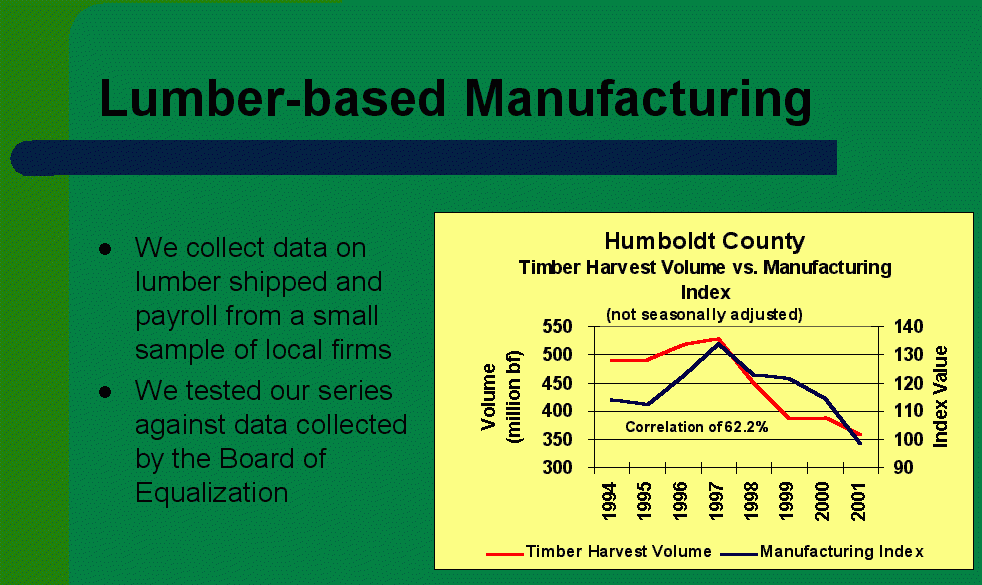
(Note that the original diagram by Peter Perrault was updated by John Manning, the Managing Director of the Humboldt Economic Index, in 2003).
When asked why board feet of lumber declined faster than the Index (which includes payroll as well as board feet of lumber), an insider of the timber industry was able to offer this explanation:
One of the big changes in the last few years has been the need for increased expenditures in forestry. Increased environmental regulations have substantially increased the expenses in forest stewardship. Through efficiencies, our production workforce has declined over the last 10 years but wages and benefits have continued to increase. Another important point is that we do not have a great deal of flexibility in harvest volumes due to adjacency issues and production capacity. In other words if we back off production in a poor market year, we can't necessarily get the volume back the following year. Operating on a sustained yield doesn't give flexibility in timing the market.
Seeing as payroll accounts for thirty percent of the weighted index value, this information makes it understandable that index values decline at a slower rate that actual lumber manufacturing statistics (based on board feet produced). Furthermore, it helps to explain the increase in index values between 1998 and 1999, and the widening gap between board feet produced and the lumber-based manufacturing index values that occurred through the following year.