
Geological Time Scale
Few discussions in geology can occur without reference to geologic time. Geologic time is usually discussed in two forms:
Relative time - named subdivisions of the Earth's geology in a specific order (for example, the "Cambrian Period", followed by the "Ordovician Period", and "Silurian Period"). Most of these subdivisions are recognized globally on the basis of their relative position in the Earth's stratigraphy and their fossil content.
Absolute time - numerical ages, often expressed in "millions of years before present". These are most commonly obtained by radiometric dating methods performed on appropriate rock types.
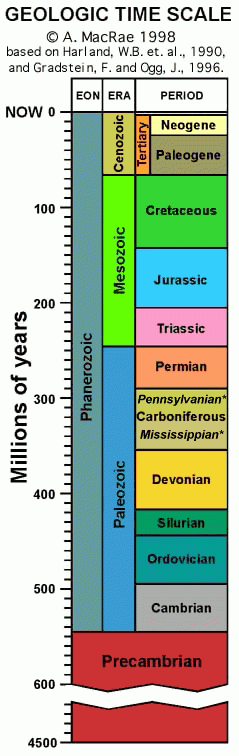
The time scale at left is both a reference and a key to the display cases at the museum. Note that in the United States it is common to break the Carboniferous into two periods, the Pennsylvanian and the Mississippian, as is done in our museum. The Museum thanks Dr. Andrew MacRae for the use of the time scale image and the short essay below.
Links corresponding with the image to the left
Neogene
Paleogene
Creataceous
Jurassic
Triassic
Permian
Pennsylvanian
Mississippian
Devonian
Silurian
Ordovican
Cambian
Precambrian
The two types of geologic time are analogous to the difference between "lunchtime" ("relative time") and the numerical time on a clock, like 12:00pm to 1:00pm ("absolute time"). "Lunchtime" occurs after "morning" and before "suppertime", but its position in time and its duration can also be measured in hours and minutes, just like the Jurassic Period occurs after the Triassic Period, and before the Cretaceous Period, and spans the time from about 205 million years ago to about 142 million years ago.
Relative time is the physical subdivision of the rocks found in the Earth's geology and the time and order of events they represent. Absolute time is the measurement taken from the same rocks to determine the amount of time that has expired. Absolute time measurements can therefore be used to calibrate the relative time scale, producing an integrated geologic or "geochronologic" time scale that combines both types of data, as is depicted here.
This geologic time scale is based upon data from Harland et al., (1990) and Gradstein and Ogg, (1996). The time scale is depicted in its traditional form with oldest at the bottom, and youngest at the top the present day is at the zero mark. The scale is broken in the Precambrian because this period is extremely long in duration (it extends from 545 million years ago to over 4.5 billion years ago). An image with a more complete timescale is also available, as is more information and references about geologic time scales.

