Working in the museum!
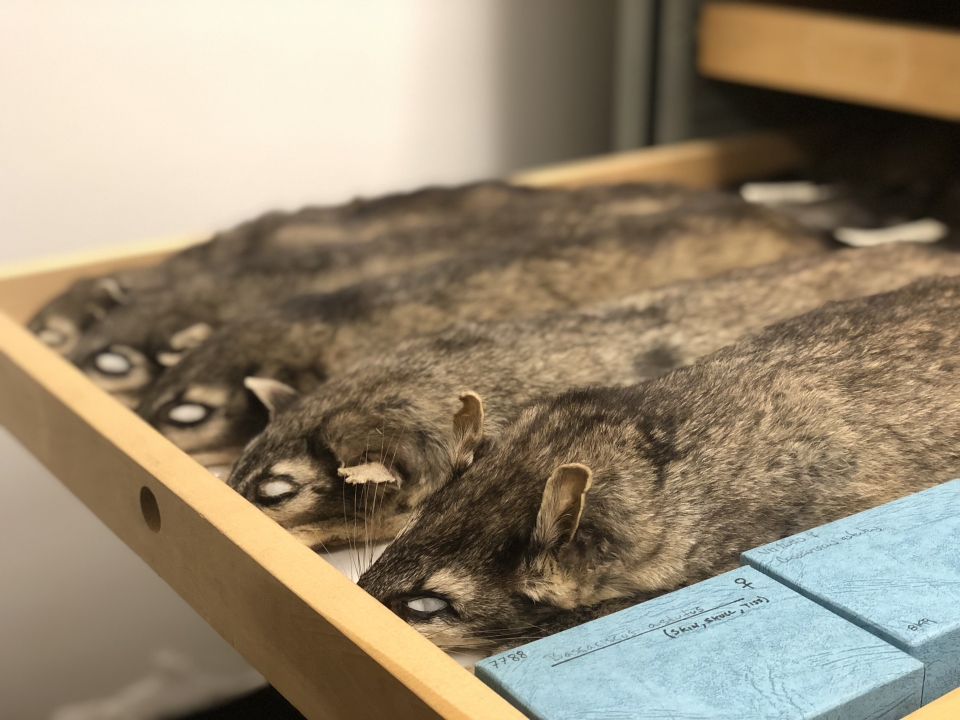
A tray of ringtail cats (Bassariscus astutus).
Undergraduate Research
In addition to our course offerings, there is a wide variety of opportunities for students to get hands-on curatorial training in mammalogy and herpetology, and to conduct directed research on the ecology, evolution, and conservation of vertebrates. Current undergraduate researchers are found here.
Graduate Research
Northern California is one of the most biologically diverse locations in North America. Within minutes of campus are some of the tallest old growth forest in the world, the Pacific Ocean, rugged mountain ranges, and six major rivers, making Cal Poly Humboldt a superb location for field studies.
There are a wide variety of opportunities for Graduate Studies in mammalogy, herpetology, ornithology, evolution, ecology, conservation genetics and systematics at Humboldt.
Marine Mammal Education and Research Program (MMERP)
Dr. Dawn Goley heads the Marine Mammal Education and Research Program (MMERP). This program provides one of the only opportunities in the country for undergraduates to do hands-on research on marine mammals. Current projects include performing surveys and developing photo identification libraries for gray whales and sea lions along the northern California Coast and assisting with telemetry studies of local harbor seals. To find out more about MMERP, check out their website or contact Dr. Goley.
Evolutionary Systematics and Conservation Genomics of Mammals
Dr. Melissa Hawkins (former Curator of the Vertebrate Museum, currently Curator of Mammals at the National Museum of Natural History (Washington, D.C.)) studies evolutionary and conservation genomics of mammals specializing in degraded DNA sources. Some of Dr. Hawkins' major research projects involve resolving the phylogenomic relationships between Southeast Asian tree squirrels, whole genome sequencing of the greater bamboo lemur, as well as local projects searching for taxonomic boundaries and signatures of hybridization in the Townsend's chipmunk group in Northern California, and conservation genomics of the Humboldt's and San Bernardino Flying squirrels. For more information on Dr. Hawkins' research check out her website here.
Collections Research
Those interested in working in the research collection need to contact the museum by email (museum@humboldt.edu) to gain access to the research collection. Depending on the nature of the research various approval is required prior to any use of the collections.
Please see the loans page for additional details.