


Breadcrumb
Program Strengths
The discipline of environmental engineering was born out of public health concerns related to clean drinking water, outdoor air quality and the proper disposal of wastes.
How are we different?
In the Environmental Resources Engineering major we are taking the next step in the evolution of the discipline. We are expanding the definition of environmental engineering so our graduates can create solutions to complex environmental problems that sustain, restore and protect our natural resources.
ERE students look for big picture solutions to energy and restoration problems.
Some examples of this ethos in the ERE major are:
- Addressing global warming, perhaps the largest environmental challenge, requires developing and implementing sustainable energy solutions. Our curriculum examines renewable energy systems and their environmental consequences.
- Traditional environmental engineering problems such as the treatment of wastewater typically require high energy inputs. Looking at the broader environmental picture, ERE faculty pioneered the use of low energy-input treatment wetlands to treat wastewater.
- Restoration of river systems and wilderness areas often requires the removal of dams and roads. We engineer these removals so that sediment runoff is reduced and the rivers and forests can return quickly to health.
- Americans spend over 90% of our time indoors, and consume almost 50% of our nation's energy in buildings. Our program highlights how making our buildings tighter saves energy and also how to address the problem of indoor air pollution that results from more tightly sealed buildings.
ERE's Top Ten Highlights
Job Prospects for ERE graduates are excellent. Current Median Salaries at around $96,000 per year. The largest category of employment is engineering consulting, followed by state regulatory agencies and federal agencies. Many ERE graduates own their own consulting firms or are local, regional and even national managers of firms and agencies.
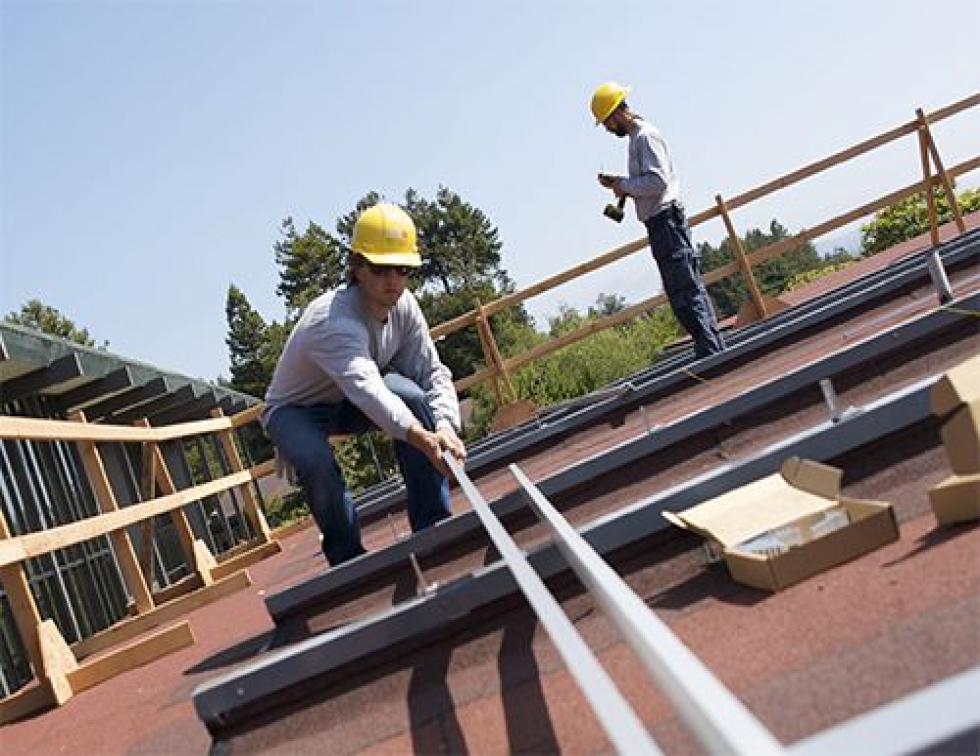
ERE Students Install Photo Voltaic Racks on top of the Music Building. Funded by the student HEIF.
ERE is one of the oldest and Largest undergraduate Environmental Engineering programs in the United States, according to the American Society for Engineering Education. Our alumni work all over the world.
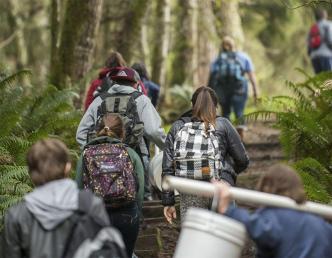
ERE Students go into the Community Forest to water flow measure for Introduction to Environmental Engineering.
One of the largest ABET accredited environmental engineering programs, graduating between 5-10% of the nation's graduates each year. Graduates from accredited programs are able to continue their professional development to become licensed professional engineers (PEs).
ERE is accredited by the Engineering Accreditation Commission of ABET.
ERE students are awarded top honors in international competitions in Interdisciplinary Math Modeling and the American Society of Civil Engineers Mid Pacific Water Treatment Competition.
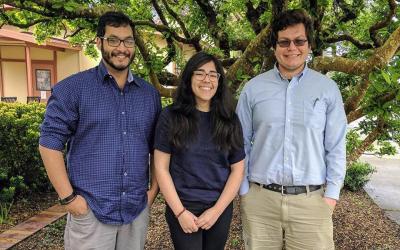
ERE students Yaad Rana, Marcela Jimenez, and Joshua Martinez received "Outstanding Winner" in the 2017 Comap Competition, and they were one of only two teams to win the Two Sigma Scholarship Award.
ERE has direct faculty and student links to the world-famous Arcata Marsh and Wildlife Sanctuary, Schatz Energy Research Center, and the Campus Center for Appropriate Technology.
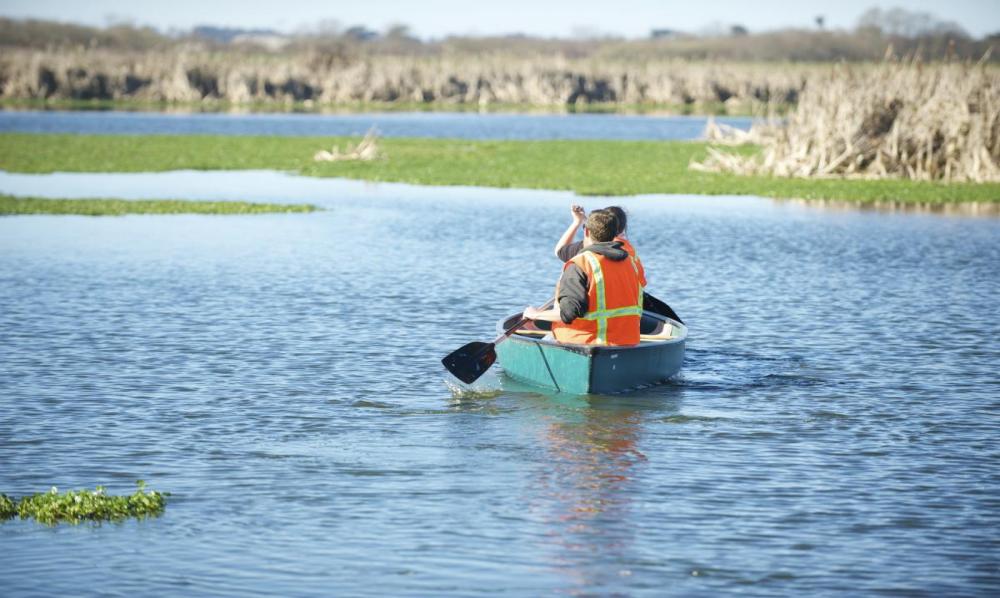
ERE graduate students canoe through the Arcata Marsh and Wildlife Sanctuary.
ERE courses and laboratory sections required for the major are taught by ERE faculty members with environmental engineering backgrounds.
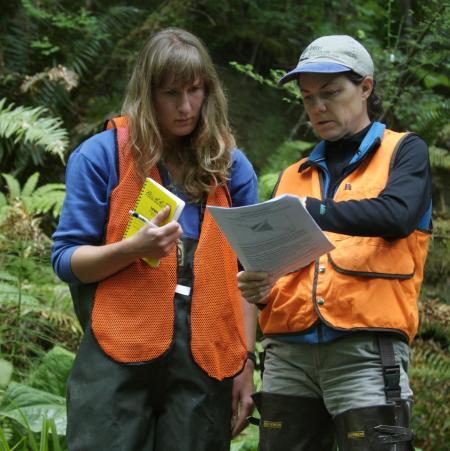
ERE Professor Margaret Lang teaches ERE student (Katy Gurin) how to survey a river cross section.
ERE has one of the highest proportions of women engineering faculty in the country with 6 of 7 tenured/tenure track faculty being women. Our proportion of women students is 35%.
ERE Professor Margaret Lang teaches ERE student (Katy Gurin) how to survey a river cross section.
Nearly a third of ERE graduates go on to complete advanced degrees. Graduates have attended: Stanford University, UC Davis, UCLA, Cornell University, University of Washington, Utah State University, and others. Many ERE graduates have earned Ph.D. degrees and are now university professors.

Two of our recent ERE graduates are now pursuing graduate degrees.(Left: Malia Gonzales. Right: Peter Duin.)
ERE students are active in many different clubs: Environmental Resources Engineering Student Association (ERESA), Society of Women Engineers (SWE), Society for Hispanic Professional Engineers (SHPE), National Society of Black Engineers (NSBE), Renewable Energy Student Union (RESU) and the American Society of Civil Engineers (ASCE).
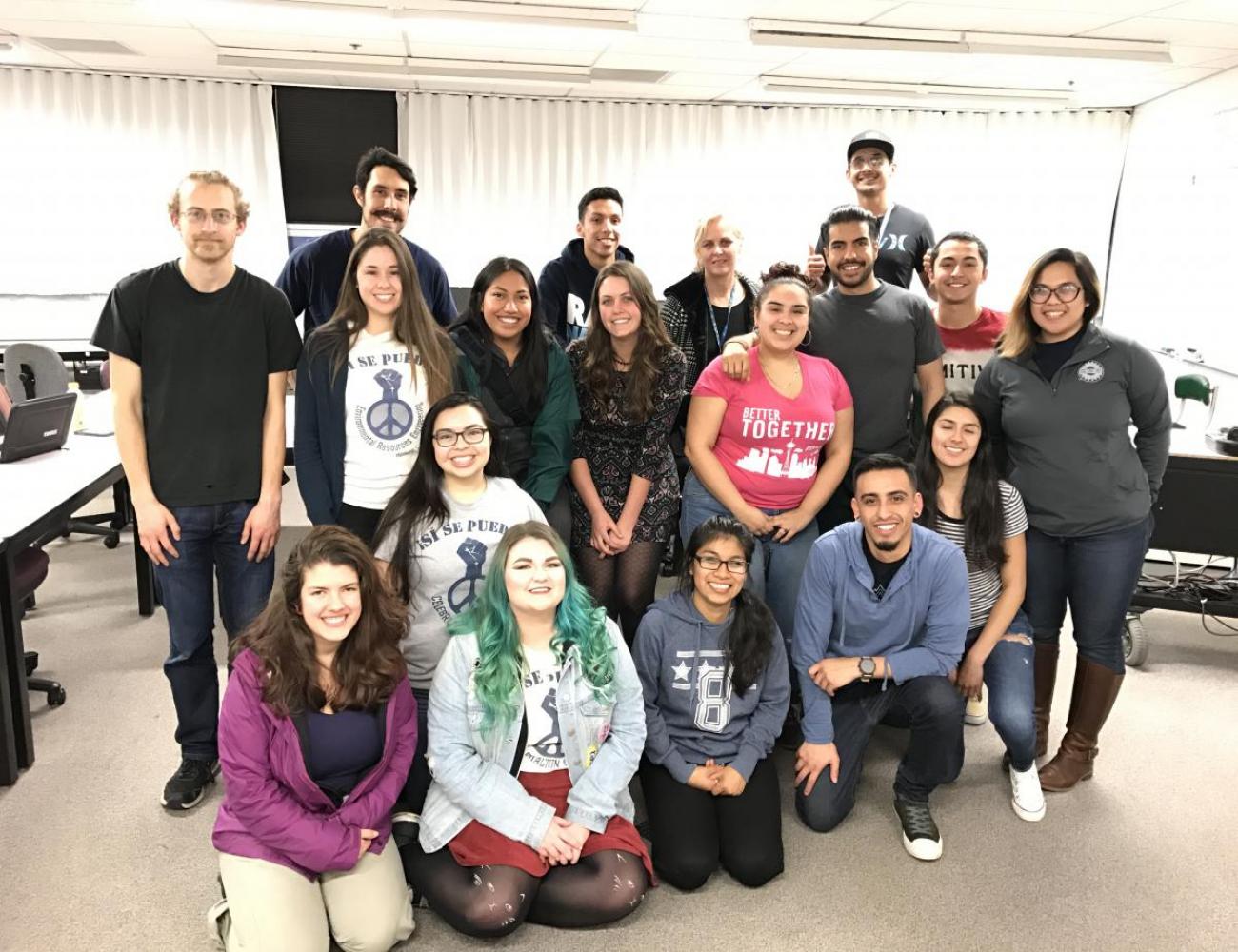
Society of Hispanic Engineers Club.
Humboldt and the ERE department are known for a cooperative spirit between faculty and students. ERE students study together, and many courses have team projects.
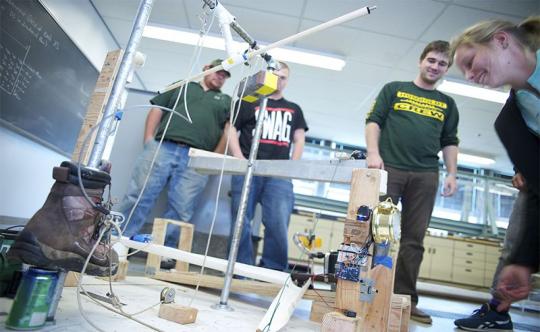
ERE students workin teams for the Rube Goldberg Project for the Introduction to Design class.
Major Strength Areas
The ERE program has three major strength areas integrated throughout the curriculum and are the focus of our faculty's research interests.
Engineers in Energy Resources focus on designing, installing, and operating technologies that use our resources in a sustainable manner. Humboldt Energy Resources engineers investigate:
- Energy generation using renewable energy resources (such as solar, wind, and hydropower)
- Sustainable energy storage and transportation
- Energy efficiency through the optimal design and management of buildings.
Engineers in Water Resources focus on designing, implementing and managing water resources with conflicting and competing objectives and constraints. Humboldt Water Resources Engineers investigate:
- Conjunctive use of surface and ground water resources
- Restoration of stream channels
- Multi-purpose, multi-objective reservoir operation
- Proper function and design of fish passage structures
- Hydraulics and hydrology of watershed systems
What we do
Engineers in Water Quality focus on water and wastewater treatment, treatment wetland design, contaminant fate and transport, and water chemistry. Humboldt Water Quality Engineers investigate:
- Optimal water and wastewater treatment solutions for small communities
- Performance of wetland based wastewater treatment facilities
- Implementation of low cost and low energy wastewater treatment facilities in developing countries