


Breadcrumb
Campus and Community Dialogue on Race
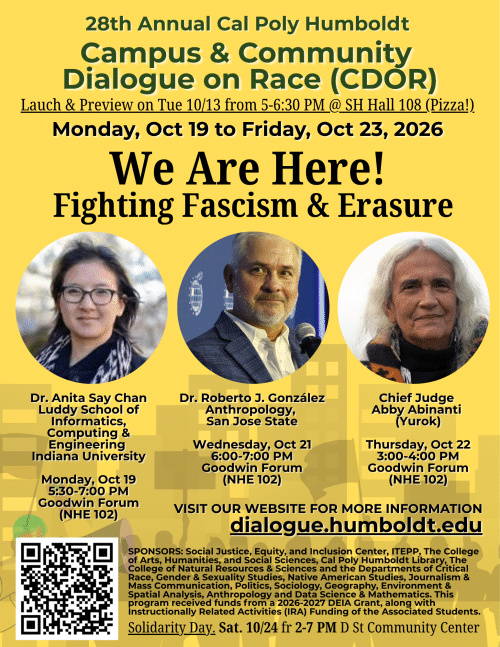
28th Annual Campus & Community Dialogue on Race (CDOR)
📅 October 19-24, 2026 | View the Schedule | Downloadable Program | Downloadable - Two Page Program
Unless otherwise noted, events are held on the Cal Poly Humboldt campus, 1 Harpst Street in Arcata, California.
Zoom Hub Available for Select Workshops
Register to Attend the Three Featured Speaker Events on Zoom
Join the Dialogue
The Campus & Community Dialogue on Race (CDOR) is a week-long series of events that brings together students, faculty, staff, and community members to explore pressing issues of racial justice and systemic inequity. CDOR continues to be a space of reflection, learning, healing, and collective action.
CDOR serves to affirm cultural identities, uplift historical marginalized voices, and welcome people of all backgrounds into a shared space of growth and transformation. Whether you're attending a session, submitting a proposal, or leading an event, you are part of a community seeking change through connection and care. We welcome your presence, your voice, and your ideas. Whether through workshops, panels, performances, creative expressions, or community dialogue. CDOR is a space for all of us.
2026 CDOR Theme: We Are Here! Fighting Fascism & Erasure
The vision of Campus & Community Dialogue on Race is to achieve racial, social, and environmental justice. The purpose of the program is to promote and facilitate social and environmental change by engaging a diverse range of individuals, communities, and viewpoints to explore the impact of racism and its intersections with all forms of oppression. In addition, students can earn a unit of credit in ES 317, Campus & Community Dialogue on Race (email Professor Atienza at pmla@humboldt.edu to enroll in the class).
The 2026 CDOR theme is "We Are Here! Fighting Fascism & Erasure." Fascism is deeply intertwined with racism and ultra-nationalism, using the concept of a superior “nation” or “race” to justify supremacy, social hierarchy, and the elimination of those deemed “others.”
In The Rise of the Techno-Tyrants, Dr. Roberto J. González writes, “Silicon Valley has thrown much of its support behind [the current administration] for reasons of opportunism, appeasement, or fear. But the roots for its fascist turn were laid long before by a culture steeped in racial hierarchies, jingoism, and militaristic utopian visions.”
In How Fascism Works, U.S. philosopher Jason Stanley identifies ten pillars of fascism that serve an “us and them” framework to seize power and dismantle democracy. These tactics include invoking a mythic past, propaganda, anti-intellectualism, unreality, hierarchy, victimhood, "law and order," sexual anxiety, favoring "the heartland," and the dismantling of public goods. Fascism constructs a rigid, dehumanizing hierarchy that prioritizes a dominant group while blaming minority groups for national decline.
For an overview of Stanley’s pillars of fascism, we recommend this short video: The 10 tactics of fascism | Jason Stanley | Big Think
More Resources on the 2026 CDOR Theme: CDOR Library Research Guide
2026 Featured Speakers
The 2026 CDOR featured speakers will address these pillars through their scholarship and their experiences.
Dr. Anita Say Chan is a feminist and decolonial scholar of Science and Technology Studies, Professor and Chair of the Luddy School of Informatics, Computing & Engineering at Indiana University. Her open-access book, Predatory Data: Eugenics in Big Tech and Our Fight for an Independent Future, reveals how new surveillance technologies employed by DHS and ICE to monitor, arrest, and deport immigrants have a long history rooted in eugenics profiling from the 19th and 20th centuries.
Dr. Roberto J. González is a Professor of Anthropology at San José State University. His work focuses on science, technology, and society; militarization and culture; processes of social and cultural control; and ethics in social science. His most recent book, War Virtually: The Quest to Automate Conflict, Militarize Data, and Predict the Future, explores how US military and intelligence agencies harness algorithmic techniques and big data in order to develop autonomous weapons systems, predictive modeling programs, and computational counterinsurgency initiatives. He is currently completing a book on AI-powered policing and surveillance technologies in the US–and their impact on communities of color. Dr. González is also researching the rise of technofascism in America.
Judge Abby Abinanti (BA Journalism, Class of 1970). Known as Judge Abby throughout Indian Country, Abinanti was the first Native American woman to pass the California bar and the first Native American woman in California to become a state judge. She received her Doctor of Jurisprudence from the University of New Mexico in 1973. Abinanti is one of a growing number of tribal judges nationwide who incorporate traditional culture into their courtrooms, with the dual aim of rehabilitating individuals and providing justice to people often failed by the criminal justice system. Her approach is allowing tribal courts to help realign nontribal courts as they seek to move away from a criminal justice approach, which has increasingly proven to be unjust.
More About the 2026 Theme
For the 2026 CDOR we are focused on Fighting Fascism & Erasure, with attention toward those groups that are most negatively affected by this structure.
What the 2026 Theme Means to Us:
- Active Resistance: Opposing the normalization of fascist policies, refusing to obey authoritarian measures, and disrupting the "business as usual" approach. Compliance empowers fascists, so refusing to go back to “business as usual” and normalizing their policies resists the fundamental basis of what fascism relies on to flourish. Fascism counts on and exploits our indoctrination of being ‘polite’ and ‘civil’.”
- Build Community Solidarity: Confront fascist rhetoric by holding each other accountable; protect each other against fascist assault; and connect with one another in the face of fear and isolation so that we see each other as allies instead of competitors.
- Education and Critical Thinking: Combatting disinformation, promoting education, encouraging critical thinking, and sharing our community stories to counter propaganda.
- Broad Alliances: Forming broad fronts across our social differences like race, class, gender, dis/ability that isolate and counter the spread of authoritarianism.
- Proactive Action: Creating communities centered on love and inclusion rather than fear and exclusion. We must fight fascism by standing up for democratic institutions and working to uphold our rights and civil liberties for all.
CDOR is focused on cultivating an environment of growth, healing, and affirmation. We want to explore possibilities for building community and broad alliances across our communities of difference to uplift and empower each other now and enrich the work toward better futures.
More Resources on the 2026 CDOR Theme: CDOR Library Research Guide
Earn Course Credit for Participating in CDOR
Students can earn a unit of credit by participating in CDOR and enrolling in the following course:
You don't need to be a CRGS student to enroll in this class; everyone is welcome!
For information about the course, please email us at cdor@humboldt.edu.
Schedule of CDOR Events
Please be advised that some of our upcoming Campus & Community Dialogue on Race (CDOR) events may cover sensitive topics such as grief, loss, and decolonization, which could trigger/activate emotional responses.
Counseling and Psychological Services (CAPS), will be available at various events to provide support. If you need assistance during or after any of these sessions, please feel free to reach out to them for help. Your well-being is our priority.
The Campus & Community Dialogue on Race (CDOR) is an annual event at Cal Poly Humboldt. It invites students, staff, faculty, administrators, and community members to present and attend programs relating to racial justice and its intersections with all forms of oppression and resistance. Our aim is to create spaces and structures for reflection, analysis, dialogue, and positive strategies for change.
Land Recognition
We acknowledge that Cal Poly Humboldt is located on the unceded lands of the Wiyot people, where they have resided from time immemorial. We encourage all to gain a deeper understanding of their history and thriving culture. As an expression of our gratitude we are genuinely committed to developing trusting, reciprocal, and long lasting partnerships with the Wiyot people as well as all of our neighboring tribes.
Please consider supporting the continued development of the Native American Studies Department's Rou Dalagurr Food Sovereignty Lab and Traditional Ecological Knowledges Institute (FSL) at Cal Poly Humboldt. You can donate at JustGiving.com.
Labor Acknowledgement
Today we recognize and acknowledge the labor upon which our country, state, and institutions are built. Remember that our country is built on the labor of enslaved people who were kidnapped and brought to the US from the African Continent and recognize the continued contribution of their survivors. We acknowledge all immigrant labor, including voluntary, involuntary, and trafficked peoples who continue to serve within our labor force.