

Breadcrumb
Emeritus & Retired Faculty & Staff Association (ERFSA)
The Humboldt Emeritus, Retired Faculty and Staff Association (Humboldt-ERFSA) protects and promotes the rights, benefits, and interests of retirees from Cal Poly Humboldt. Through luncheons, special events, campus activities, and advocacy efforts, ERFSA helps retirees stay informed, connected, and engaged. Membership is open to CalPERS annuitants, emeritus faculty and staff, and eligible retirees from other CSU campuses.
How to join Humboldt-ERFSA:
(local organization)
To join Humboldt-ERFSA, pay electronically at: Cashnet or send a check to the Cashier’s Office, SBS 285, 1 Harpst St., Cal Poly Humboldt, Arcata, CA 95521. Emeritus status is not a requirement for joining ERFSA.
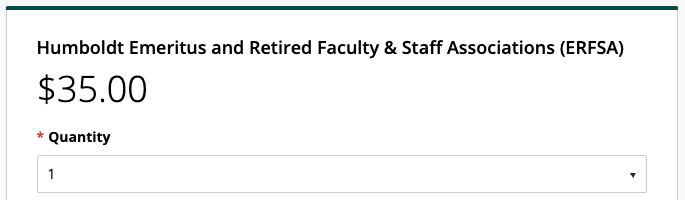
Semester dues are only $35.00 to help defray the cost of advertising, mailings, socials, and other miscellaneous expenses. You can click the down arrow in the "Quantity" drop-down menu to pay for up to two (2) semesters at a time, shown below:
How to join CSU-ERFSA:
(state organization)
Founded in 1985, CSU-ERFSA protects the pension and health care benefits of emeritus and retired California State University faculty and staff. The CSU-ERFSA REPORTER newsletter features articles and updates of interest to CSU retirees. To learn more or join, visit csuerfsa.org.
Emeritus Status
See Emeritus Status tab for information on how to apply, benefits of emeritus status, obtaining an ID and parking permit, verifying status (for retirees prior to December 2020), and for a list of retirees granted emeritus status after January 1, 2021.
Fall 2026 Luncheon Guest Speakers
Time: 11:30 am
Place: In-person Meeting at Baywood Golf and Country Club 3600 Buttermilk Ln, Arcata , CA
Fall 2026 ERFSA Luncheon Presentations (PDF)
September 10, 2026: Ryan Aylward, NOAA Warning Coordination Meteorologist.
“El Niño—Just Hot Water.”
Discussion about El Niño—what it is and isn't—and how El Niño and the Southern Oscillation impact our local weather and climate.
https://www.climate.us/
https://www.weather.gov/education/
Introduction by Jeffry Borgeld
October 8, 2026: Cutcha Risling Baldy, Professor of Native American Studies, 2026 Outstanding Professor Award Recipient.
“Rou Dalagurr: Everyone Works Together - Indigenous Food Sovereignty & Community Resilience.”
A discussion exploring how the Rou Dalagurr Food Sovereignty Lab creates real-world solutions that support both people and the environment. Engaging sustainability, Indigenous leadership, climate action, or community-based research, this presentation highlights how everyone has a role to play in land management and decolonized futures. Come see how working together today can help shape a healthier future for generations to come.
https://www.humboldt.edu/food-sovereignty
https://www.youtube.com/watch?v=7KypLkFLRNg
https://www.canva.com/design/DAG5KD7tAIc/m1IfuRmeHhdtgb779Phh4A/view?utm_content=DAG5KD7tAIc&utm_campaign=designshare&utm_medium=link2&utm_source=uniquelinks&utlId=hcc2e7a4b6d
Introduction by Kumi Watanabe-Schock
November 12, 2026: Dr. Justus Ortega, PhD., Dean of the College of Professional Studies, and Dr. Sarah Landis, PT, MS, DPT, Director of the Health and Medical Science Degree Program and Biomechanics Lab Manager
“Physical Balance and Fall Risk.”
The Cal Poly Humboldt Fall Risk Program is a collaborative community initiative that partners with local healthcare providers, senior centers, community organizations, and wellness programs to promote healthy aging and reduce fall risk among older adults. This presentation will highlight the impact of these partnerships, showcase ongoing research findings, and demonstrate how community engagement, experiential learning, and applied research come together to improve the lives of older adults while preparing for the next generation of healthcare professionals.
Introduction by Lou Ann Wieand
December 10, 2026: Christine Noel, Education Curator, Sequoia Park Zoo.
“Stories of Survival at the Sequoia Park Zoo.”
Sequoia Park Zoo provides a home to many non-releasable rehabilitated animals, including black bear, eagle and owls. Stories of zoo team survival and descriptions of the specialized care, husbandry and welfare practices that go into caring for these animals will be discussed. The Zoo’s website is redwoodzoo.org. We are also accredited by the Association of Zoos and Aquariums (AZA), their website is aza.org.
Introduction by Susan Dobie
Past Luncheon Presentations
Spring 2026 ERFSA Luncheon Presentations (PDF)
Fall 2025 ERFSA Luncheon Presentations (PDF)
Spring 2025 ERFSA Luncheon Presentations (PDF)
Fall 2024 ERFSA Luncheon Presentations (PDF)
Spring 2024 ERFSA Luncheon Presentations (PDF)
Fall 2023 ERFSA Luncheon Presentations (PDF)
Spring 2023 ERFSA Luncheon Presentations (PDF)
Fall 2022 ERFSA Luncheon Presentations (PDF)
Spring 2022 ERFSA Luncheon Presentations (PDF)
Fall 2021 ERFSA Luncheon Presentations (PDF)
Spring 2021 ERFSA Luncheon Presentations (PDF)
Fall 2020 ERFSA Luncheon Presentations (PDF)