Breadcrumb
Fossil Focus Exhibits
Fossils tell many stories of the past.
Explore the images of the many different types of fossils on display at the museum below.
Visit the museum to learn more about how fossils are formed.
Ammonite Models
Life reconstructions of Placenticeras meeki and Baculites grandis, two very different ammonites that lived in the Late Cretaceous, are hanging in the Life Through Time exhibit area. Placenticeras, the coiled ammonite is 24" in diameter and Baculites, the straight ammonite, is 88" long. For more information and photos, see the Cephalopods section of our Cretaceous exhibit.
Read more:
Cretaceous Description and Visuals
Museum Case Index:
Case #11 - Cretaceous Subperiod
Insects—web only
Primitive, wingless, insects are first seen in the fossil record approximately 380 million years ago. Insect fossils in this web-only display date back to the Jurassic Period. They include insects in amber as well as impression fossils.
Web Only - Case Index:
Insects
Making of a Fossil
Fossils take many forms. Learn the difference between processes such as petrification, carbonization and impressions.
Museum Case Index:
Making Fossils
Echinoderms
Ancient echinoderms, including sea lilies, sea stars, sand dollars and sea biscuits are displayed here. The collection contains some very detailed specimens of sea lilies.
Read More:
Echinoderms Descriptions and Visuals
Museum Case Index:
Echinoderms
(Many additional echinoderms are displayed in the cases of the Life Through Time Exhibit.)
Plants
Plants have been on the planet for 400 million years. Learn about the evolution of wood and see fossilized extinct trees and ferns.
(Additional plant fossils are displayed in nearly all of the cases, beginning with the Silurian, of the Life Through Time Exhibit.)
Trilobites
Trilobites are arthropods which lived from 570-240 million years ago. Many different types of trilobites are shown here from the U.S., Africa, and Canada.
Museum Case Index:
Trilobites
(Many additional trilobites are displayed in the Paleozoic cases of the Life Through Time Exhibit.)
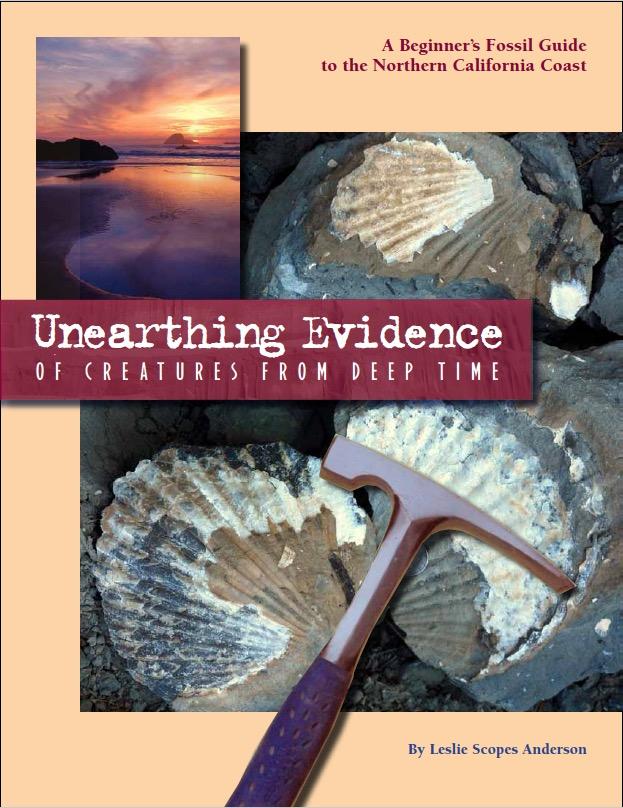
Unearthing Evidence
A Beginner’s Fossil Guide to the Northern California Coast
By Leslie Scopes Anderson
About the Author: Leslie Scopes Anderson received a BFA from University of Utah and is now a graduate student at Cal Poly Humboldt. She is a nature photographer and a volunteer naturalist at the Arcata Marsh. She has an avid interest in and curiosity about our natural world. Please contact her with any comments or corrections about this guide: Lsa9@humboldt.edu