

Breadcrumb
Environment & Community, M.A. | Class of
Emma Lundberg
Graduate Research Asst.
Employer: (University of Wisconsin-Madison), Fisheries Biologist (Wisconsin Department of Natural Resources)
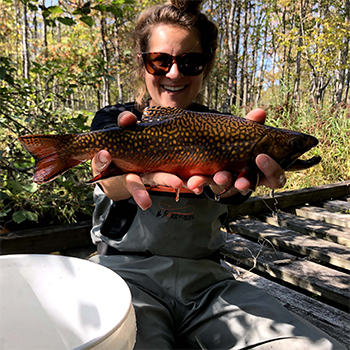
Job description: I have been a research assistant for Dr. Caroline Gottschalk Druschke for the last four years; two years at the University of Rhode Island on the Future of Dams project (spanning New Hampshire, Rhode Island, Maine) working to understand how decisions about dams and dam removal are made, and two years at the University of Wisconsin-Madison where I work with Dr. Druschke and the Wisconsin Department of Natural Resources on projects broadly related to river restoration, settler colonialism, fish migration, and the human dimensions of natural resources. As a fisheries biologist with Wisconsin DNR, I work on a state-wide project where we study the ecological relations between beaver and trout species and the potential implications these interactions on recreational use and riverine management into the future.
About Emma
The education and training I received in the E&C program prepared me to think critically and beyond disciplinary boundaries; something I will never take for granted. As an interdisciplinary freshwater scientist, I am often simultaneously working from multiple positions while trying to never lose focus of what I think is truly important: the ways that settler colonial logics are manifest in natural resource management and what we, as a society, can do about it. As an E&C graduate student, I was able to study what I was really interested in (the multiple, conflicting human perspectives of high elevation lake fish removals) in ways that I found interesting and innovative by combining various fields of knowledge and experience, while also having the autonomy to be creative with my research. Even though I find being an interdisciplinary scientist is certainly difficult, particularly in world that values disciplinary bounds, I believe my interdisciplinary background is an asset and one of my greatest strengths. The ability to and importance of bridging knowledge gaps is something I learned while I was an E&C graduate student and it’s a skill that has had a powerful impact on my career and personal approach to research.