

Kelley Reid
Breadcrumb

Advisor
Andrew StubblefieldKelley Reid, 2011
Thesis:
Skimming of gravel bars is an important industry in Humboldt County. Concerns have been voiced that the practice could release fine sediment into the stream which could affect salmonids. For his Masters thesis, Kelley sought to collect quantitative information to inform the debate. Gravel samples were taken from five gravel bars, and sifted into size classes. Statistical analysis will be used to determine if there was a difference between pre-extraction, post-extraction, after rains, and after-inundation gravel bars. Kelley works for the Army Corps of Engineers in Eureka, CA.
Kirsten Reddy
Breadcrumb
Advisor
Andrew StubblefieldKirsten Reddy, 2017
Thesis:
Kirsten grew up on the Russian River outside of Cloverdale, CA. She graduated in 2011 from Cal Poly Humboldt with a B.S. in Environmental Management and Protection. She then went on to be a member of the Watershed Steward?s Project where she worked with Department of Fish and Wildlife doing salmon spawner and habitat typing surveys in Southern Humboldt and Mendocino Counties. Her love of rivers and streams was quickly rediscovered and brought her back to Humboldt to pursue a Master?s in Watershed Management. Her thesis work explores the relationship between forest thinning and increased water yield. She hopes this work may eventually help guide management decisions for restoring dense stands to a more productive state while increasing low flows to maintain ecologically healthy streams.
Nathan Queener
Breadcrumb
Nathan Queener, 2015
Thesis:
Nathan completed a B.A. in Environmental Studies at the University of Montana. His thesis research focused on understanding the spatial and temporal distribution of stream drying in the Mattole River headwaters, the factors driving observed decreases in dry-season flows, and the resulting consequences for aquatic habitat, especially the survival of juvenile coho salmon.
Jeffrey Paulson
Breadcrumb
Advisor
Han-Sup HanJeffrey Paulson, 2016
Thesis:
I completed my B.S. in Forest Operations in the fall of 2014 at Cal Poly Humboldt. My academic interests include natural resource planning and management, specifically with regard to commercial timber harvesting. I began my work with the Forest Operations Team during my senior year at Humboldt. My work began in the summer of 2014, working with Green Diamond Resource Company and the U.S. Department of Energy in an effort to determine how to best utilize commercial timber harvest residues for bioenergy production. After becoming deeply involved in this research work in the following year, I decided that pursuing a graduate degree was something that I wanted to do. Consequently, I am now continuing my academic career and earning a M.S. in Forest Operations with a focus on GIS.
Trever Parker
Breadcrumb
Trever Parker, 2011
Thesis:
Trever received her B.S. in Natural Resources Planning with minors in Zoology and Applied Mathematics from Humboldt. She has worked for Streamline Planning Consultants in Arcata since 2001. Through this firm, Trever serves as the City Planner for the City of Trinidad, and is currently working on their general plan and local coastal plan update. She assists in stream assessments/monitoring, water quality sampling and wetland delineations. She has completed permitting and environmental assessments for a full range of development projects including habitat restoration projects, in-stream gravel mining, mixed use developments and more. She has also been successful with grant writing and administration. Trever is very familiar with coastal regulations and processing coastal development permits as well as environmental analysis under NEPA and CEQA. She also teaches EMP 425 (Environmental Impact Assessment) at Humboldt.
Trever's thesis is entitled "Fluorometry as a bacterial source tracking tool in coastal watersheds, Trinidad, CA". In this study, a fluorometer was used to measure fluorescence in natural creeks as an indicator of concentrations of optical brighteners found in laundry detergent. Fluorometry was used in Trinidad area watersheds in conjunction with bacterial sampling and measurement of other water quality data for correlation and comparison in order to identify bacterial pollution from failing septic systems. Results showed that optical brighteners, when coupled with other information such as rainfall and turbidity, may be able to accurately predict whether bacterial standards will be exceeded within individual watersheds. Fluorescence of optical brighteners was also shown to be a useful tool for prioritizing watersheds and tributaries for more detailed investigation of bacterial pollution sources. This study was funded by the State Water Resources Control Board through the Clean Beaches Initiative with Proposition 50 (Water Security, Clean Drinking Water, Coastal and Beach Protection Act of 2002) funding.
Tim Montgomery
Breadcrumb
Tim Montgomery, 2014
Thesis:Modeling work plan logistics for biomass recovery operations using spatial analysis.
I completed a B.S. in Forestry with a minor in GIS for Agriculture at Cal Poly San Luis Obispo. My research interests are focused on the production and exploitation of forest resources. I am currently working on a GIS-based model which defines the economics and logistics of centralized biomass grinding operations. I am working with silviculturist from Green Diamond Resource Company and a private contractor from Steve Morris Logging. Their combined years of experience are being used in developing system logistics for my model.
Celeste Melosh
Breadcrumb
Advisor
Andrew StubblefieldCeleste Melosh, 2015
Thesis:
Celeste grew up both in Santa Rosa, CA and moved overseas to Jakarta, Indonesia when she was 11. She got her bachelor?s degree at Mount Holyoke College in South Hadley, Massachusetts in environmental science with a focus on sustainable agriculture. After moving back to Santa Rosa, she spent 2 years exploring the art of film while working for KRCB public television. She inevitably went back to learning about the environment for a master?s in Watershed Management here at Humboldt. Celeste?s thesis investigated the function of LiDAR data in the modeling of water flow over impervious surfaces in the Lake Tahoe Basin. She looked at how improvements to the estimates of directly connected impervious area through the use of LiDAR data could affect the predicted levels of pollutants and runoff into the lake.
Ivan Medel
Breadcrumb
Advisor
Andrew StubblefieldIvan Medel, 2017
Thesis:
Ivan graduated from UCLA in December of 2008 with a B.A in Geography. Ivan began his career path in the environmental sciences as a volunteer with the Santa Monica Bay Restoration Foundation (SMBRF) in August 2009 helping implement the baseline monitoring at the Ballona Wetlands Ecological Reserve. At the SMBRF Ivan eventually became the Watershed Program where he implemented and contributed to numerous projects to improve water quality and natural habitats within the Santa Monica Bay and its watersheds. Ivan?s thesis research involves studying depositional response patterns within the Salt River Ecosystem Restoration Project.
Bret McNamara
Breadcrumb
Advisor
Jeffrey KaneBret McNamara, 2018
Thesis:
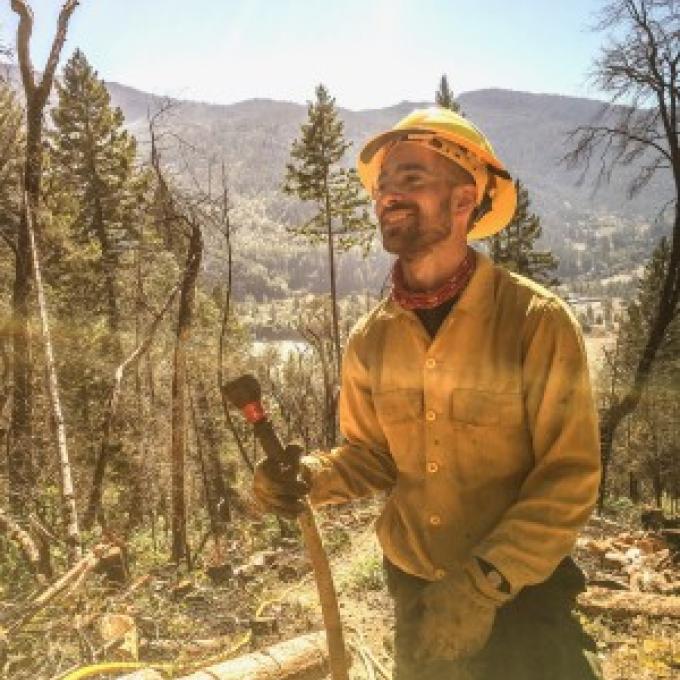
Bret is from Olympia, Washington, where he graduated from the Evergreen State College, volunteered as a firefighter and EMT, and worked in a local hospital. Currently, he studies rare Baker cypress ecosystems as a master?s student at Humboldt and research assistant to the Wildland Fire Lab. His research projects include post-fire regeneration, fuel succession, fire behavior modeling, and habitat suitability modeling. In the future Bret hopes to be involved in forest management and restoration projects.
Larry Maurin
Breadcrumb
Advisor
Andrew StubblefieldLarry Maurin, 2008
Thesis:
Larry came to Humboldt in 2005 and completed his Master's degree in August 2008. His thesis was titled, First-year erosion responses following stream channel crossing fill removal in Redwood National and State Parks, Northwestern California. This study examined the effectiveness of a variety of current road removal techniques in Redwood National Park. He grew up in San Marino, California and has a B.S. in Environmental Engineering from the University of Illinois at Urbana-Champaign. Larry was employed as a Watershed Technician at Green Diamond Resource Company in 2008 and 2009. As well as serving as an Americorps restoration team member in 2010 in Vancouver, WA, Larry will be serving as a Peace Corps volunteer in forestry and agriculture in Zambia beginning in February 2011.