


Breadcrumb
Jobs, Internships, and More
Below are a number of opportunities that you may be interested in. Other opportunities can always be found on the Academic and Career Advising Center’s Handshake page.
Please note that not all of the following programs are associated with Cal Poly Humboldt or the Department of Biological Sciences. Endorsement of the program by Cal Poly Humboldt or the Department of Biological Sciences should not be inferred.
Week of November 2-6, 2026
Plant Genomics REU @ Michigan State University, Program 2027: Talented and curious undergraduate researchers can apply now for the Summer 2027 Plant Genomics REU Program at Michigan State University (running May 23 to July 31, 2027). Applications are officially open, and we are eager to welcome promising students into our research community this upcoming summer. Every student selected for the program is paired with an MSU faculty mentor to lead an independent research project spanning foundational plant genomics, genetics, or computational biology. We provide fully covered on-campus housing and meals, a $6,500 stipend, and round-trip travel assistance. Comprehensive program details and online application forms are available at https://plantgenomics.natsci.msu.edu/.
We also feature former participant highlights and alumni updates on our dedicated LinkedIn page (https://www.linkedin.com/company/michigan-state-university-plant-genomics-reu/) and Instagram account (https://www.instagram.com/msuplantgenomics/).
Download a flyer
Paid Spring 2027 CPUC internship (applications due Nov 16): The California Public Utilities Commission, in partnership with the Schatz Energy Research Center, is seeking to hire an undergraduate or graduate student for a Spring 2027 internship focused on energy and environmental policy. The intern will work with CPUC’s Infrastructure Planning & CEQA team to support research on environmental review and energy infrastructure siting, along with public workshops and meetings. This part-time, paid internship offers up to 20 hours per week and is expected to begin on or near January 13, 2027, and continue through the spring semester, with potential for summer continuation. Work will primarily be remote.
Eligible applicants must be undergraduate or graduate students in good academic standing and enrolled at Cal Poly Humboldt during both Fall 2026 and Spring 2027. Relevant coursework or experience in environmental science and management, environmental studies, land use planning, or a related field is required.
Applications are due by Monday, November 16, 2026, at 8:00 AM Pacific.
View the full internship announcement and application instructions
Apply for the Spring 2027 CPUC internship
If students have questions, please contact the Center at schatzenergy@humboldt.edu.
Graduate Writing Courses:
English 601 - Writing a Research Proposal is a 2-unit course for graduate students across campus that will take place on Tuesdays, from 5-6:50pm in Founders Hall 203. Students work on writing the first chapter of the MA project and learn the versatile genre of the research proposal.
English 670 - Facilitated Writing Community is a 2-unit course for graduate students across campus that will take place on Thursdays, from 5-6:50pm in Founders Hall 234. Flexible hybrid class. Students have the option of attending sessions in the classroom, participating online, or doing both. Work on master's research while in a supportive community.
English 675 - Graduate Writing Capstone is a 2-unit course for graduate students across campus that will take place on Mondays, from 5-6:50pm in Founders Hall 181.The course moves through four phases: finishing the project, designing and publishing it, finding and addressing readers, and practicing public-facing communication. Students will have support to prepare: a 45-second pitch, a Three-Minute Thesis presentation, and a professional portfolio in order to practice translating research for doctoral programs and professional opportunities.
Two exciting new course offerings are being offered this Spring: BIOL 480/480L (Biodiversity and Ecological Survey Techniques) and BIOL 580 (Science Communication). BIOL 480/480L is open to undergrads who have the prerequisites (ZOOL 314 or BOT 356); BIOL 580 is open to undergraduates with instructor approval. Please note that the time the Science Communication has been changed relative to the time originally published in the schedule, to minimize conflicts with other courses. For more information, please see the attached course flyers (Biology 480/480L)(Biology 580). Please contact the course instructors directly if you have any questions. In most cases these classes can count towards your degree, but please verify that with your advisor before registering.
Global Learning Hub at UC Davis, Summer Abroad Opportunities for BIO Students:
Brewing and Beer in Belgium and Germany: https://globallearning.ucdavis.edu/pathways/academics/studyabroad/sa/mc_brewing
- June 20 -July 17, 2027
- Courses are UC Davis Introduction to Brewing and Beer (3 units), and Directed Group Study of Food Science and Technology (5 units)
- Info Sessions upcoming, check the webpage for more information!
- Explore how barley, hops, and centuries of culture shape brewing in Germany and Belgium’s iconic beer cities.
- For more information, contact the Program Coordinator Sarah Wiens
Bio 2 in Belgium: https://globallearning.ucdavis.edu/pathways/academics/studyabroad/sa/belgium_bio
- June 19 – July 17, 2027
- Courses are UC Davis Introductory Biology: Molecules to Cells (4 units), and Directed Group Study of Biological Sciences (4 units)
- Watch a recording of the program Information Session here: https://video.ucdavis.edu/media/BIO+2+and+Microbiology+in+Belgium+Info+Session/1_y2x0wph4
- In this program, you will complete an introductory biology class in molecular and cellular biology. The small class size makes it ideal for students who want to interact closely with the instructor, and a small cohort of peers, to discover the intricacies of the molecular processes needed to create a cell.
- For more information, contact the Program Coordinator Jasmine Li
Microbiology in Belgium: https://globallearning.ucdavis.edu/pathways/academics/studyabroad/sa/belgium
- June 19 – July 17, 2027
- Courses are UC Davis Introductory Microbiology (3 units) and Directed Group Study of Microbiology & Molecular Genetics (5 units)
- Watch a recording of the program Information Session here: https://video.ucdavis.edu/media/BIO+2+and+Microbiology+in+Belgium+Info+Session/1_y2x0wph4
- This program introduces you not only to microbiology as a discipline, but also to the historic laboratories that led to modern microbiology. MIC 102 is an introductory course covering the biology of bacteria, archaea, lower eukaryota and virus. There will be strong focus on the role of microbes in human disease—and our response to them—and on the role of microbes in biotechnology, agriculture and their environmental impacts activities and more while on this program.
- For more information, contact the Program Coordinator Jasmine Li
Microbiology Lab in the Kingdom of Smiles, Thailand: https://globallearning.ucdavis.edu/pathways/academics/studyabroad/sa/thailand
- June 18–July 16, 2027
- Course options are UC Davis courses Introductory Microbiology (3 units), Introductory Microbiology Lab (2 units), and Directed Group Study of Microbiology (3 units) OR Food Microbiology Laboratory (4 units) and Directed Group Study of Food Science (4 units)
- Register for an info session on 11/4, 12 pm PST here: https://goglobal.ucdavis.edu/register/?id=627f600e-c3fd-4c10-ab47-923a6c7aca3d
- Learn experientially. Core course laboratory investigations examine environmental samples collected during local class field trips. You can look forward to meeting locals and other travelers, trying fabulous food, hiking in urban and rural settings, water activities and more while on this program. For more information, contact the Program Coordinator Sophia Ferris-Green
Life Sciences in Japan: https://globallearning.ucdavis.edu/pathways/academics/studyabroad/sa/japan_life
- June 19–July 16, 2027
- Course options are UC Davis courses Structure & Function of Biomolecules (3 units) and Directed Group Study of Biological Sciences (5 units) OR Tutoring in Molecular and Cellular Biology (3 units) and Directed Group Study of Biological Sciences (5 units)
- Watch a recording of the program Information Session here: https://video.ucdavis.edu/media/t/1_ugi6mnhp OR register for an upcoming information session on 11/17 at 2pm PST: https://goglobal.ucdavis.edu/register/?id=1e3f3cb9-0c65-402c-a951-3834682784fe
- Connect natural science and Japanese culture through hands-on discovery from Kyoto to Osaka.
- For more information, contact the Program Coordinator Emeline Diolot-Bobalik
Global Health Internship Programs: https://globallearning.ucdavis.edu/pathways/academics/studyabroad/si#global-health
- July 31–September 4, 2027
- Courses are UC Davis courses Education Abroad Internship (4 units) and Writing for Internships: Global Health (2 units)
- Register for an info session on 11/05, 12 pm PST here: https://goglobal.ucdavis.edu/register/?id=7a0a9627-4886-4e43-a622-76ac5dea4a1f
- Participate in an internship in Bolivia, Ghana, the Philippines, or South Africa!
- Pediatric Health Internships in Bolivia: https://globallearning.ucdavis.edu/pathways/academics/studyabroad/si/global-health-bolivia_la-paz/placements
- Pediatric Care and Reproductive Health Internships in Ghana: https://globallearning.ucdavis.edu/pathways/academics/studyabroad/si/global-health-ghana/placements
- Remote Island Medicine Internships in the Philippines: https://globallearning.ucdavis.edu/pathways/academics/studyabroad/si/global-health-philippines/placements
- Hospital Medicine and Health Disparities Internships in South Africa: https://globallearning.ucdavis.edu/pathways/academics/studyabroad/si/global-health-south-africa_ct/placements
- For more information, contact the Program Coordinator Brooke Paynter
Financial Aid can be used for study abroad, and scholarships are available! Be sure to check out the Global Learning Hub resources for funding your program.
Summer 2027 Plant Science opportunity in Colombia! Explore real-world solutions to improve farming and food systems in tropical and global settings by spending your summer in Colombia! Join UC Davis this summer for Agriculture and the Environment in Colombia, a hands-on program where you'll explore how agriculture can address urgent global challenges such as climate change, food security and sustainability through this immersive program based at the Alliance of Bioversity International and CIAT in Cali and Palmira, Colombia, one of the world's leading agricultural research hubs. You'll also travel to Salento in Colombia's renowned coffee region to hike through biodiverse Andean landscapes and examine the connections between agriculture, conservation and rural livelihoods, gaining practical skills and a global perspective for careers in agriculture, environmental science and international development.
Program Details
- Dates: August 1-29, 2027
- Location: Cali, Palmira, and Salento, Colombia
- Academic Area: Plant Sciences - see courses
- Language of Instruction: English
- Enrollment: Limited to 30 students
Funding Available
- Additional funding opportunities include the Gilman Scholarship: Up to $5,000 through the U.S. Department of State's Benjamin A. Gilman International Scholarship Program. And the Gilman STEM Supplemental Award is an n additional award of up to $1,000 for eligible students completing STEM coursework or internships abroad. Deadline: January 7, 2027, 11:59 p.m. Pacific Time.
- Financial aid for your Summer Abroad program would come from your home campus. Students should consult with their home institution about financial aid eligibility and timelines. Upon request, the Global Learning Hub can issue an Enrollment Verification Letter confirming your enrollment in the program for you to provide to the financial aid office at your home campus.
Learn More
- Watch the Information Session: Watch Recording -or- join the next information session on Nov. 9 from 12:00-1:00 p.m. Pacific Time online. Register
- Attend an Application Overview Session: Join UC Davis Global Learning Hub staff on November 18, 2026, from 6:00–7:00 p.m. Pacific Time to learn about eligibility, the application process, and important deadlines. Register here
Ready to Apply?
- Create a UC Davis Study Abroad Account.
- Fill out your profile with your programs of interest.
- Start your application; available in late November.
- Starting on Wednesday, December 2, 2026 at 9 a.m., submit your application and pay your $300 non-refundable deposit. The last day to submit applications for open programs is Thursday, March 18, 2027 at 11:59 p.m.
New botanical position @ Field Museum, Chicago - Assistant Collections Manager - Botany:
The Field Museum of Natural History has an opening in the Gantz Family Collections Center for an Assistant Collection Manager (Botany & Mycology, with a focus on Seed Plants). The Field Museum's Searle Herbarium is the fifth largest in the Western Hemisphere and houses 2.5 million accessioned flowering plant specimens, including nearly 40,000 types. Representation is worldwide, but particularly strong in tropical Central and South America. The Central American material is overall one of the world's finest single collections with special strengths in Guatemala, Honduras, and Costa Rica. The South American collections are important with special strengths in Venezuela, Colombia, Ecuador, and Peru. A good representation in North American taxa is found, especially for Missouri and Illinois. In addition the Field Museum curates an extensive collection of approximately 2,000 dried fruits, large seeds, bark and other plant parts that generally are not accommodated on herbarium specimens. The gymnosperm collection consists of approximately 12,000 collections, 1,000 cones and 41 types. The Assistant Collection Manager reports to the Collections Manager(s), or a Collections Head, and is expected to assist with day-to-day aspects of collections care, curation, and operations and is assigned to specific projects as needed.
Learn more here: https://www.fieldmuseum.org/landing/careers
Apply at: https://fieldmuseum.clearcompany.com/careers/jobs/f5328461-b154-d0fb-54e1-6c58987a87fb/apply?source=CJB-0
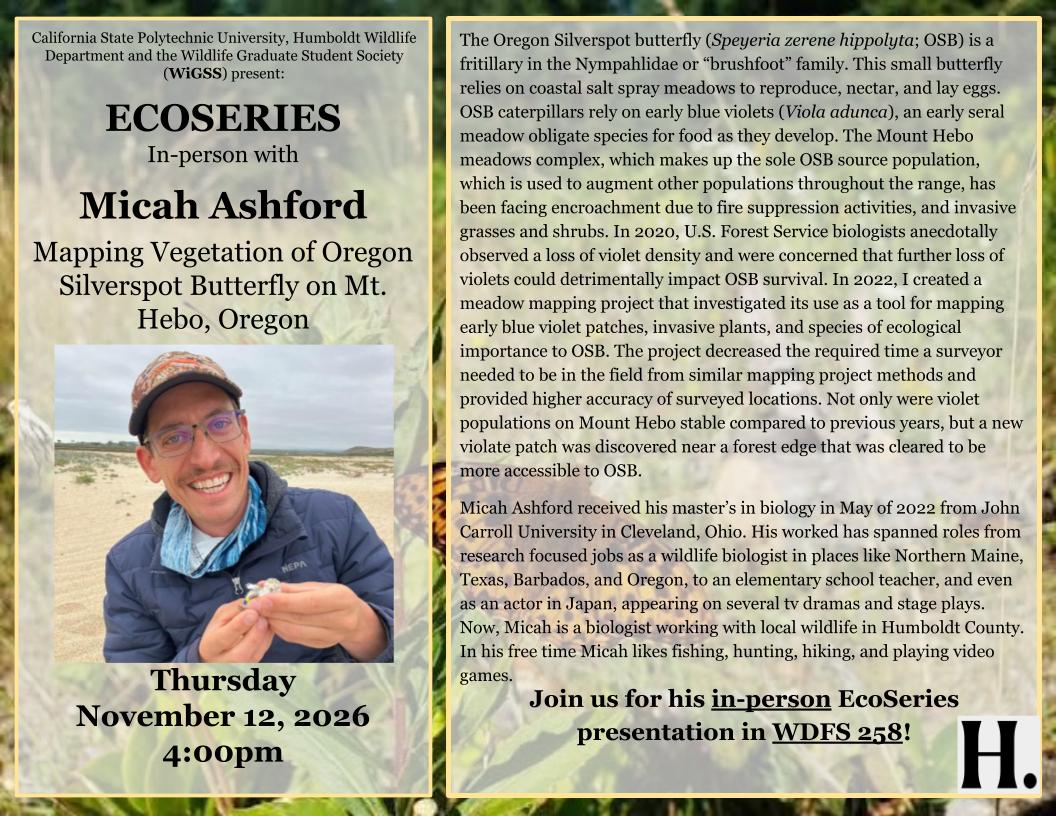
Wildlife EcoSeries 11/12 - Micah Ashford: WiGSS and the Wildlife Department are hosting our next EcoSeries talk for the Fall 2026 semester, scheduled for next Thursday, November 12th at 4 pm. This presentation will be in person in WDFS 258. This week's topic: Mapping vegetation for the Oregon Silverspot Butterfly on Mt. Hebo, Oregon|
The Oregon Silverspot butterfly (Speyeria zerene hippolyta; OSB) is a fritillary in the Nympahlidae or “brushfoot” family. This small butterfly relies on coastal salt spray meadows to reproduce, nectar, and lay eggs. OSB caterpillars rely on early blue violets (Viola adunca), an early seral meadow obligate species for food as they develop. The Mount Hebo meadows complex, which makes up the sole OSB source population, which is used to augment other populations throughout the range, has been facing encroachment due to fire suppression activities, and invasive grasses and shrubs. In 2020, U.S. Forest Service biologists anecdotally observed a loss of violet density and were concerned that further loss of violets could detrimentally impact OSB survival. In 2022, I created a meadow mapping project that investigated its use as a tool for mapping early blue violet patches, invasive plants, and species of ecological importance to OSB. The project decreased the required time a surveyor needed to be in the field from similar mapping project methods and provided higher accuracy of surveyed locations. Not only were violet populations on Mount Hebo stable compared to previous years, but a new violate patch was discovered near a forest edge that was cleared to be more accessible to OSB.
Download a flyer
Discover cancer research careers at the University of Florida Health Cancer Institute:
Invitation to apply for 2027 visit!
Apply now for the University of Florida Health Cancer Institute's annual Cancer Research Career Explorations Program! This visit will allow you to learn about the wide range of Ph.D. options at the University of Florida and discover the groundbreaking cancer research at the National Cancer Institute-designated UF Health Cancer Institute. The program provides cancer research highlights by UF trainees, information on Ph.D. pathways, and a career panel. Attendees will be invited as special guests to the UF Health Cancer Institute's annual Research Showcase on Feb. 4, featuring more than 150 trainee research posters.
Program Dates:Feb. 3-5, 2027
Program Location: University of Florida Health Cancer Institute
Gainesville, FL
APPLY NOW! The application deadline is December 1st.
REU in biological collections research: Spend 10 weeks exploring biological collections and their data through REU-EXTEND (EXTENded Data & Biological Collections). This NSF-funded Research Experience for Undergraduates program pairs students with researchers for hands-on work spanning field research, curation, genomics, bioinformatics, data science, and scientific communication. Applications are open for the NSF funded REU-EXTEND program (EXTENded Data & Biological Collections). This 10-week undergraduate internship program provides students hands-on research experience spanning field research, curation, genomics, bioinformatics, data science, and scientific communication. Students will work with scientists from the Illinois Natural History Survey (INHS) of the Prairie Research Institute at the University of Illinois Urbana-Champaign. Participants receive a $7,000 stipend, university housing and meals, and round-trip travel support. Students can select research projects in collections including herpetology, fish, mammals, birds, mollusks, crustaceans, insects, botany, paleontology, plant diseases, medical entomology, environmental DNA, and more. This full-time, in-person internship program runs May 25–August 1, 2027. Applications are open through January 31, 2027.
Learn more and apply: REU-EXTEND at Prairie Research Institute
Applications open Nov. 1 through the National Science Foundation’s Education & Training Application Portal.
Week of October 19-23, 2026
Learn Spanish and Shadow Doctors in Latin America, Summer 2027: Shadow Abroad is hosting a Virtual Open House on Tuesday, October 27, at 4 p.m. Pacific Time. Pre-med or pre-health students interested in Spanish immersion, clinical shadowing, and international experience, should consider attending. Students will learn about our Summer 2027 programs in Latin America, including academic credits, program options, financing, grants, and scholarship opportunities.
Learn more at: https://www.shadowabroad.com/
Register for the Open House using this link: https://www.shadowabroad.com/open-house
Sequoia and Kings Canyon NP Biological Science Tech Positions: The job announcements for Summer 2027 Seasonal Biological Science Technician (Plants) positions are open! The open period is Monday, October 19 - Monday, October 26. Interested applicants must apply through the USAJOBS website at the following job announcement number: CAHQ-27-13080629-DE-JEA, USAJOBS - Job Announcement. Announcements open on Monday, October 19, 2026, and will close on the day when application caps have been reached. To receive consideration, complete application packages should be submitted expediently. If a cap is not reached, that announcement will close at 11:59 PM (EST) on October 26, 2026. Results of previous job announcements indicates the cap could be reached well before the October 26 deadline.
Hosted by the DOE Joint Genome Institute, the 5th Viral EcoGenomics and Applications (VEGA) symposium will take place November 18-19, 2026 on the UC Berkeley campus. Organized every two years since 2018, the goal of this symposium is to bring together a “Viral Ecogenomics” community to foster discussion on how to best capture and characterize uncultivated viral diversity, understand the role of viruses in natural ecosystems, and functionally explore viral genetic diversity toward innovative biotechnological and industrial applications.The symposium will include a mix of plenary talks, panel discussions, posters and networking sessions. Beyond providing an overview of the latest discoveries related to functional characterization of novel viral diversity, molecular mechanisms of virus-host interactions and phage-based technologies for microbiome manipulation, the VEGA symposium represents a unique opportunity for students and researchers in the viral ecogenomics field to exchange ideas with experts in the field, as well as with peers from other institutions. Abstracts are due Friday, October 16, 2026 to be considered for a short talk (see information in the registration confirmation email). Registrations are due November 4, 2026.
Learn more here: https://jgi.doe.gov/work-with-us/events/vega-symposium
Register here: https://web.cvent.com/event/26264cb2-a426-475a-b859-87ebeabd476a/register
Methods in Primate Behavior and Conservation Field Course in Costa Rica: DANTA is pleased to announce our 2027 Methods in Primate Behavior and Conservation Field Course, to be held in the spectacular Osa Peninsula of Costa Rica. Designed for undergraduate and early graduate students, this immersive program provides hands-on experience in primate behavioral research, tropical ecology, and wildlife conservation. Students will develop practical field skills while exploring the extraordinary biodiversity of the Osa Peninsula and examining real-world conservation challenges in one of the world's most important tropical ecosystems.
Dates: June 15-30, 2027
Program Fee: $3,100
Application Deadline: May 1, 2027
Enrollment: Limited to 15 students
Applications are accepted on a rolling basis, and early application is strongly encouraged as spaces may fill before the deadline. In addition to field-based instruction, participants will visit a wildlife rehabilitation center, tour a sustainable chocolate plantation, and explore the rich marine biodiversity of the Golfo Dulce during a dolphin-watching and snorkeling excursion. The course also includes an overnight stay on the Boruca Indigenous Reserve, where students will learn about traditional culture, history, and sustainable living practices. DANTA is committed to integrating environmental stewardship and socially responsible practices into all aspects of its field courses and conservation mission.
For more information, visit www.danta.info or contact conservation@danta.email.
Interested in a career in Biomedical Research? Apply to the Graduate Group in Integrative Pathobiology at UC Davis: GGIP Offers Graduate Students:
· A Multidisciplinary, Collaborative, Inclusive Research Environment|
· M.S. or Ph.D.
· Laboratory Rotations
· Access to Professional Development
· Opportunities with School of Medicine and Veterinary Medicine (#1 Veterinary School in the country)
· We are an Inclusive Excellence Graduate Group
· Comprehensive Mentorship from Motivated Faculty
Virtual Open House; October 30, 12-1 p.m. PST on Zoom; Register here: https://ucdavis.zoom.us/meeting/register/SoeKSjGWTi232SlEK6YJ4Q#/registration
Week of October 12-16, 2026
UC Irvine Masters in Conservation and Restoration Science - Recruiting for Fall 2027: UCI’s Masters in Conservation and Restoration Science (MCRS) program is recruiting for our Fall 2027 cohort. Applications are now open, and our priority deadline is February 1st, 2027. MCRS is a professional, field-based graduate program that provides training for students interested in careers in research and management of our terrestrial and marine natural resources. The MCRS degree provides students with the academic and professional skills needed to study, protect, and conserve natural resources and to hold leadership and management positions in environmental fields related to conservation, restoration, and sustainability.
For more information about the program, visit the MCRS webpage (http://mcrs.bio.uci.edu). To sign up for our upcoming virtual information session on Wednesday, November 4th at 5:30pm Pacific, REGISTER HERE
UCSB Sea Turtle Field Course, Summer 2027 - Lecturer Led: UCSB Sea Turtle Field Course and Expedition Group
2 WEEK PROGRAM | COSTA RICA | SUMMER 2027
Also, Check out our WEBSITE and APPLY
https://biomaseaturtles.org
Founded by a graduate and lecturer from UC Santa Bárbara - Bren School of Environmental Science & Management, BIOMA has provided to over two thousand university students worldwide with a two-week intensive academic & high quality sea turtle experiential learning and hands-on research experience. Our participants collaborate side by side with experts to learn about sea turtle biology, ecology and management while doing impactful on-site conservation work and living in a local community. Student teams (about 18 like-minded students per group), will build skills of real world application, boost their resume and knowledge while discovering incredible landscapes at Costa Rica’s Pacific sunshine coast.
Join us at BIOMA and APPLY to not only learn about sea turtles and science. It's about connecting people and creating an unbreakable bond between science and humanities.
University of Kentucky’s Dept. of Toxicology & Cancer Biology Graduate Programs:
Master’s in Forensic Toxicology & Analytical Genetics: This is a professional degree program, which educates and prepares students to directly enter the workforce as advanced working professionals
No GRE requirement
This program has 2 areas of concentration:
Forensic Toxicology/Chemistry & Forensic/Analytical Genetics
The program curriculum contains two required internships, which provide our students with hand-on experiences to be strongly competitive in the job market
Application deadline is April 1, 2027.
PhD in Toxicology & Cancer Biology: has 2 concentration focuses:
Toxicology – Students investigate the effects of toxic agents on humans and our environments
Cancer Biology – Students investigate problems related to cancer development, improved cancer treatments, and preventions
No GRE requirement
All PhD students receive financial support in the form of a Graduate Research Assistantship; which includes a yearly stipend, health insurance and full-tuition coverage
Application deadline is January 6, 2027.
Master’s in Toxicology: Toxicology – Students investigate the effects of toxic agents on humans and our environments
No GRE requirement
Application deadline is April 1, 2027.
Info Sessions and Application Dates: Stanford Medical Postbacc Fellowship (COMET): Stanford’s Clinical Observation and Medical Transcription (COMET) Fellowship is a 1-year, unparalleled, post-baccalaureate clinical experience with outstanding faculty at Stanford University School of Medicine. Learn the art of medical documentation in one of our partnered specialties: Family Medicine, Internal Medicine, Geriatrics, Palliative Care, Endocrinology, Infectious Disease, Dermatology, Pediatrics, Plastic Surgery, Pathology, Cardiology, and More!
Engage in research and quality improvement projects
Support clinical operations and population health initiatives
Build connections with faculty, physician/PA/NP mentors and other pre-health students
Potential for leadership development for fellows able to make a longer commitment
For more information and to apply, visit our website: https://med.stanford.edu/comet.html
Oregon Dept of Fish and Wildlife Summer Opportunities: A zoom webinar about internships and career opportunities with this agency will be held:
Date: Tue, Oct 20
Time: 3 pm
Zoom link: https://hum.link/ZEa
Handshake Registration for Event: https://humboldt.joinhandshake.com/events/2043418/share_preview
Paid Pre-Med Summer Internship in Healthcare Careers: The Paid Summer Internship for Health Profession Careers program provides students with opportunities to observe and shadow professionals in primary care, geriatrics, and psychiatry during the summer. These clinical placements will provide participants with an overview of healthcare specialties while helping them develop professional skills and learn about healthcare challenges in rural communities. Throughout Summer 2027, students may shadow one or more healthcare professionals, including physicians, physician assistants, and other allied health professionals.
For more info and to apply, visit: https://docs.google.com/forms/d/e/1FAIpQLSfdhXIcjuepWevI71u3yf3W3Z_sjm4vOM1i9IS6_FnlqtJrxQ/viewform
The James F. Welsh Biology Scholarship endowment will provide multiple scholarships of $2,500 - $3,000, depending on available funds, to be awarded early every fall semester. The Welsh Biology Scholarship supports students who intend to go to graduate school (M.S. or Ph.D programs) after obtaining their Bachelor's degree from Humboldt. The award is not intended for students planning on attending professional schools such as medical, pharmacy or veterinary school. To be eligible for the award, you must meet the following application criteria: 1) you must currently be classified as having senior class standing (90 or more completed units); 2) You must be enrolled at Cal Poly Humboldt for spring 2027 semester (that is when the funds will be disbursed; students graduating this semester are not eligible, unless attending CPH as a graduate student in spring) 3) you must have an overall GPA of 3.0 or higher; 4) must be a biology, botany, marine biology, or zoology major; and 5) you must intend to pursue graduate education in some area of the biological sciences. In addition, preference will be given to those students who are graduating in spring 2027; however, all students who meet the criteria will be considered. If you meet the eligibility criteria and are interested in being considered for the scholarship, please submit the following information no later than Sunday October 25, 2026 11:59 p.m. Faculty will make final decisions on awardees based on the above criteria so please fill out the form completely.
Link to application form: https://forms.gle/SMMT7BcauHKnM1iR6
Application deadline: Sunday, October 25, 2026 by 11:59 p.m. PST
Awardees will be notified by November 13, 2026.
Siering/Wilson Undergraduate Research Endowment: The Siering/Wilson Research Endowment is a program designed to fund undergraduate research activities in the broad disciplines of Microbial Ecology and Environmental Microbiology. Proposals from undergraduate students (freshman to seniors) in ALL departments within the College of Natural Resources (CNRS) at Cal Poly Humboldt will be considered. Projects may be theoretical, investigative, hypothesis-driven, or applied in focus. Since most questions related to the field of microbial ecology are interdisciplinary in nature, projects that involve collaborations among faculty mentors with different disciplinary expertise will be given preference. We anticipate multiple grants of $500-$1500 will be awarded to support projects to be conducted in the Spring, Summer and/or Fall of 2027. Funds may be used for research supplies and services (e.g. DNA sequencing, environmental analysis), but may not be used for travel.
Download the application here: Siering Wilson Undergraduate Research Endowment Application 26/27 or email Dr. Mark Wilson for more information at msw13@humboldt.edu.
The deadline for applications is Wednesday, December 9, 2026 by 5 p.m. PST.
Week of October 5-9, 2026
Green Diamond | Job Shadow & Scholarship Program: Green Diamond is excited to announce the second year of our Job Shadow and Scholarship Program, designed to help students connect academic learning with real-world career opportunities in forestry and natural resource management. This program was created for students pursuing academic degrees in accredited forestry or natural resources programs. Our goal is to help them explore career paths, see some of the hands-on application of the work, and receive meaningful financial support as they work toward completing their education.
Through this program, students can:
- Participate in a three-day unpaid job shadow experience at one of our operating locations.
- Learn and see hands-on application of the work directly from experienced forestry and natural resource professionals.
- Explore career paths and connect classroom learning with field work.
- Apply for a scholarship award of up to $2,000.
How to apply: The program is open for applications now with details included in the process. Interested students can apply directly through our website: https://www.greendiamond.com/communities/scholarships
Application Deadline: November 30, 2026
Green Diamond | 2027 Natural Resources Scholarship | Application Process Is Open: Green Diamond is excited to announce we are accepting applications for our Natural Resource Scholarship. This is a fantastic opportunity for students who are passionate about the environment and are pursuing studies that contribute to the enrichment of Natural Resource programs and other related disciplines closely aligned to these programs. The scholarship application process is online and available through our website. This scholarship is open to a wide range of students including high school seniors, returning students, and those enrolled in vocational, undergraduate, and graduate programs at higher education institutions. Students have until November 30th to apply. The winners will be decided by a committee who will base the decision on several criteria including industry involvement, academic merit, participation in extracurricular activities, and the student’s field of study. We encourage you to share this exciting opportunity with your students through counselors, advisors, department newsletters, and scholarship boards. Award amounts are up to $1,000 each. The amount and number of scholarships awarded is contingent on how many candidates apply and the relevance of the field of study. We will award the winning recipients on January 15, 2027. The application form collects basic information and asks a few questions about the applicants’ interests and qualifications.
Interested students can apply by visiting the Green Diamond website at: https://www.greendiamond.com/communities/scholarships.
If you have any questions, please reach out to the HR Service Line at HumanResources@greendiamond.com or call 206-224-5859.
RGGS Comparative Biology Ph.D. program, Graduate Student Fellowship, Postdoctoral Fellowship and Kade Applications NOW OPEN: We are pleased to announce that applications are now being accepted for the RGGS Comparative Biology Ph.D. program, Graduate Student Ph.D. Fellowship program, Postdoctoral Research Fellowship program, and Annette Kade Postdoctoral and Graduate Student Exchange Fellowship programs.
Application Deadlines:
- Comparative Biology Ph.D. Program: December 15, 2026
- Graduate Student Ph.D. Fellowship Program: December 15, 2026
- Postdoctoral Research Fellowship Program: November 15, 2026
- Annette Kade Graduate Student Exchange Fellowship Program: November 1, 2026
- Annette Kade Postdoctoral Exchange Fellowship Program: November 1, 2026 (Note: This is a one-way exchange for postdocs at German and French institutions. AMNH postdocs are not eligible to participate.)
Information can be found on our website at https://www.amnh.org/research/richard-gilder-graduate-school/academics/fellowship-and-grant-opportunities.
Inquiries may be directed to info-rggs@amnh.org.
Discover Eden’s international field courses in ecology, marine biology and conservation for 2027: These short-term programmes combine academic foundations with hands-on fieldwork, helping students gain skills and explore conservation careers. Since 2022, more than 280 students from 78 institutions in 17 countries have participated, highlighting practical, meaningful learning that complements university studies. We collaborate with 100+ universities, 20 of which grant academic credits.
More info is available at: https://urldefense.com/v3/__https://discovereden.co.za/__;!!OzdlGbv3!6FgPfCG0wErq396uu7J4dh-HkLTdt-ujftfBqbPSfiGaLmqk6HB_FxLfVsXo8h36TCG3OKYdmZeiyFIN4QkfVSyXKC8$ .
Sonoma County Mycological Association (SOMA); Mycology Opportunities for College Students — SOMA Camp 2027, Membership, Scholarships & More:
MEET SOMA — OCTOBER 15: One of the easiest ways to get involved with SOMA is simply to come to a meeting! Our October speaker is Damon Tighe, a Bay Area biotechnologist, naturalist, educator, and community scientist who has been involved in DNA barcoding fungi for more than a decade. Come meet the SOMA community, learn about fungi, and find out how to become involved in upcoming meetings, mushroom forays, SOMA Camp, and other activities.
“Fungi of Western Australia & Queensland”
Thursday, October 15
Doors: 5:30 PM | Potluck: 6:00 PM | Presentation: 6:45 PM
Sebastopol Grange
6000 Sebastopol Avenue, Sebastopol
BECOME A SOMA MEMBER: Students, faculty, and anyone interested in fungi are welcome to join SOMA! Membership is a great way to connect with Northern California’s mycological community through educational speakers and meetings, mushroom forays, newsletters, special events, SOMA Camp opportunities, and more. SOMA members also have access to discounted Early Bird registration for SOMA Camp 2027. Become a SOMA member: (Annual fee: $50 adult, $30 student, $30 senior, $350 lifetime)
https://www.sonomamycology.org/become-a-member
SOMA CAMP 2027 T-SHIRT DESIGN CONTEST — DEADLINE OCTOBER 15! Biologists can be artists too! We’re inviting students to submit an original design for the SOMA Camp 2027 T-Shirt Design Contest. This year’s theme is Fungal Conservation. Designs must be original, created without AI, and use no more than four colors. The winning artist receives admission to SOMA Camp 2027 — a prize valued at approximately $750, including the full four-day Camp, meals, and bunk-style cabin lodging in Occidental.
Deadline: October 15, 2026
Submit designs to: camp@sonomamycology.org
SAVE THE DATE — SOMA CAMP 2027! January 15–18, 2027 | Occidental, California: SOMA Camp is an immersive four-day gathering devoted to fungi, featuring mushroom forays, mycology, science, lectures, workshops, art, food, and community in the beautiful Sonoma County redwoods. Our 2027 featured speakers include Giuliana Furci, Julie Schreiber, and Dennis Walker.
Early Bird Registration: October 24–November 1
SOMA members will have the opportunity to purchase discounted Camp tickets during Early Bird registration, so now is a great time to join!
Learn more about SOMA Camp: https://www.sonomamycology.org/soma-camp
Week of Sept. 28 - October 2, 2026
AAD's Dermatology Career Prep Program: Five immersive days with dermatologists, residents, medical students, and admissions leaders. You build your CV and elevator pitch, prepare for medical school applications and entrance exams, visit Chicago medical school campuses, practice basic procedural skills, and explore the subspecialties of dermatology. June 7–11, 2027 • 7 a.m.–5 p.m. daily Skokie Banquet & Conference Center, 5300 W. Touhy Ave., Skokie, IL 60077 The $200 fee covers programming, workshop materials, scheduled meals, and networking. Lodging and travel are not included.
To learn more and apply: https://www.aad.org/member/career/diversity/pathways/hs-college
Application deadline: November 15, 2026 Questions? Contact Pathways@aad.org
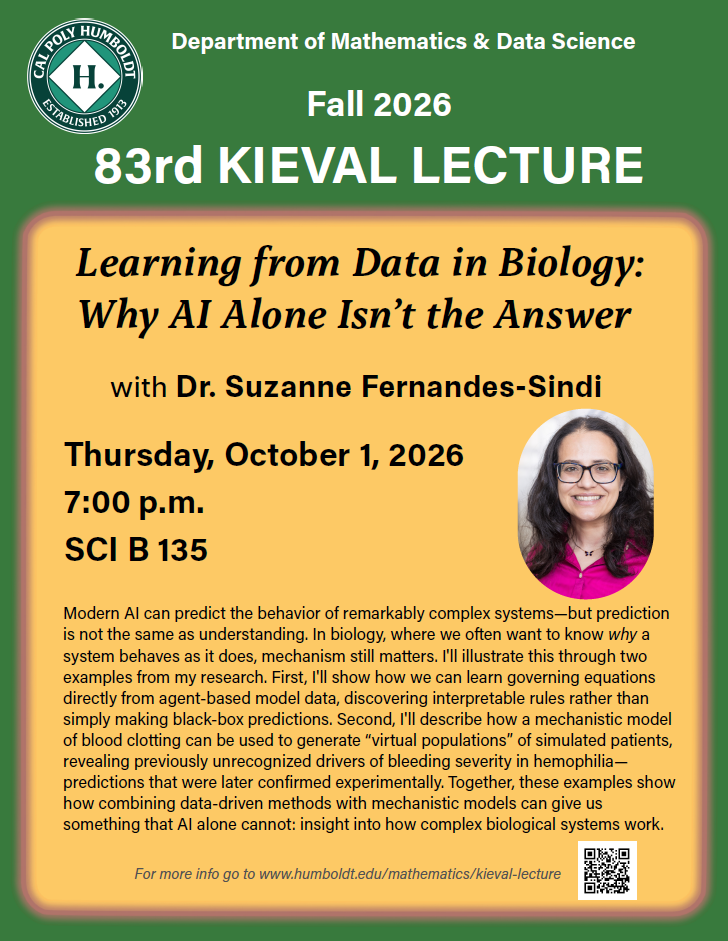
83rd annual Harry S. Kieval lecture, which takes place on October 1st, 7 p.m. in SCI-B 135. The speaker is Dr. Suzanne Fernandes-Sindi from UC Merced, speaking on “Learning from Data in Biology: Why AI Alone Isn’t the Answer”. Download a flyer with more info.
Save the Date for the 2027 Wigi (Humboldt Bay) Symposium! April 8-10, 2027 at Eureka’s Sequoia Conference Center: This year’s symposium theme is Restoring Balance to Wigi: Learning from the past to create a better future for Humboldt Bay and will feature sessions on both bay and ocean-focused topics including restoration efforts, tribal projects and land acquisition, aquaculture, food systems and sovereignty, ecology, community resilience, sea-level rise, erosion and sediment management, extreme weather patterns and El Niño impacts, and highlight current processes that have been informed by past work. Registration for this event will open soon! We encourage folks to pass on this information to anyone else who might be interested. Visit the Coastal Ecosystems Institute of Northern California website for more information and to subscribe to Symposium email announcements.
Call for Abstracts! The Wigi (Humboldt Bay) Symposium is a community-oriented conference focused on research, restoration, sustainable use, and enjoyment of the Humboldt Bay region. In order to create an engaging and interdisciplinary symposium schedule, we are inviting scholars, practitioners, and community members to submit a brief abstract of work they are interested in presenting.In highlighting our theme of past, future, and restoring balance, we are asking presenters to consider the past research and actions taken that have allowed their current work to take place.
To submit your abstract, please visit this Google Form link!
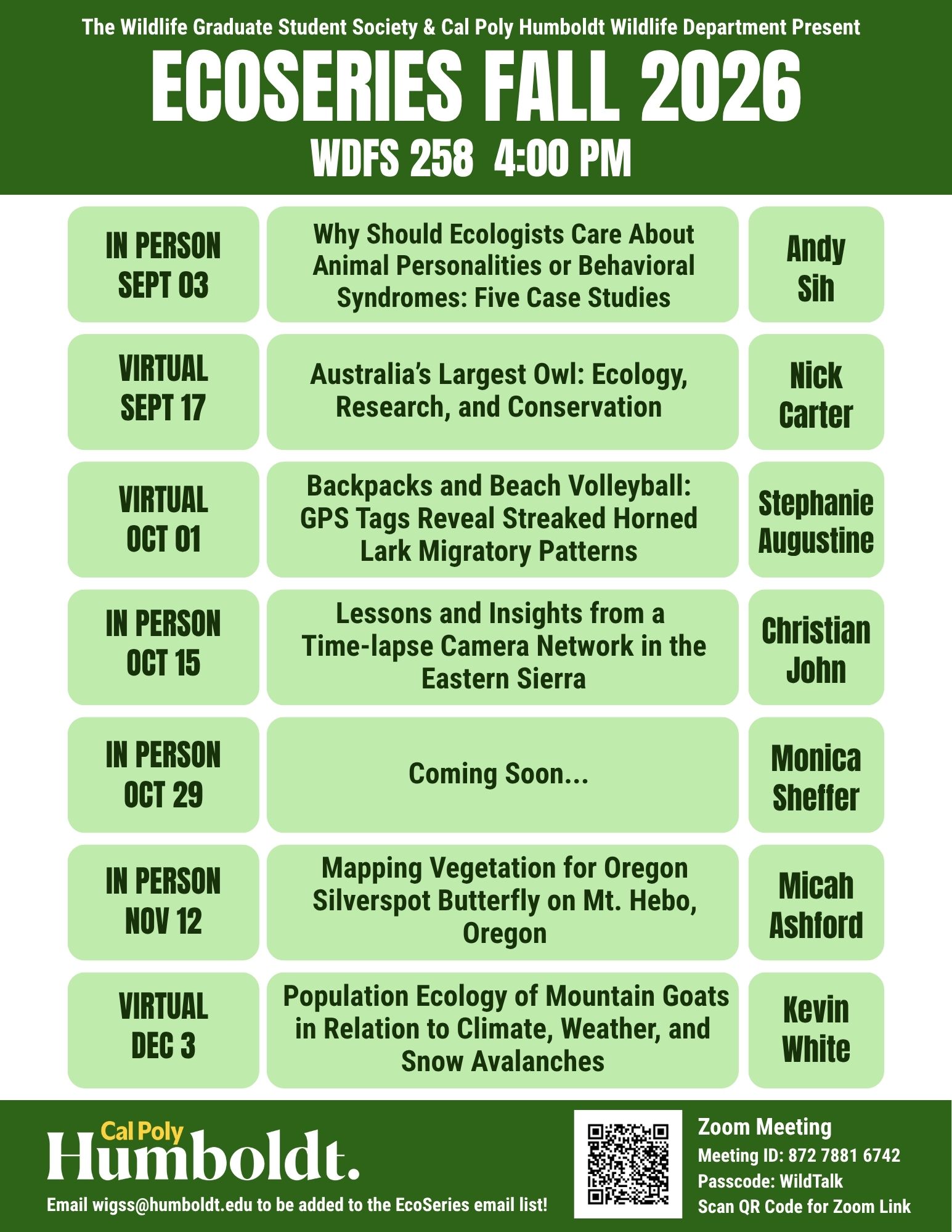
WiGSS and the Wildlife Department are hosting our next EcoSeries talk for the Fall 2026 semester, scheduled for next Thursday, October 1st at 4 pm. This presentation is virtual and will be streamed on Zoom. We will be hosting a viewing party of the presentation in WDFS 258.
This week's topic: Backpacks and beach volleyball: GPS tags reveal streaked horned lark migratory patterns
A federally threatened subspecies, the streaked horned lark is an endemic denizen of remnant open landscapes west of the Cascade Range in Washington and Oregon. While their breeding ecology has been well studied, information on migration timing, routes, and habitat use, is sparse. We fitted archival GPS "backpack" tags on larks breeding on prairies and airfields on Joint Base Lewis-McChord military installation in the South Puget Lowlands, and two beaches on the Washington coast. Our results provide the first high-resolution spatial data for two regional populations of this imperiled bird, and will both inform future species reintroduction plans as well as provide insight into priorities for habitat conservation outside of the breeding season.
Download a flyer with the Fall Semester 2026 Schedule of Ecoseries Talks
Sequoia Park Zoo Conservation Grant Opportunity: The Sequoia Park Zoo Advisory Group’s Conservation Council is accepting pre-proposals for their 15th annual Conservation Grant Program. The Council is soliciting for short pre-proposals to be submitted online between October 1 and November 2, 2026. Once reviewed and if accepted, applicants will be invited to submit a full proposal due in early January, 2027. Pre-proposals must have a clear, measurable impact on the conservation of wildlife and/or habitats. Appropriate projects include proposals for research and/or the implementation of a conservation management plan (including habitat restoration). Special consideration is given to projects that are in line with the Sequoia Park Zoo’s mission, focus on species represented at the Zoo, or support local wildlife or habitats. Funds will be granted up to $3,000 for projects that can be completed within two years.
For details and to apply, please visit Sequoia Park Zoo's website at: https://www.redwoodzoo.org/173/Conservation
Discover cancer research careers at the University of Florida Health Cancer Institute: This competitive program allows promising undergraduates to apply for a free visit to the NCI-designated University of Florida Health Cancer Institute. The program provides cancer research highlights, information about Ph.D. pathways and a career panel. Attendees are invited as special guests to the annual UF Health Cancer Institute Research Showcase.
Learn more and apply at: https://cancer.ufl.edu/education/undergraduate/career-explorations/ or Download a flyer with more details.
California Native Plant Society; Introduction to Grass Identification and Keying: A two-day Workshop Saturday and Sunday, November 21-22, 2026 Target Audience: Professional and student botanists, consultants, regulators, and ecologists who wish to improve their grass identification and keying skills. Description: This is an introductory workshop focusing on keying grasses in The Jepson Manual, 2nd Ed. (JM2) and Jepson eflora as well as on sight-recognition of several common native and non-native grasses occurring on the North Coast. The workshop starts with an overview of the Poaceae and an introductory review of essential grass morphology and keying terminology. The rest of the workshop will be guided dissection and keying of specimens in the laboratory using a microscope and the JM2 and Jepson eflora. Keying will be punctuated with guidance and commentary on keying group, tribe and subfamily characteristics. Several local common grasses will be displayed and discussed to enhance sight-recognition. Participants should have knowledge of basic plant terminology and use of dichotomous keys such as in the JM2.
Register HERE ( https://www.zeffy.com/en-US/ticketing/introduction-to-grass-identification-and-keying-a-two-day-workshop-saturday-and-sunday-november-21-22--2026 ) (note, you do not need to tip Zeffy). Cost: $35 students; $175 CNPS members; $225 non-CNPS members.
Week of Sept. 14-18, 2026
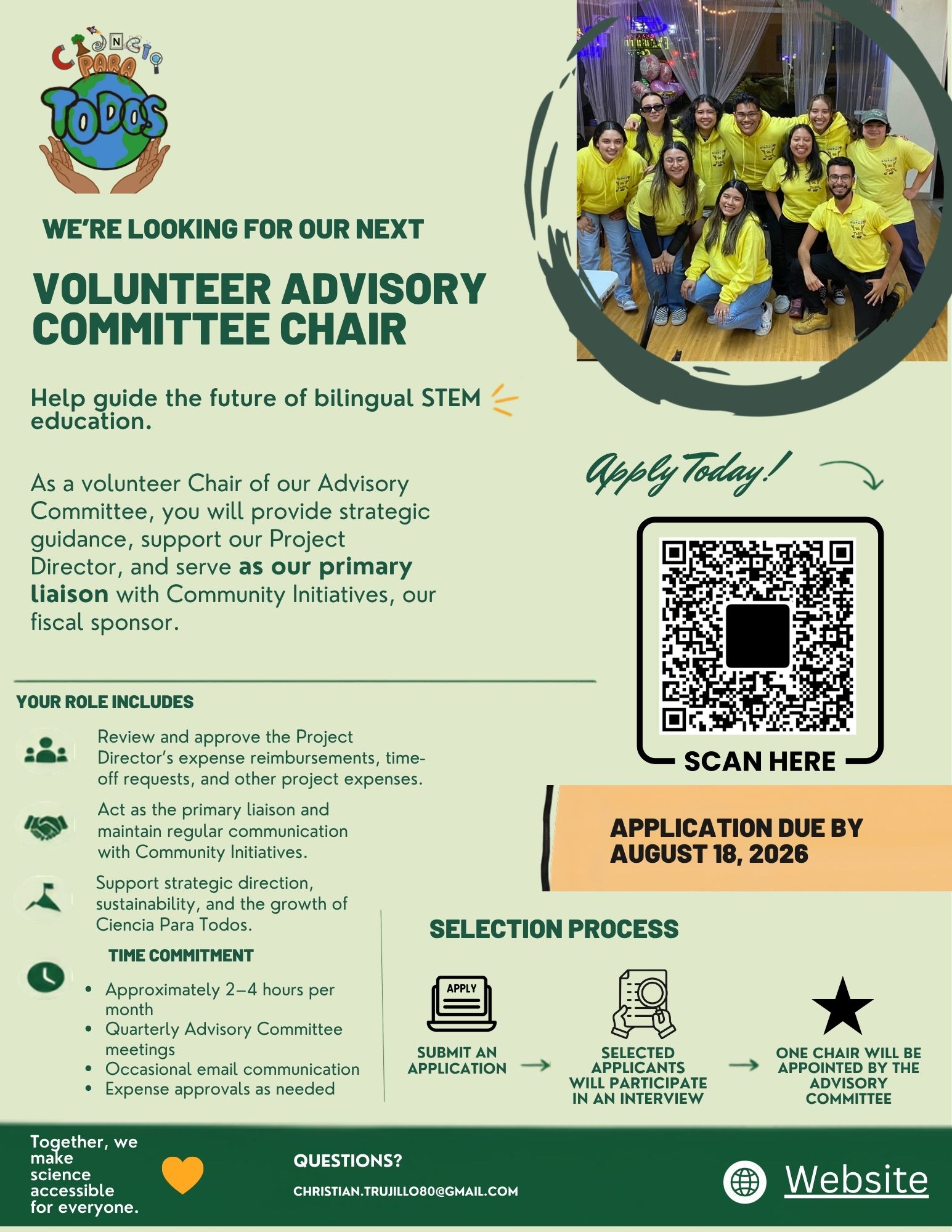
Ciencia Para Todos: Ciencia Para Todos (CPT) is looking for a volunteer advisory committee chair. Help guide the future of bilingual STEM education. As a volunteer Chair of our Advisory Committee, you will provide strategic guidance, support our Project Director, and serve as our primary liaison with Community Initiatives, our fiscal sponsor. The time commitment is approximately 2-4 hours per month. If you have questions, contact Christian.Trujillo80@gmail.com or download a flyer with more information.
Wildlife Ecoseries Speaker, Sept. 17 at 4 p.m. over Zoom or via streaming party in Wildlife 258: WiGSS and the Wildlife Department are hosting our next EcoSeries talk for the Fall 2026 semester, scheduled for next Thursday, September 17th at 4 pm! This presentation is virtual and will be streamed on Zoom. We will be hosting a viewing party of the presentation in WDFS 258. This week's topic: Australia's Largest Owl: Ecology, Research, and Conservation
The Powerful Owl (Ninox strenua) is Australia’s largest owl and a highly mobile, threatened apex predator completely reliant on tree cover to establish and maintain territories. Despite requiring large amounts of habitat, Powerful Owls are capable of occupying territories in urban and agricultural landscapes provided enough resources are available. As an apex predator that contributes to maintaining ecosystem function, it is critical to understand how Powerful Owls interact with human-modified landscapes and associated threatening processes to effectively implement impact mitigation and management strategies that support the conservation of this threatened species.Utilising GPS tracking collected from Powerful Owls across the urban-rural-forest landscape gradient in Victoria, Australia, Nick’s research has explored how Powerful Owls respond to various threatening processes, including habitat fragmentation, urbanisation, roads and poor spatial policy. Additionally, despite being a non-rodent-consuming predator, his team discovered that Powerful Owls were exposed to anticoagulant rodenticides and identified the secondary exposure pathway, confirming a new chemical threat impacting the species. Drawing from his industry background, Nick’s research aims to bridge academia, industry and communities to support real-world conservation outcomes for Powerful Owls and urban biodiversity. This presentation will discuss how owls are responding to various land cover, legislation, and chemical-threatening processes, and how research can support evidence-based decisions for policy reforms, national rodenticide regulatory reviews, and conservation management of a threatened apex predator.
About the speaker: Dr Nicholas Carter is an Australian ecologist and researcher who has been studying Powerful Owls (Ninox strenua) since 2017 with the Deakin University Powerful Owl Research Team (DUPORT). His research focuses on the ecology and conservation of the species in human-modified landscapes, spanning GPS tracking and movement ecology, habitat use, breeding ecology, diet, and toxicology. Alongside his research, Nick works as an ecological consultant, where he applies his research to real-world conservation, planning and land-management challenges for a variety of community, industry, and government stakeholders.
Zoom link: https://humboldtstate.zoom.us/j/87278816742?pwd=XJTdJfczfD2BE1wPjCROINYuTwY53C.1
Meeting ID: 872 7881 6742
Passcode: WildTalk
Each EcoSeries presentation is immediately followed by an EcoSocial in WDFS 258! Hang out and chat while enjoying some free snacks during this 20-minute social period.
MIT EAPS Graduate Application Mentorship Program: The graduate students at MIT’s Earth, Atmosphere and Planetary Sciences (EAPS) department are hosting our eighth annual Application Mentorship Program. The Application Mentorship Program is a student-run initiative offering support for prospective applicants to the EAPS graduate program. Applying to graduate school can be daunting, so why not chat with someone who’s already been through it. We welcome anyone interested in applying to a graduate program in EAPS to sign up. Participants in the EAPS Application Mentorship Program will be matched with a graduate student volunteer who can provide feedback on the applicant's personal statement and answer questions regarding EAPS, MIT, or graduate school in general. Mentorship may come in the form of:
Reading and giving feedback on the applicant’s personal statement
Answering questions about the logistics of applying to grad school (e.g., “what is a personal statement?”, “how important is it to have taken the classes listed on the EAPS website?”)
Answering questions about the department
Answering questions about the mentor’s own educational trajectory
The Application Mentorship Program aims to provide students who are underrepresented and/or unfamiliar with our program and/or fields with an additional resource as they navigate the graduate school application process. We value the diverse perspectives and backgrounds of all members of our community, and we hope to support this diversity among future generations of students. We especially encourage applicants from underrepresented and non-traditional academic backgrounds to use this resource.
To learn more about the mentorship program, potential applicants can visit our website here!
To learn more about applying to EAPS, please visit the Admissions page here.
If you would like to apply for mentoring, you can do so here. Please note that the sign up form will close on November 15, 2026 or once we reach capacity.
The CSUBIOTECH Student Travel Grant Program supports faculty-mentored CSU student travel to biotechnology-related professional meetings and workshops or to collect biotechnology-related data at shared instrumentation facilities or research sites. CSUBIOTECH defines biotechnology as a fusion of biology and technology, and welcomes and encourages applications from students in all disciplines related to the current practice of biotechnology, including but not limited to agricultural science, business, clinical sciences, computer science, engineering, life sciences, math, and/or physical sciences.The Fall 2026 round will support travel between January 1, 2027 and December 31, 2027. Student applicants must ask faculty mentors to submit their completed and signed proposals by Monday, October 5, 2026 by 5:00pm. You can find more information, including eligibility and application details in the competition RFP.
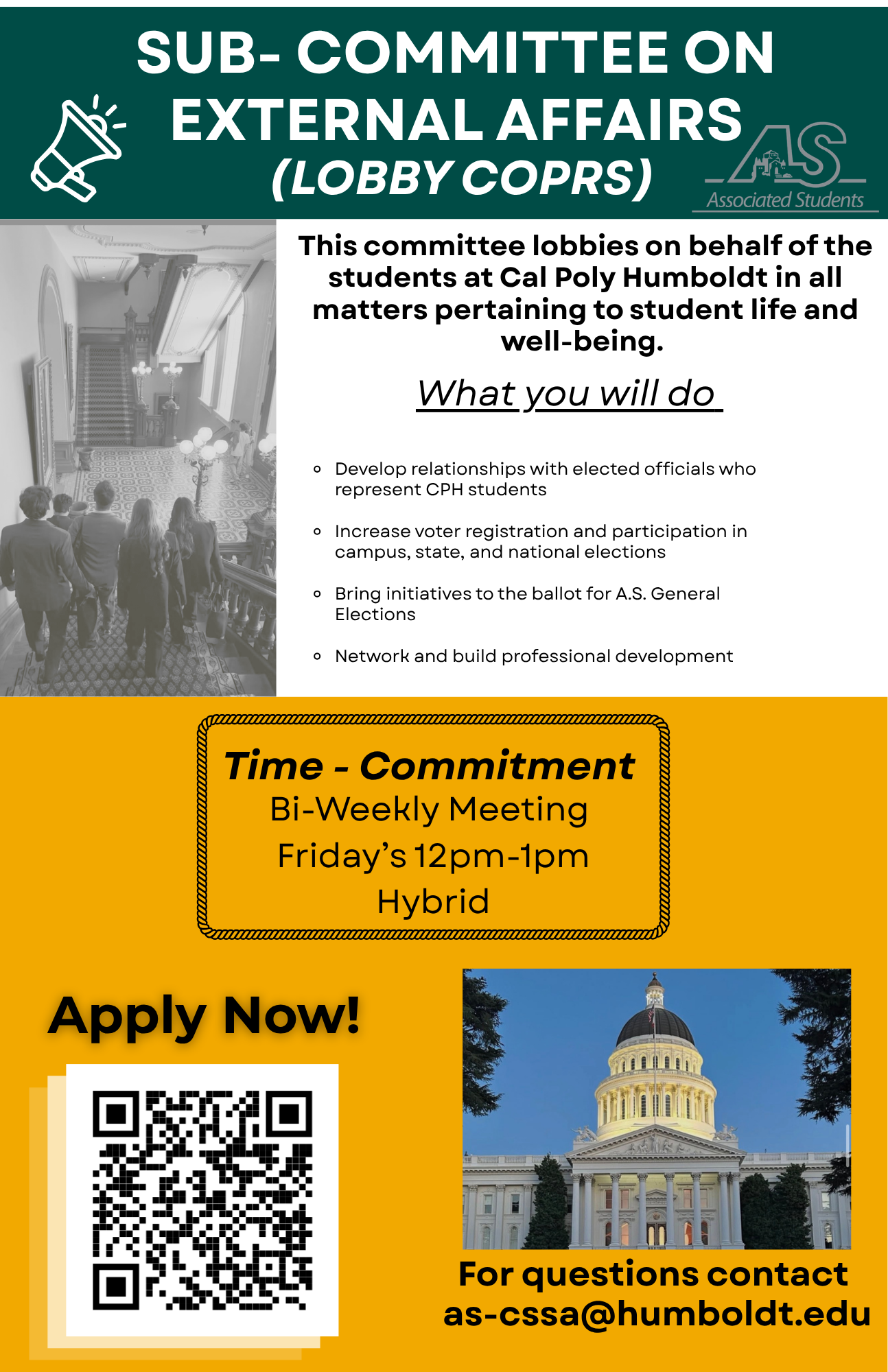
Associated Students (A.S.) Sub Committee on External Affairs at Cal Poly Humboldt is seeking student leaders to serve as Committee Members: The Sub-Committee on External Affairs, also known as Lobby Corps, is focused on advocating on behalf of Cal Poly Humboldt students on matters related to student life, student well-being, and the overall student experience. The committee is also responsible for developing relationships with elected officials who represent our students, supporting voter registration and civic participation, and bringing student-focused initiatives to the ballot during A.S. General Elections. This committee is a great opportunity for students who are interested in advocacy, civic engagement, leadership, government, public policy, or simply making a positive difference in the student experience at Cal Poly Humboldt. The Sub-Committee on External Affairs is an advisory committee consisting of six students appointed by Associated Students. An advisory committee focuses on providing independent advice, insights, and recommendations to the organization. The committee is expected to meet on Fridays from 12 p.m. to 1 p.m. on a bi-weekly basis starting this week, September 18th.
Learn more at: https://www.humboldt.edu/associated-students or download a flyer
Apply Now!: Associated Students Committee Application Form
Week of Sept 7-11, 2026
The Goldwater Scholarship and Excellence in Education Foundation is pleased to announce the Barry Goldwater Summer Research Internship Program, a new initiative that will expand opportunities for college freshmen and sophomores to participate in cutting-edge research in their fields of interest. Authorized by Congress, the program marks the Foundation’s 40th anniversary and builds on its longstanding commitment to identifying, encouraging, and financially supporting undergraduates who aspire to become the nation’s next generation of research scientists, engineers, and mathematicians. In its inaugural summer of 2027, the program will support 20 research positions in Chemistry; Computer and Information Sciences and Engineering; Engineering; Life Sciences; and Physics and Astronomy. Throughout the Foundation’s 40-year history, undergraduate research has remained one of the most important factors in guiding students toward research careers in these fields. Goldwater Interns will join collaborative research teams at laboratories across the nation, working alongside senior researchers, postdoctoral scholars, graduate students, and other undergraduates. Each intern will receive $10,500 in financial support for the 10-week research experience. Applications are due November 2, 2026, and selected applicants will be notified by January 15, 2027.
For additional information and application materials for the Goldwater Summer Research Internship Program, please visit https://goldwaterinternship.gov.
Research Associate / Senior Research Associate, Cell Culture; Full-time | On-site | Reports to Senior Scientist | $85k-$130k | 100% Health Benefits Covered : Now hiring a hands-on Research Associate to Senior Research Associate to support stem cell culture and neuronal differentiation for an active therapeutic program. The primary work centers on maintaining pluripotent stem cell (iPSC) cultures and differentiating them into disease-relevant neuronal cell types to support disease modeling and downstream assay work. This is an excellent set of hands with a strong track record for clean, reproducible bench work and rigorous aseptic technique. It is a demanding, fast-paced environment with shifting priorities and frequent new asks, and it offers meaningful contribution to patient-directed science and broad exposure to a growing organization.
Apply at:https://www.violetresearch.org/careers or download the flyer with more information.
HBMS Community Education Scholarship for Students: The Humboldt Bay Mycological Society (HBMS) is pleased to announce the annual Community Education Scholarship, with an award of $800. The recipient will be required to give a 45-minute to 1-hour presentation on a mycology-related topic of their choice. This presentation, including a PowerPoint, will be delivered in person at our monthly meeting on Wednesday, January 20, 2026, at 7:00 p.m. in Arcata, CA.
Submission Deadline: October 31, 2026
Download a flyer with more information and application instructions or visit: www.hbmycologicalsociety.org/scholarships
The Environmental Policy & Management (EPM) MS program at UC Davis is hosting a series of virtual webinars to help prospective students learn about graduate school, the application process, and career pathways in environmental policy.
Download a flyer with more details
Cornell University invites applications for a Curatorial Associate to manage the L. H. Bailey Hortorium Herbarium (https://cals.cornell.edu/lh-bailey-hortorium-herbarium) a full-time, 12-month staff position. The Curatorial Associate oversees all aspects of herbarium collection curation in accordance with established museum standards. Responsibilities include processing and cataloging incoming specimens and archives, managing collection data, maintaining systematic organization, and performing routine care and conservation. The position also evaluates collection standards and develops strategies to improve the physical condition of the collection, streamline processes, and enhance overall efficiency.
For more information, visit: https://jobs.hr.cornell.edu/us/en/job/WDR-00060776/Curatorial-Associate
Research grants available from Friends of the Arcata Marsh: These grants are for Cal Poly Humboldt students who are pursuing research projects that are broadly or specifically related to the Arcata Marsh & Wildlife Sanctuary. Grants will be awarded based on each project’s relevance to Marsh ecology, processes, and habitat concerns. At least $1,000 may be awarded per calendar year. *While there is no deadline for application, proposals will be evaluated in the order that they are received. Both undergraduate and graduate students are eligible to apply. Grants are not intended to be the total source of project support and must be spent on out-of-pocket expenses such as supplies, laboratory testing, or travel. Grants may not be used to pay for college tuition or fees, living expenses, food, salaries, or any expenses based on number of hours worked. Download a flyer with more information
ANNOUNCEMENT: UNDERGRADUATE FIELD STUDY OPPORTUNITIES! Wildlands Studies offers international environmental field programs where students gain hands-on field experience while earning upper-division academic credit. Students study topics such as ecology, conservation biology, climate change, environmental policy, geology, and human-environment relationships, all while working alongside PhD scientists and professional researchers in the field. Programs take place in Australia, Belize, Chile, Ecuador, French Polynesia, Iceland, Indonesia, Japan, Nepal, New Zealand, Thailand, and Alaska, and bring together students from universities across North America. Participants earn 10 upper-division semester credits, and scholarships or financial aid may apply.
Join us on campus:
We’re hosting an in-person Student Information Session at Cal Poly Humboldt on Thursday, September 10th at 4:00 PM in NR 201. Can’t make it in person? We also host weekly Zoom Information Sessions every Wednesday at 5pm PT.
Learn more at www.wildlandsstudies.com
Black and Indigenous Scholars Award in Mammalogy: The Black and Indigenous Scholars Award in Mammalogy is now accepting applications for awards of up to $1500 to support the further development of mammalogy by Black/African American, African, and Indigenous individuals. The application form and terms of the award are available here: http://www.mammalsociety.org/form/black-indigenous-scholars-award. The application window is open, and it closes at 11:59 pm PST on October 30; award recipients will be notified by November 30. Any questions about the application process or the award itself can be directed to the IDEA committee asm.idea.committee@gmail.com.
Terms of the award:
The Black and Indigenous Scholars Award is targeted at research and activities related to mammals. There are no thematic limits to this award; research on ecology, behavior, biogeography, genomics, physiology, taxonomy, or any other arena is acceptable. The only taxonomic limit is that this is not intended to support research on humans (although research on how humans impact non-human mammals could be acceptable). Applicant will be a current, potential, or aspiring mammalogist from or residing in North or South America who is Black/African American, African, and/or Indigenous, as outlined in the United Nations guidelines for identifying Indigenous peoples.
Shadow Abroad Medical School Application Accelerator; Free Webinar on September 22 at 4 p.m. PT: Application Accelerator Webinar; Sept. 22 | 7 PM ET / 4 PM PT | Virtual
Planning for medical school? Join us for a free workshop on the application process and what you can be doing now to prepare. Register: https://www.shadowabroad.com/webinar-series/
Week of August 17-21, 2026
State Park's North Coast Redwoods District is hiring two fully benefited positions in the botany program for year-round work. Field work includes floristic botanical surveys and rare plant monitoring for restoration projects, fire effects monitoring in grasslands and oak woodlands, assisting with revegetation planning, implementation and monitoring. Candidates for both positions should have the ability to lead a small crew as needed. One of the positions will lead the fire effects monitoring efforts. Office work includes QA/QCing and analyzing GIS data, making maps, data entry and summaries, writing project summaries and draft reports.
Candidates have thorough knowledge of the local flora, can use the Jepson manual and other plant keys, are willing to work independently, don't mind working in increment weather or steep terrain AND are interested in working with and writing up the data they collected in the office. The reporting location for these positions will be Fort Humboldt SHP in Eureka.This is a full time position, with a field season (mainly field work) April through August (typically four 10-hour days per week) and office work with sporadic field work for the remainder of the year. The classification is Forestry Technician (starting at $23.93/ hour), benefits start after 480 hours of work have been completed.
For more info and to apply, visit: https://calcareers.ca.gov/CalHrPublic/Jobs/JobPosting.aspx?JobControlId=527717
Week of August 3-7, 2026
The Trinity County Resource Conservation District is accepting applications for the position of Horticulture and Ecological Restoration Assistant - Conservation Technician II. The Horticulture and Ecological Restoration Assistant Conservation Technician II will work under the supervision of the Horticulture Specialist and the Project Coordinator in the Ecological Restoration Program, and is responsible for assisting with nursery operations, supporting stewardship of the Young Family Ranch, and assisting in additional restoration activities such as noxious weed removal, irrigation, and revegetation site maintenance. The Horticulture and Ecological Restoration Assistant is a full-time position with flexible scheduling, paid leave, medical benefits, and retirement options. This is a grant-funded position until December 31st. District employees are subject to routine management reviews and serve at the Board of Directors' discretion. The Native Plant Nursery is a 0.1-acre conservation nursery located on the grounds of the historic Young Family Ranch, where plants for restoration projects are grown and housed. In addition to assisting in the nursery, this position will help with general landscaping and stewardship needs for the Young Family Ranch and assist with District outreach and events.
First review of applications is August 10, 2026; Download the vacancy announcement and details for more information
The Center for Teaching and Learning is looking for several graduate students to join the Mid-Semester Feedback Program and get started at the beginning of Fall 2026. Students working in this program have gained valuable skills in group facilitation, aggregation and analysis of qualitative data, and reporting. Grad Students! Looking for an on-campus job that will provide opportunities to hone your facilitation skills in any field? We are looking for new team members to join the Mid-Semester Feedback Program, where you will gain valuable group facilitation experience, as well as skills in aggregation/analysis of qualitative feedback. Graduate student facilitators meet with faculty to discuss their courses, facilitate student group conversations, and gather feedback about their course experience. The goal is to provide anonymous feedback to the instructor for enhancement/improvement.
· $16.90/hour
· 1-2 hour paid training ~ beginning of fall semester
· Group facilitation weeks 5-14 of the semester
· Hours based on your schedule, up to 20 hours per week
Details about the Mid-Semester Feedback Program can be found on the CTL website.
Email your resume to Shi Feng: sf300@humboldt.edu