



Breadcrumb
Scholar Training
Funded by a 3.6 million dollar grant through the California Institute of Regenerative Medicine (EDUC2-12620),
Our two-step program is designed to train students for careers in stem cell biology and regenerative medicine.
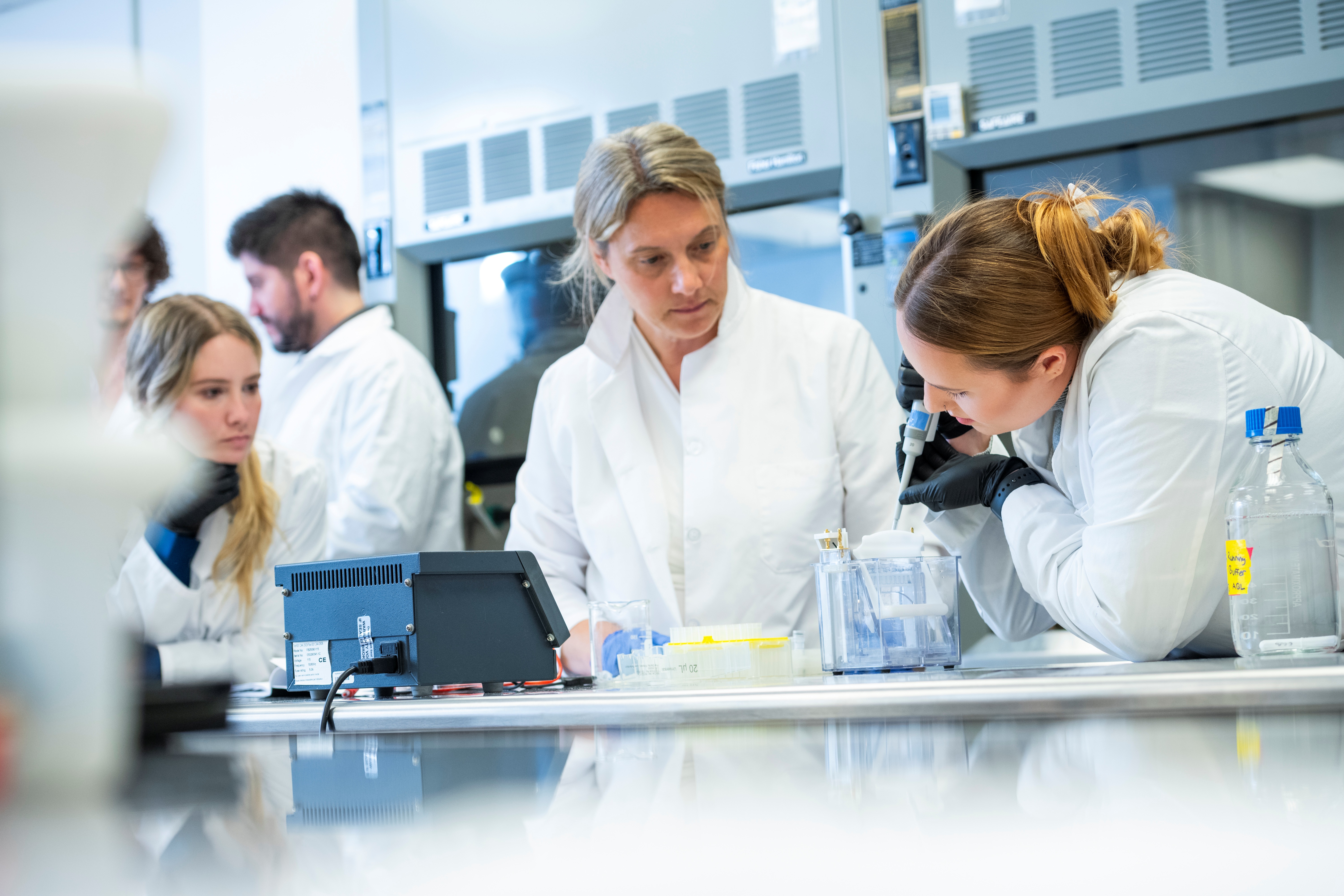
Pre-Internship Training Accepted students begin their journey with BIOL 544L: Stem Cell Biology Lab, a 5-week hybrid course held during the first summer session.
During this intensive program, Humboldt professors and scientists from our host institutions provide one-on-one training in molecular biology and mammalian cell culture. Trainees will explore foundational principles, current topics, and research methods in stem cell biology and regenerative medicine, alongside a dedicated workshop in bioinformatics and computational biology.
Beyond the lab, students receive direct mentorship through the internship application process. Our goal is to have every trainee officially placed in their host laboratory by the time the course concludes.
Financial Support: The Humboldt CIRM Bridges Award covers the full cost of BIOL 544L tuition and provides $1,000 toward room and board.
The 12-month Humboldt CIRM Bridges 3.0 internship is comprised of six primary components:
1. Full-Time Mentored Research: Trainees complete a hands-on, 40-hour-per-week research experience (September 1st – July 31st) focused on stem cells, gene therapy, and understanding human diseases. Students intern in host laboratories at The Gladstone Institutes, Stanford University, UC Davis, UC Santa Cruz, or Cedars-Sinai.
2. Mentoring and Career Development: The curriculum includes three units per semester dedicated to research design, execution, analysis, and communication (RDEAC), plus nine units of experiential learning and professional development (ELPD). Trainees will complete an advanced cell culture laboratory course and three specialized courses from the Regulatory Affairs Professional Society: Good Clinical Practice, Good Laboratory Practice, and Good Manufacturing Practice.
3. Patient and Healthcare Engagement: Trainees interact directly with patients and patient advocates to gain real-world insight into the challenges of developing new cell therapies and drugs. These engagement activities take place at the host institutions as well as locally in Humboldt County.
4. Community Outreach and Education: Students actively educate the public about stem cells, gene therapy, and the promise of regenerative medicine. Local outreach and patient engagement activities are designed in collaboration with the Humboldt-Del Norte County Medical Society and the Humboldt Del Norte Pre-Medical Education Task Force (HUMPET).
5. Annual CIRM Bridges Meeting: Each July, CIRM Bridges students from across the state convene for an annual conference. Every trainee is expected to attend and present a research poster summarizing their year of work.
6. Comprehensive Financial Support: During the 12-month internship, all trainees receive a cost-of-living stipend of $3,000 per month, plus $8,000 to cover tuition and fees for the academic year. The grant also covers all travel costs associated with the Annual CIRM Bridges meeting.