

Breadcrumb
Michael G. Scott Award Recipients
The Michael G. Scott Award is given annually to the outstanding graduating senior in the Department of Fisheries Biology at Cal Poly Humboldt. The outstanding senior is selected on the basis of Humboldt GPA and on contributions made to the fisheries profession. The award carries with it a financial gift ($1000), the student name and award recognition are announced during graduation ceremonies, and the student's name is added to a brass plaque that hangs prominently on the second floor of the Fisheries and Wildlife Building.
Some words about Michael Scott as told by his father, Cuthbert Scott:
“Michael was enamored with wild and all living things beginning as a toddler. His greatest interests as he grew up had to do with wildlife. As he grew older these interests focused on fishing. He served 2 or 3 years in Vietnam in support of combat units. After Humboldt, he was one of the helicopter borne firefighters (smokejumpers) and ended up with the U.S. Forest Service as a ranger and fish biologist in Alaska. He spent a lot (probably most) of time in the field and most of his projects had to do with improvement of fish habitat in the Misty Fjords and Tongass NF areas. And, as for many other Humboldt Fisheries Biology students, he loved to fish!”
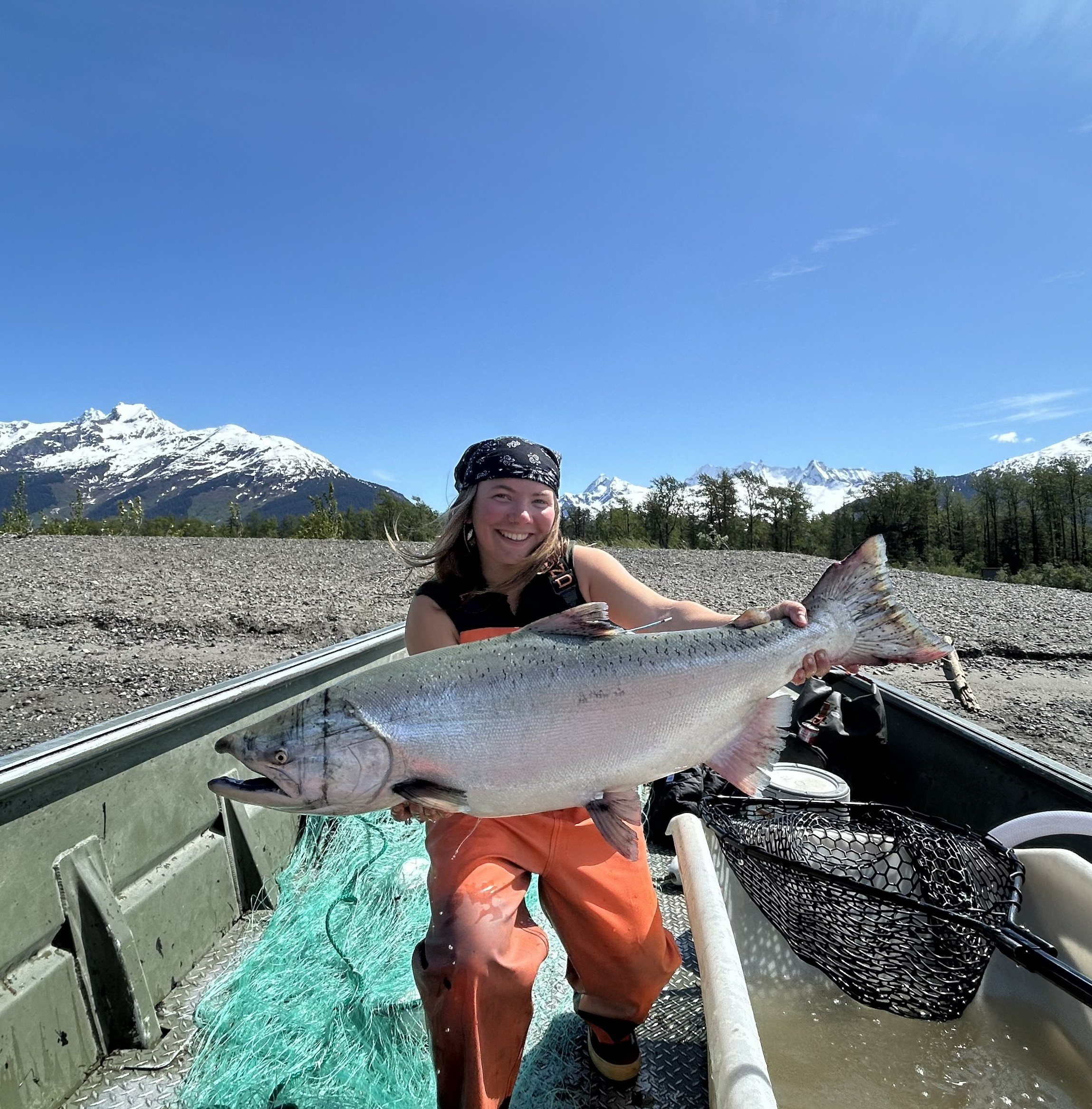
Elin Antaya
Received: 2026
I am truly honored to be a co-recipient of the 2026 Michael G. Scott Outstanding Senior in Fisheries Biology Award. I’d like to thank Michael G. Scott for his service in the military and with the Forest Service, as well as his lasting contributions to fisheries biology, and I hope to carry on his legacy in my own work. I’m also incredibly grateful to everyone who has supported me along the way with the fisheries program. Moving from Alaska to Humboldt was a big step, and I’m especially thankful to my friends, family, and faculty for supporting me and encouraging me throughout the trials and tribulations of being a student. Humboldt has opened more doors than I ever could’ve imagined. One of the highlights has been working aboard the R/V North Wind and R/V Coral Sea on the Trinidad Head Line, contributing to long-term cooperative fisheries oceanographic research with the Southwest Fisheries Science Center, an experience that definitely gave me a lasting appreciation for zooplankton. Growing up, I always had a curiosity for fish, as much of my life revolved around them. But the seeds of curiosity grew into the passion for fisheries research that I have today, and I’m incredibly grateful that I’ve been able to develop and strengthen that passion through the Humboldt Fisheries program.
A huge strength of the program is the truly hands-on approach of teaching, from tons of lab work in the field, to having a hatchery on campus to apply the techniques we learn in class to outside of the classroom, and having the opportunity to meet the fisheries community and build professional connections that have led to many wonderful opportunities for myself and other students. Over the past three summers, I’ve worked for the Alaska Department of Fish and Game, where I got to actually apply the skills I learned in Techniques in Fisheries Biology every single day because having that level of preparation before graduation has made the transition into professional work much smoother. I am so grateful to have gotten the opportunity to study abroad through the fisheries department and go on a bilateral exchange to the University of Tasmania to spend a semester learning about Antarctic ecosystems and fisheries of the southern hemisphere, and that could not have been possible without the support and encouragement from the faculty. While the hands-on learning is vital to making the fisheries program what it is, what makes the Humboldt Fisheries program truly exceptional is the faculty, as the level of support they provide to the students is remarkable. Their passion for fisheries and the research they do shines through in their teaching and makes me excited to learn every single day. I have felt so much encouragement over the years as the professors have supported me when pursuing opportunities and challenged me to grow into a better student, better fisheries professional, and better person
Post graduation, I am moving to Idaho to work for the Northwest Youth Corps in conjunction with the U.S Forest Service in the Payette National Forest as a Fisheries Technician. I am so thrilled to be continuing to diversify my experience and work in freshwater fisheries and spend the next 4 months doing backcountry field work in the Northern Rockies (and spend all my free time fly fishing)! Looking further ahead, I plan to return to Alaska and follow a path similar to Michael Scott’s, working in the Tongass National Forest. My goal is to contribute to the protection, management, and sustainable use of fisheries within America’s Salmon Forest so that the joy of fish can be shared through family and community for generations to come. Thank you to all, family, friends, and faculty, who have supported me along the way and shaped me into the person I am today. I am so grateful for these last four years of learning here at Cal Poly Humboldt and so excited for the lessons that life will continue to teach as I swim forward into my career in fisheries!
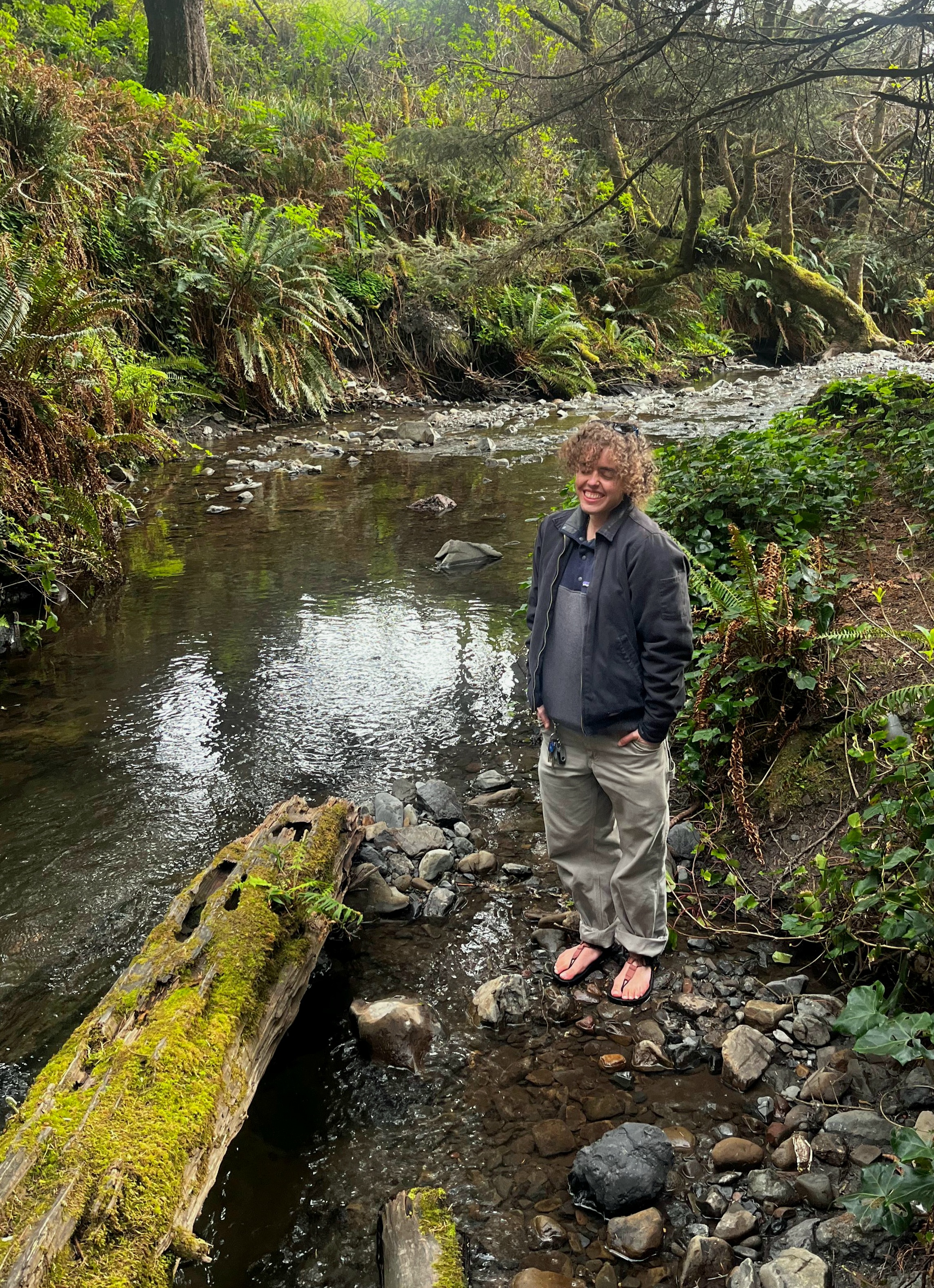
Levy Young
Received: 2026
I am honored to receive the Michael G. Scott Award and to be counted among this group of fisheries scholars and professionals. I'd like to thank Mr. Scott for his profound contributions to the field, as well as his family for their generosity and their dedication to Mr. Scott's legacy.
I'm also incredibly grateful to Cal Poly Humboldt's Fisheries department. My family moved to Humboldt when I was three years old, and I've been lucky enough to spend the last twenty years learning, playing, and working in this beautiful place. However, I struggled to find my footing and my passion when I first started college; I knew that I wanted to continue my education outside, but I cycled through several natural resources-focused majors, unsatisfied, before a required biology class sparked my interest in fish. I switched my major one last time and never looked back! In fisheries, I was truly excited to go to class each morning, because I knew I'd be hearing from professors with research that fascinated me and participating in labs that took me all over Humboldt, from bays to forested creeks to our very own fish hatchery. In addition to these in-class experiences, I also had the incredible opportunity to perform genetic lab work for statewide collaborators to inform endangered fish conservation, all while pursuing my own research projects. I often found myself stunned to be doing what I was doing, especially on my trips up to the recently-undammed Klamath River, watching as steelhead in full spawning colors made their way up to streams inaccessible for the century before. None of this would have been possible without the faculty and staff here, who always seem to be offering students as many opportunities as possible to succeed in the field and get involved in what excites us most.
I don't yet know what's next for me after graduation, but I'm confident that I'll be well-equipped to succeed regardless of where I end up! I hope to build on what I've learned in the freshwater program to participate in restoration design, implementation, and monitoring. I'm particularly interested in developing and refining field methods to move fisheries science forward, as well as salmonid conservation and recovery.
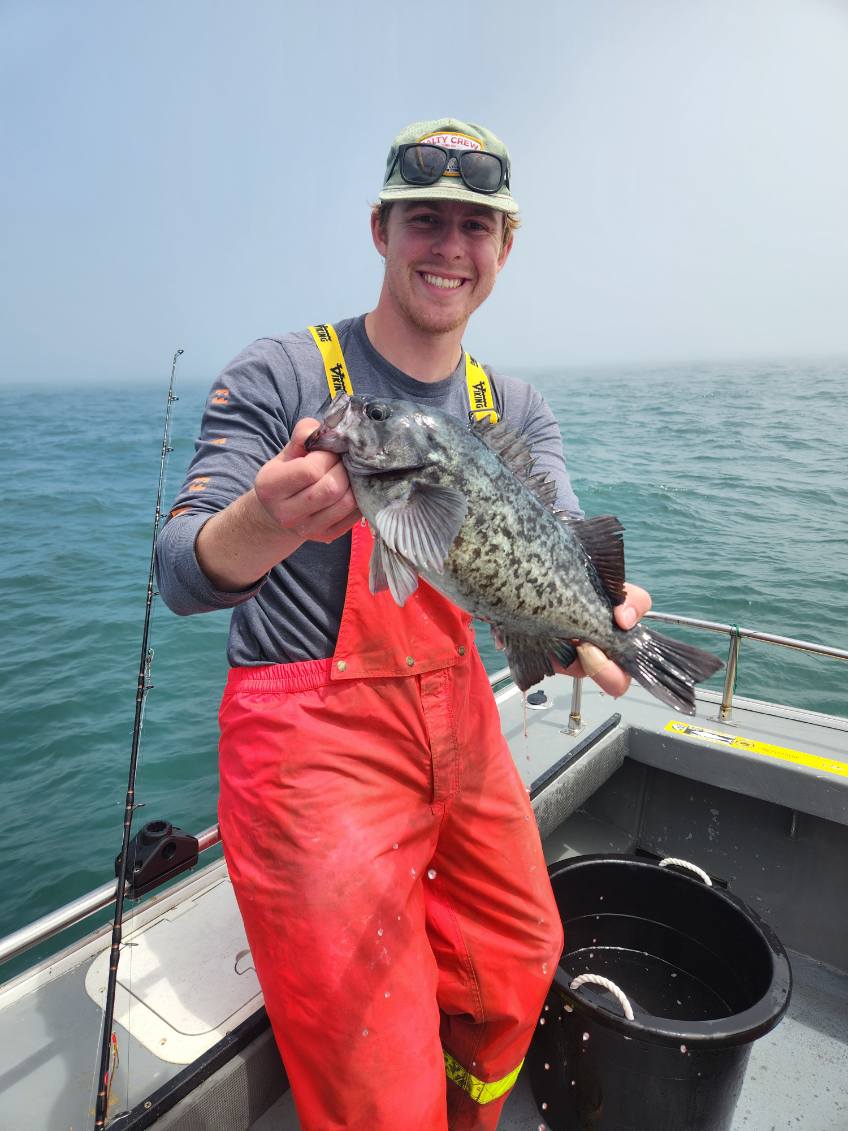
Inigo Baxter
Received: 2025
I wanted to start off by saying thank you to Michael G. Scott for his military service to our country, as well as his contributions to the field of fisheries biology. I am extremely honored and grateful to be the recipient of the Michael G. Scott Outstanding Senior in Fisheries Biology Award, and I look forward to carrying on his legacy into the future. Furthermore, I want to thank all of the faculty and staff within the fisheries department, as well as my family and friends for supporting me through this journey and pushing me to be the best student that I could be.
I arrived at Cal Poly Humboldt with an interest in fishing but did not realize how much I would learn to appreciate and love the world of fisheries biology. I cannot emphasize enough how exciting and interesting every class has been within the program. Each professor has provided me with a new outlook on the world that has shaped me and changed my life forever. Whether I was showing up to lectures in the morning or going out sampling for labs, I looked forward to every class that I had. The fisheries program provided a community that I was not expecting to find, and every opportunity that I have had in Humboldt, whether it be sampling in urban streams, sandy beaches, or out in the ocean, has been because of amazing professors and friendly graduate students. Additionally, I have made many friendships with fellow students that will last a lifetime, with each giving me new perspectives on fisheries, and teaching me more about fishing than I could have ever learned on my own. I can’t express how thankful I am to everyone within the fisheries department, and the amazing educational experience that I have had at Humboldt!
When looking forward to the future, I am not sure what the next step is going to be. All that I know is that I enjoy the world of fisheries biology and will continue this career for the rest of my life. My time at Cal Poly Humboldt has taught me that the world is in a precarious place, but we have the opportunity and obligation to create change for the better, which is what I plan to do!
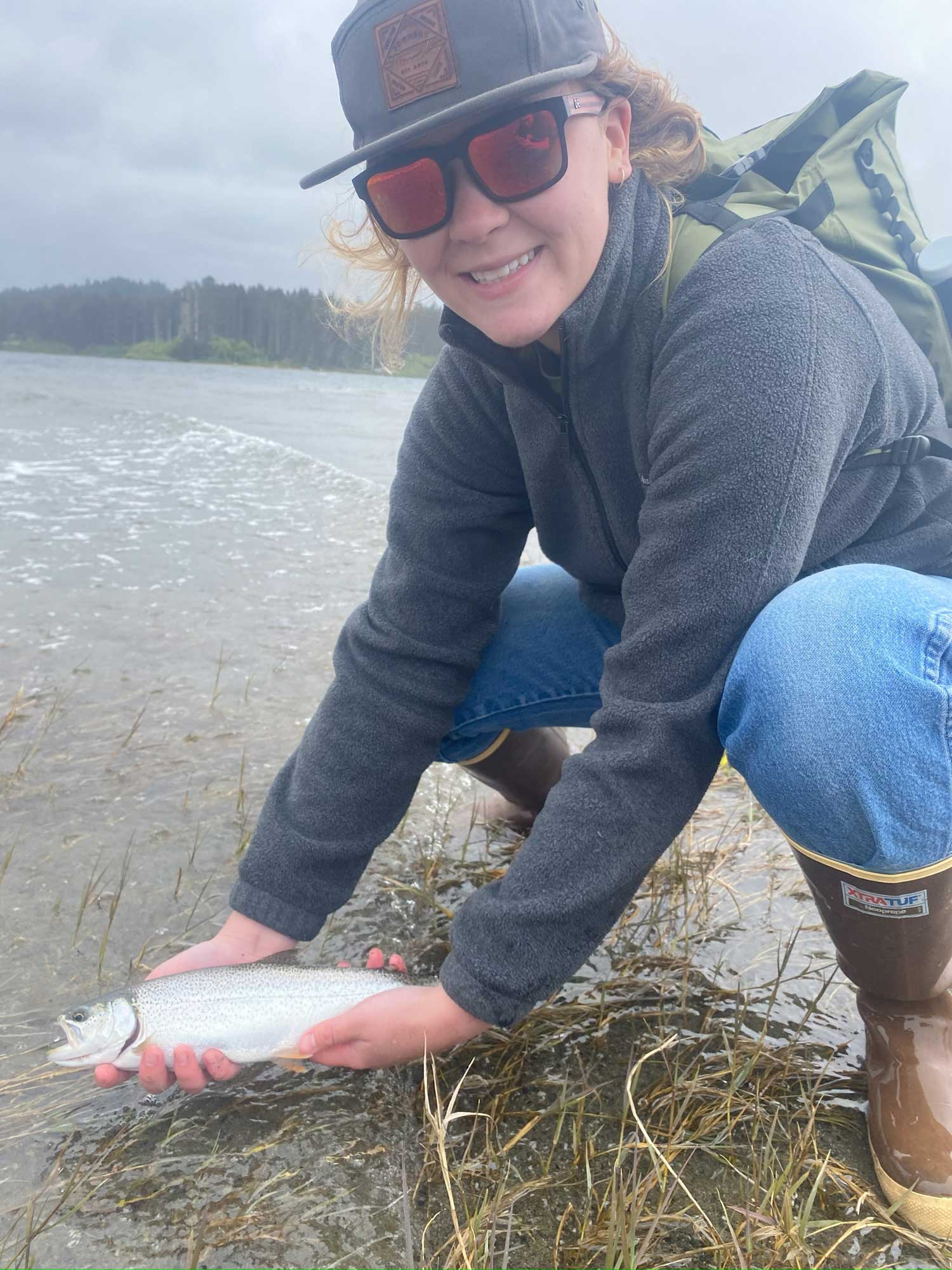
Madison Richardson
Received: 2024
I am absolutely honored to be the recipient of the Michael G. Scott Outstanding Senior in Fisheries Biology Award. I want to thank Michael G. Scott for his military service, forestry service, and his contributions to fisheries biology. This award would not be possible without him, and I hope to honor his legacy in the field of fisheries biology. Thank you to all of the amazing people that have supported me along this journey, including my exceptional friends who always motivated me to do my best, the incredible faculty in the Department of Fisheries Biology who offered me countless opportunities to develop my skills as a scientist, and my loving family who inspired me to pursue my passion in this field.
I arrived at Cal Poly Humboldt as a transfer student from Reedley College in the Central Valley. I quickly seized every opportunity to get my hands dirty whether it was puking and reeling in rockfish from MPAs, sifting through coastal sediment samples, or spawning trout in the hatchery.
The aspects of this program that I value the most are how many skills I’ve gotten the opportunity to develop in every single class. Whether it was seining and identifying local marine fish and invertebrates, reading scales to age Micropterus salmoides, extracting eDNA from water samples, and modeling catch per unit of effort of Micropogonias undulatus. I have been able to apply these techniques to my professional life which have allowed me to get recruited to work in many different projects. This department allows students to be immersed in fisheries biology and I truly believe this program is one of a kind. The friends I have gained through this department, both classmates and faculty, are friendships I will carry with me for the rest of my life. I am so glad that I didn’t listen to anyone that said I would get homesick if I moved to Humboldt by myself, because I now have two homes and two families.
After graduation, I will be working remotely for NOAA CoastWatch as a contracted specialist where I will help develop satellite products and work on projects with other NOAA scientists dependent upon their research. I have the unique opportunity to combine my love for fisheries and statistics with this job, and I am incredibly thankful to have interned the previous summer for NOAA CoastWatch which has made this current position possible. Looking further down the line, I hope to make helpful contributions to science wherever it can be improved to help better the lives of all living things on this planet. Thank you to all those who have supported me. I am honored by this recognition, and I am excited for the journey ahead!
Grant Christian
Received: 2023
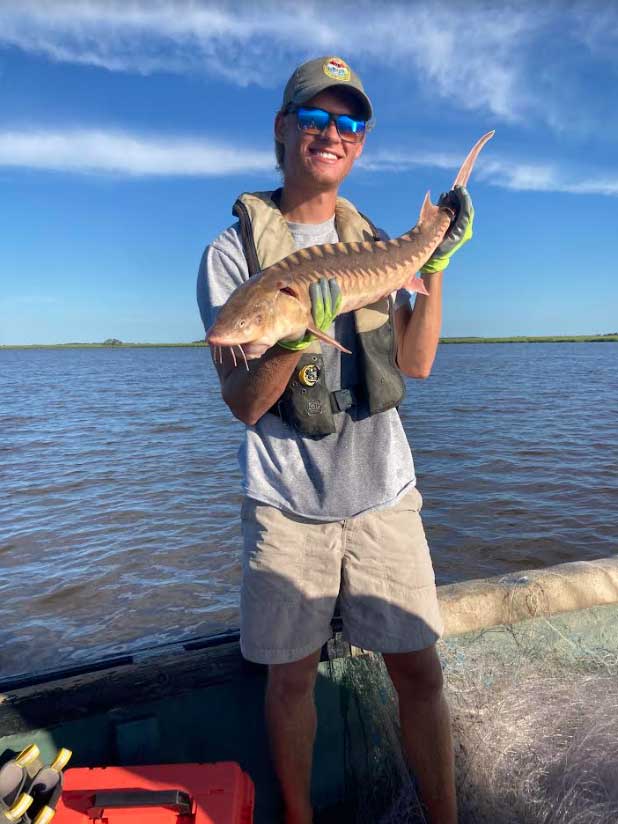
Michael Scott served our country both at home and abroad, and I want to thank him for hisservice. I am very honored to receive this award, and I value the opportunity to carry on hislegacy in the fisheries field. I want to thank all of the fisheries faculty, as well as my family andfriends for supporting my education during my time as an undergraduate.
Looking back, Cal Poly Humboldt was the perfect place for me to attend college. I say thisbecause I strongly feel that the education I gained here was completely unique, and could not bereplicated anywhere else in the world. Specifically, the fisheries program has provided me withunique opportunities to: interact with indigenous communities, trawl for offshore species,explore ancient forest creeks, perform extensive genetics labwork, and work in a fullyfunctioning fish hatchery on campus. These opportunities only exist because of a faculty thatreally cares about exposing their students to as many hands-on experiences as possible. I thinkit’s also important to note that my college experience was significantly hampered by theCOVID-19 pandemic, and I still was able to gain, what I believe to be, a world-class education.Once again, thank you to all the faculty and staff that make these experiences possible forundergraduate students.
I grew up in the Pacific Northwest and watched firsthand as several of the fisheries I loved wereforced to close due to low population numbers. I want to stop this from happening in the futureby working to create regulations that are better at sustainably managing fisheries for the benefitof people and the environment.
Vinnie Baroga
Received: 2022
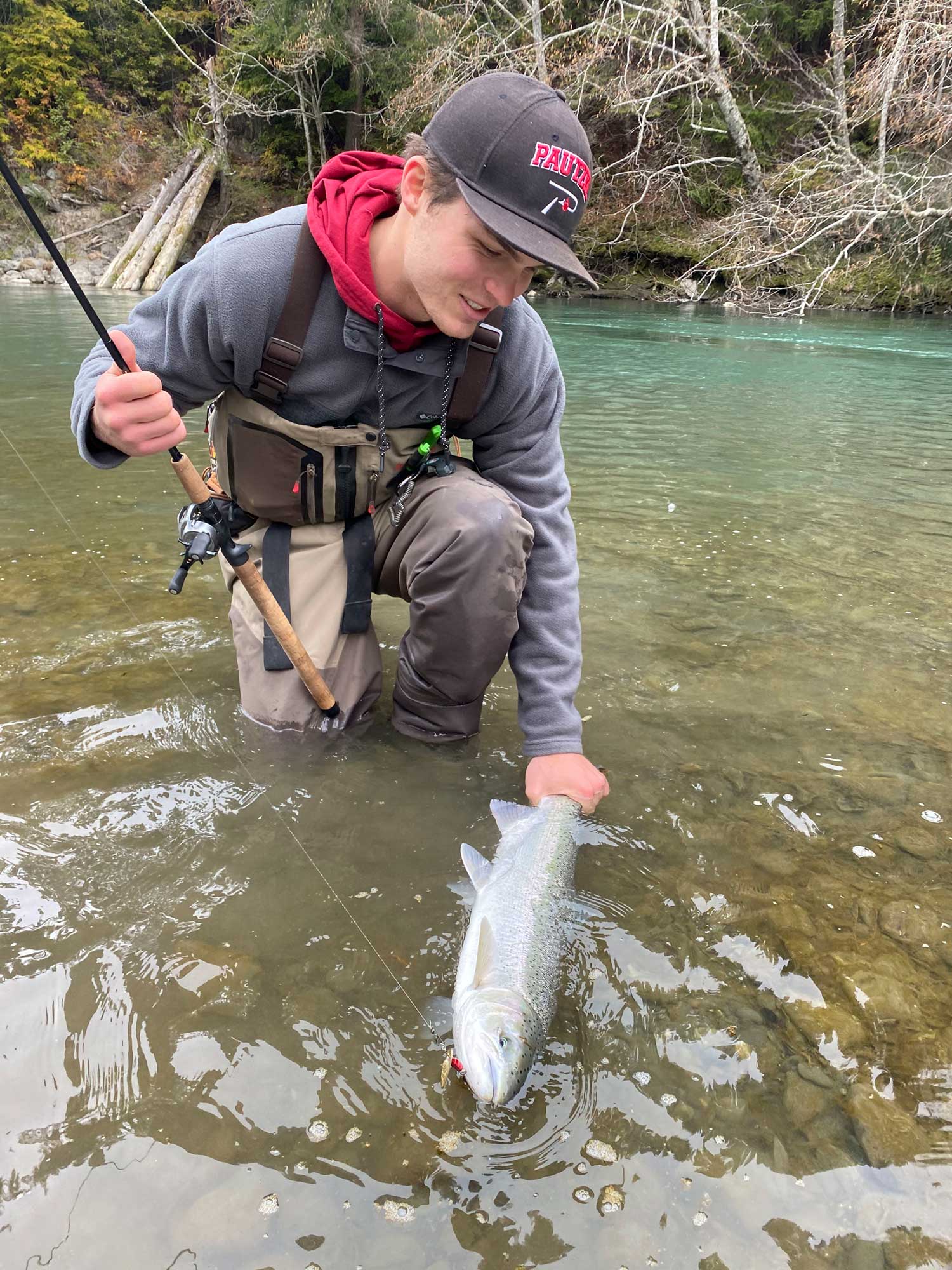
It is a true honor to receive the 2022 Michael G. Scott Award. Mr. Scott made incredible contributions to both our country's freedom and the environment and I am enamored to be related to his legacy in this way. This accolade would not be possible without the support of my friends, family, and faculty that have pushed me to be the absolute best version of myself over the last four years at Cal Poly Humboldt. Five years ago, I had no idea that Cal Poly Humboldt and the Fisheries Biology program even existed. As an avid salmon and steelhead angler growing up in Washington State, working with the conservation of these species has always been a dream of mine. The discovery of Cal Poly Humboldt opened my eyes to the world of Fisheries Biology and the science that encompasses it. Out of all of my great memories and experiences I have acquired over the last four years, the thing I value most about the Fisheries Biology program is the passion of our professors and faculty. Throughout the course of my education, every fisheries professor I had made an effort to assist me in one way or another. The Fisheries Biology program is led by some truly incredible individuals that are passionate about their jobs and sincerely care about the future and well-being of their students. Another aspect of the Fisheries Biology program that I appreciate is the companionship that comes along with it. Many of my current best friends are also in the Fisheries Biology program, and being surrounded by individuals with the same goals and passions as myself has been monumental for my academic success.In the future, my dream is to enter the field of Salmonid Conservation. I have been working at Taylor Shellfish for the past year, gaining hands-on real-world experience in the aquaculture field, and the cultivation of shellfish is also something I hope to be a part of in the future. I hope to do some level of international work in my future to gain experience with global diversity in the fisheries field. For me, as long as I truly know I am making a difference in the ecological world, I will be satisfied. When it is all said and done, I am hoping to have extensive experience working as a fisheries biologist in the Alaskan backcountry.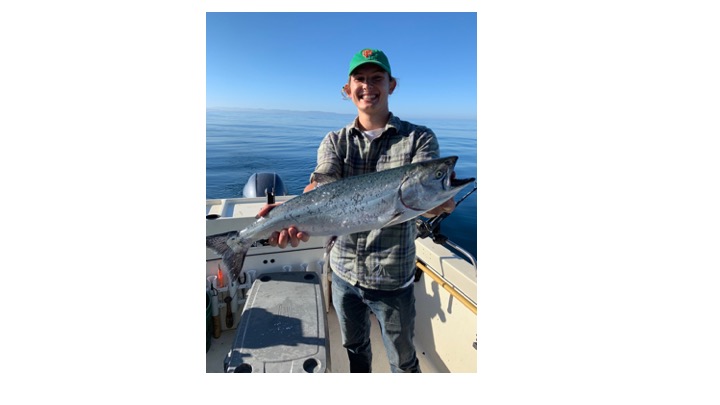
Gavin Bandy
Received: 2021
It is truly an honor and a privilege to receive the Michael G. Scott Outstanding Senior in Fisheries Biology Award. This would not have been possible without the incredible support, encouragement, and knowledge of the Fisheries Department faculty, as well as my fellow classmates, friends, and family. When I first arrived at Cal Poly Humboldt as an undergraduate, I knew I wanted to pursue an education/career in aquatic sciences, however, I was unsure what the next four years would hold for me. The opportunities and experiences I have gained through my course work and technician positions within the department have allowed me to explore the diverse field of Fisheries Biology and what specialization best suited me.
One aspect of the Humboldt Fisheries program that I highly value, is the amount of field experience students can participate in. The diversity of habitats and field settings within Humboldt County, as well as the collaboration between the University and other agencies, is an incredibly unique educational experience and has been instrumental in guiding my educational and career interests. Being able to apply the concepts learned in lecture to practical field settings, is something that has significantly furthered my passion for this field. The atmosphere of Fisheries courses is something I also hold in high regard. The learning environment is one in which you learn fundamental concepts of the field, hear the diverse experiences of the professors, collaborate with both undergraduate and graduate students, and feel a real sense of community amongst the department. Although my degree is in the freshwater emphasis, I have gained an appreciation for all aspects of the field through taking courses and talking with the faculty. Additionally, the emphasis Cal Poly Humboldt puts on understanding the cultural significance and value of Fisheries resources is extremely important for me. It is especially significant for the location of Humboldt, as the field continues to grow and strives to become more inclusive.
The Fisheries Biology Department at Cal Poly Humboldt is one that continually inspires its students to exceed. I am currently continuing my education at Humboldt perusing a Master’s Degree in Dr. Andrew Kinziger’s Lab. My studies will entail developing methodologies to perform local-scale occupancy estimates of Coho Salmon using environmental DNA. In my future career, I hope to work with the restoration of Pacific Salmonid populations and their habitats. Again, I would like to thank the faculty and students at Humboldt, as well as my friends and family, for helping me along my educational journey.
Michael Academia
Received: 2020
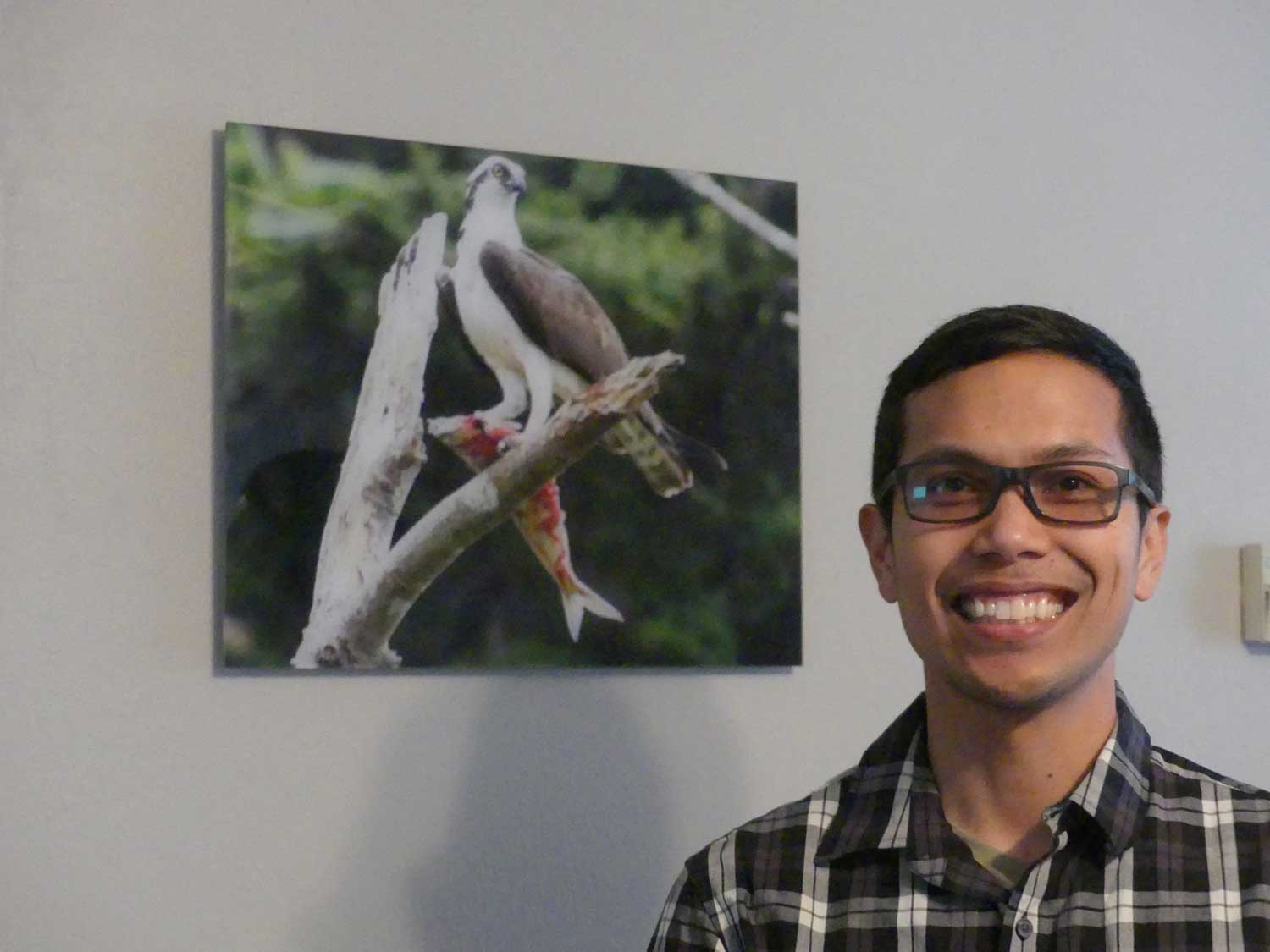
In honor of Michael G. Scott, we must remember the importance of our academic lineage and I am proud to be a part of it. Our reputation has earned respect and is held in high regard throughout professional and scholastic communities. With the professors and staff, I was able to achieve much during my time as an undergraduate, that included a $65,000 grant that will replace an outdated water recirculation system at our on-campus hatchery. Thus, ensuring future students with unique opportunities and learning experiences as one of the only universities with a fish hatchery. The professors took the time, effort, and were dedicated to my success as I published a peer-reviewed scientific article in Western Birds between predator-prey relationships, specifically ospreys and the fish they eat. With significant findings, I presented my research at three major conferences including The First AFS & TWS Joint Conference (American Fisheries Society & The Wildlife Society)./p>
As leaders in our field, we are taught the importance of adaptive management and I am building the bridge between Ornithology and Fisheries Science. We are shifting the paradigm, considering trophic interactions other than our own, and moving towards Ecosystem Based Fisheries Management. I plan to continue my studies of ospreys as biomonitors of fisheries and aquatic health while pursuing a graduate degree.
Taylor Zenobia
Received: 2020
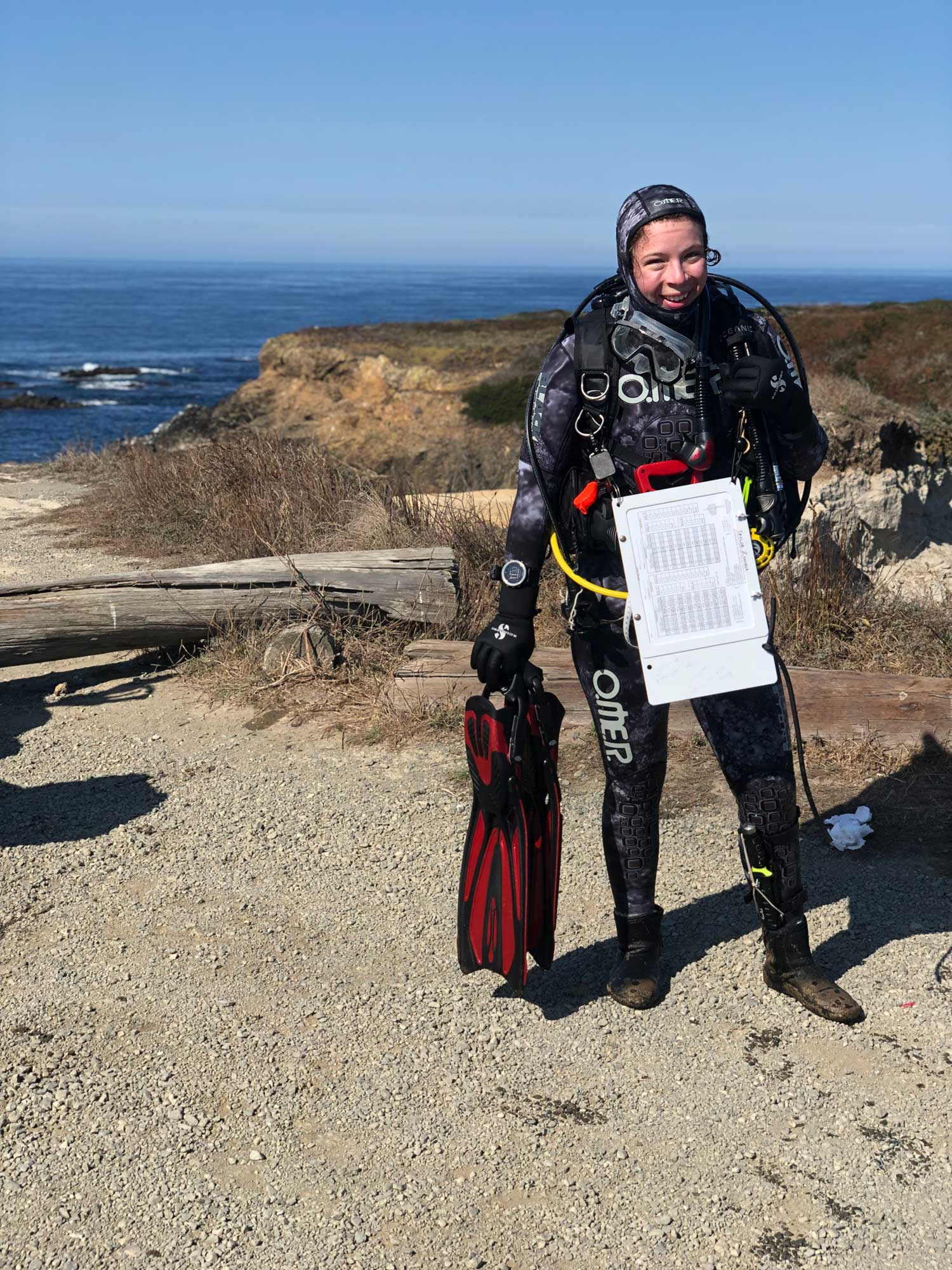
Fish hold incredible cultural, economic, nutritional, and political value. As a student within the fisheries biology program, I have learned that by focusing on fish we have the power to impact our environment, our society, and protect our world for future generations. The faculty, staff, and students within the fisheries biology program hold each other to a high standard that is recognized in the professional fields I have participated in as an undergraduate student. As leaders in our field, I find it incredibly important to bring my personal perspective and experience to the material that I am acquiring and using that to question the origin of these ideas. The faculty within the department has responded to my queries by allowing me the opportunity to collaborate with my peers, specialists in the field, graduate students, and people in other majors. This has resulted in broadening my perspectives and creating new knowledge by coming together with others and incorporating multiple perspectives into paradigm shifts. As a student I have also had the unique opportunity to double minor in Scientific Scuba Diving and Women's Studies. These other curricula have given me the hands-on knowledge of what it's like to be a scientist underwater, counting hundreds of fish as they swim by, and to learn critical theory about how oppression is structured into our society and our experiences. By incorporating all of these knowledge bases I have found myself to be a better scientist overall and a more responsible global citizen. I have grown most as a student and scientific researcher from the unique hands-on opportunities offered by the faculty and supported by the staff at the marine laboratory to conduct independent undergraduate research and present my findings at globally recognized conferences. My current research has focused on the integrated culture of macroalgae with the sustainable production of other trophic level organisms and the implementation of addressing social problems such as gender inequality, environmental classism, and global food insecurity within scientific research. I completed three independent projects and was awarded best student abstract by the United States Aquaculture Society and the World Aquaculture Society in 2019. I was also awarded the best student oral presenter at the Aquaculture America conference in 2020 for my research on reducing the electric energy requirements for land-based macroalgae aquaculture systems. My future career plans include continuing my education in graduate studies at Cal Poly Humboldt; this will entail studying the population dynamics of the Galapagos Ocean Whitefish. I hope to eventually go on to complete a PhD program to help reduce the impacts of food insecurity across the world.
Josh Cahill
Received: 2019
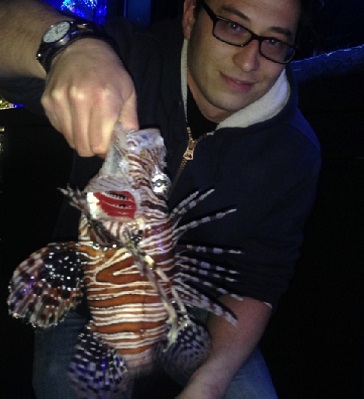
I am truly flattered and honored to receive the Michael G. Scott Award, but I would have been unable to succeed without the support and encouragement of the fisheries biology faculty, my fellow classmates, and my family. Balancing family duties and academic responsibilities was a difficult undertaking. With my wife’s inspiration, I returned to college as a 36 year-old aquarium nerd/ex-construction worker that had never used PowerPoint or Excel. I only possessed the desire to absorb as much piscine knowledge as humanly possible. Reflecting on my time spent at Cal Poly Humboldt, I realize that the element of the fisheries biology program that I hold in highest regard is the dedication of the department to ensure students’ academic and professional success in the field of fisheries biology.
I was allured to the fisheries biology program at Cal Poly Humboldt because of the amount of fieldwork that aspiring fish biologists are exposed to. In my opinion, the hands-on aspect of the program combined with the classroom curriculum offers a more vocational degree than other biological sciences. The individual disciplinary expertise offered by all professors during their course fieldwork was enlightening and invaluable. The fisheries biology staff and faculty also offered opportunities for undergraduate student success through project opportunities, volunteer hours on and off campus (e.g. at the hatchery, marine lab, and aquaponics facility), job and internship emails, and assisting graduate students with their research. On a more personal note, each professor in the department had been supportive and willing to help in various capacities at different times throughout my college career.
The fisheries biology program at Cal Poly Humboldt delivered beyond my expectations, and my time spent in the department was a rewarding experience. As my education progressed in this diverse, multi-disciplinary field, I began to realize that different fisheries course contents built upon and complimented one another. While I have earned a bachelor’s degree in fisheries biology, I feel as though I have merely scratched the surface. I hope to return to Cal Poly Humboldt in the fall to pursue a master’s degree in fisheries biology, and plan to work as a fisheries biologist focused on restoration of salmonids and their habitat.