

Breadcrumb
Resolution on Committee Governance and Oversight Policy
Applies to: Faculty Staff Student
Month/Year Posted: Feb 2025
Policy Number: P25-01
Purpose of the Policy
This policy aims to outline the guidelines for the initiation, maintenance, and phasing out of committees within the University. The Committee on Committees (CoC) serves as the governing body responsible for overseeing the functionality of University committees, annually approving their initiation, functionality, and phasing out.
Table of Contents
- Policy Body
- Appendix I- University Committee Definition Guide
Definitions
- University Committee
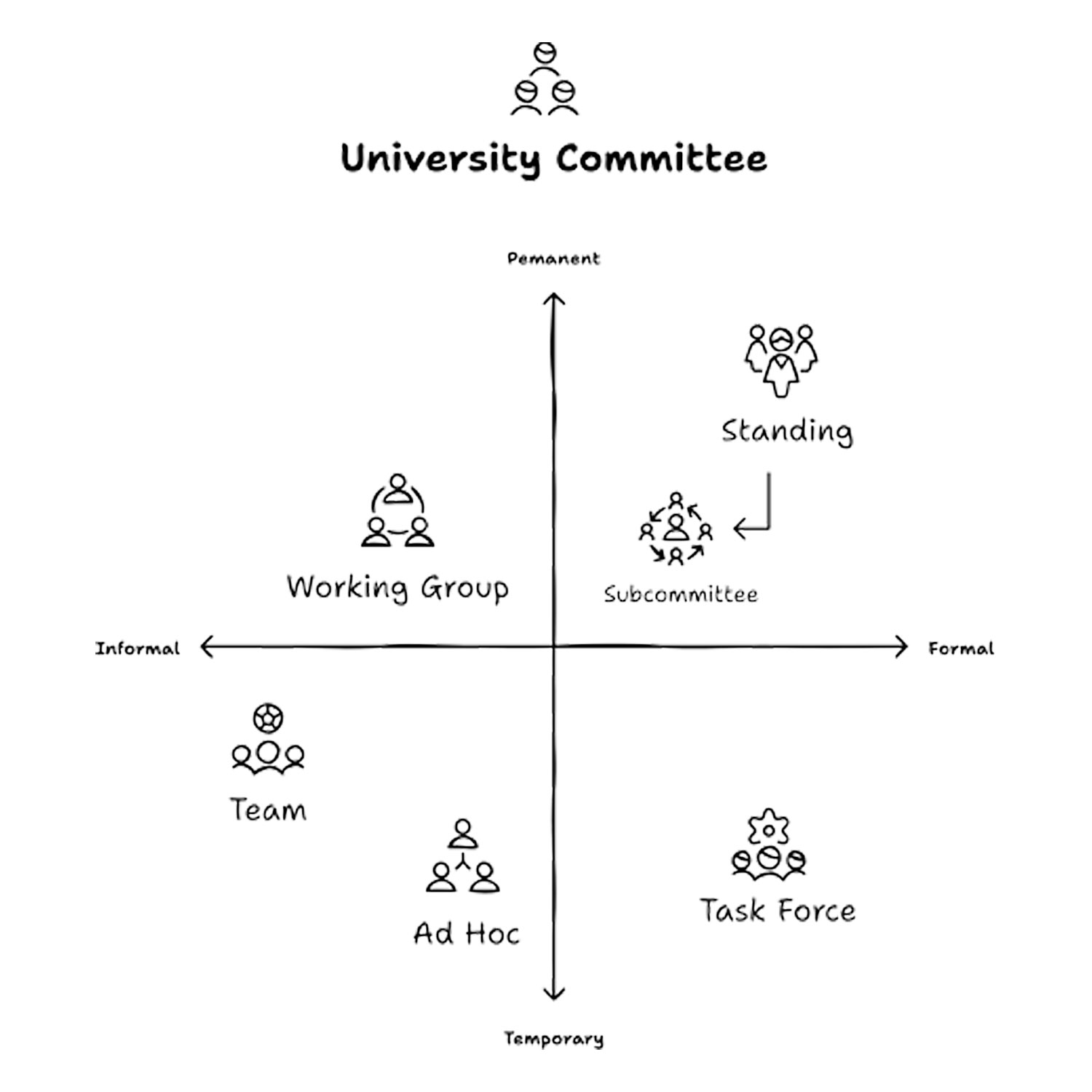
A University Committee is a deliberative body that includes representation from multiple Divisions, established to discuss, advise, or make decisions on matters impacting the broader university community. University Committees are distinguished by their broad scope, formal structure, and focus on fostering inter-divisional collaboration and coordination. Committee is an umbrella term for the following types of committees. - Standing Committee
A Standing Committee is a permanent or semi-permanent body established by the university, shared governance, or through legislation to address ongoing or recurring issues within its jurisdiction. These committees operate under a clearly defined mandate with specified responsibilities and authority delegated by the institution’s governing body or administration. Standing Committees are integral to the university’s governance structure and are expected to produce sustained long-term outcomes. Example: University Resources and Planning Committee (URPC). - Ad Hoc Committee
An Ad Hoc Committee is a temporary body formed to address a specific, short-term, and non-recurring issue or purpose. These committees are composed of members selected for their relevant expertise and are dissolved upon the fulfillment of their defined objectives. Ad Hoc Committees provide flexibility for tackling unique challenges or opportunities. Example: Search Committee. - Task Force
A Task Force is a temporary group established to address urgent or time-sensitive issues requiring immediate attention and resolution. Task Forces are action-oriented, often empowered to make recommendations or implement solutions within a set timeframe. They may operate independently of existing committee structures but should report their creation and conclusions to the Committee on Committees (COC). Example: Graduate Studies Task Force. - Working Group A Working Group is a temporary assembly of members brought together to collaborate on specific tasks, projects, or initiatives. Working Groups are often formed within the context of an existing committee structure and focus on challenges requiring detailed research, exploration, or preparation of recommendations. Working Groups’ outcomes are typically advisory in nature and may evolve into proposals for broader action. Example: Polytechnic Implementation Working Group.
- Team A Team is an action-oriented group composed of individuals working together to achieve specific, practical objectives. Teams are characterized by their flexibility, informal structure, and focus on accomplishing clearly defined tasks or supporting broader departmental or divisional goals. Teams typically operate without a fixed term and can assemble or disband as needed. Example: Emergency Operations Team.
- Subcommittee A Subcommittee is a specialized, permanent subgroup of a larger committee, tasked with examining particular aspects of the committee’s broader mandate. Subcommittees conduct in-depth analysis or research and report their findings and recommendations to the parent committee. Subcommittees enhance the efficiency of their parent committees by addressing focused areas of concern. Example: The Committee on Committees is a Subcommittee of the Constitution and Bylaws Committee.
Policy Details
- Purpose
The purpose of this policy is to outline the guidelines for the initiation, maintenance, and phasing out of committees within the University. The Committee on Committees (CoC) serves as the governing body responsible for overseeing the functionality of University committees, annually approving their initiation, functionality, and phasing out. - Committee Initiation
- Proposal Submission: Any entity of the University community may submit a proposal for the initiation of a new committee to the CoC. The proposal should include the purpose, scope, goals, and expected outcomes of the committee.
- Review and Approval: The CoC shall review all proposals for committee initiation and make a recommendation on their approval based on their alignment with the University's mission, strategic priorities, and existing committee structure. Approval will follow nominal Senate bylaws.
- Composition: Upon approval, the CoC shall make recommendations regarding the composition of the new committee, considering relevant expertise, diversity, and representation from various stakeholders and partners within the University community.
- Committee Maintenance
- Leadership: Each committee shall designate a chair or co-chairs responsible for leading meetings, facilitating discussions, and ensuring progress towards the committee's goals.
- Meetings: Committees are expected to hold regular meetings as scheduled by their respective chairs. Meeting agendas and minutes should be documented and made accessible to all committee members.
- Reporting: Supervising authorities shall gather annual reports from Committee chairs and provide regular updates to the CoC on the activities, achievements, and challenges faced by their committees.
- Resources: The University shall provide necessary resources, including administrative support and budget allocation, to facilitate the work of committees.
- Directory Maintenance: The CoC shall work with the Senate Office to establish and maintain an online comprehensive directory of all University committees. This directory shall include, at a minimum, the name, purpose, membership, and current operational status of each committee, and shall be updated annually to ensure accuracy. The CoC shall communicate updates through Senate reports.
- Transparency and Communication: All committees shall maintain a current and publicly accessible humboldt.edu webpage to share governing documents, a list of members, and a designated contact person.
- Committee Phasing Out
- Evaluation: The CoC shall perform an annual review of all University committees to determine their operational status, specifically evaluating whether each committee is active or inactive.
- Recommendation: Based on the evaluation, the CoC may recommend to the supervising authority whether a committee should be continued, modified, or dissolved.
- Appeal: Committees appealing their dissolution shall submit a formal request to the Senate Executive Committee, providing a written statement and relevant documentation. The Senate Executive Committee will review the appeal, considering the committee’s alignment with institutional goals and effectiveness. After deliberation, the committee may uphold, reverse, or modify the dissolution decision, and the final outcome will be determined by the supervising authority and communicated in writing.
- Phasing-out Process: If a decision is made to dissolve a committee, the CoC shall oversee the phasing-out process to ensure a smooth transition, including the documentation of the committee's work and the transfer of any ongoing responsibilities.
- Amendments: Any amendments to this policy shall be proposed, reviewed, and approved by the University Senate.
- Implementation: This policy shall be communicated to all University stakeholders and implemented effectively upon approval by the CoC.
- Compliance: All University committees and stakeholders are expected to comply with this policy and adhere to its guidelines.
History
- Committee on Committees: 01/22/2025
- Reviewed by University Senate: 02/11/2025
- Approved by Provost/President: 02/18/2025
Appendix I- University Committee Definition Guide
| Term | Definition |
|---|---|
| University Committee | A University Committee is a deliberative body that includes representation from multiple Divisions, established to discuss, advise, or make decisions on matters impacting the broader university community. University Committees are distinguished by their broad scope, formal structure, and focus on fostering inter-divisional collaboration and coordination. Committee is an umbrella term for the following types of committees. |
| Standing Committee | A Standing Committee is a permanent or semi-permanent body established by the university, shared governance, or through legislation to address ongoing or recurring issues within its jurisdiction. These committees operate under a clearly defined mandate with specified responsibilities and authority delegated by the institution’s governing body or administration. Standing Committees are integral to the university’s governance structure and are expected to produce sustained long-term outcomes. Example: University Resources and Planning Committee (URPC). |
| Ad Hoc Committee | An Ad Hoc Committee is a temporary body formed to address a specific, short-term, and non-recurring issue or purpose. These committees are composed of members selected for their relevant expertise and are dissolved upon the fulfillment of their defined objectives. Ad Hoc Committees provide flexibility for tackling unique challenges or opportunities. Example: Search Committee. |
| Task Force | A Task Force is a temporary group established to address urgent or time-sensitive issues requiring immediate attention and resolution. Task Forces are action-oriented, often empowered to make recommendations or implement solutions within a set timeframe. They may operate independently of existing committee structures but must report their creation and conclusions to the Committee on Committees (COC). Example: Graduate Studies Task Force. |
| Working Group | A Working Group is a temporary assembly of members brought together to collaborate on specific tasks, projects, or initiatives. Working Groups are often formed within the context of an existing committee structure and focus on challenges requiring detailed research, exploration, or preparation of recommendations. Their outcomes are typically advisory in nature and may evolve into proposals for broader action. Example: Polytechnic Implementation Working Group. |
| Team | A Team is an action-oriented group composed of individuals working together to achieve specific, practical objectives. Teams are characterized by their flexibility, informal structure, and focus on accomplishing clearly defined tasks or supporting broader departmental or divisional goals. Teams typically operate without a fixed term and can assemble or disband as needed. Example: Emergency Operations Team. |
| Subcommittee | A Subcommittee is a specialized, permanent subgroup of a larger committee, tasked with examining particular aspects of the committee’s broader mandate. Subcommittees conduct in-depth analysis or research and report their findings and recommendations to the parent committee. They enhance the efficiency of their parent committees by addressing focused areas of concern. Example: The Committee on Committees is a Subcommittee of the Constitution and Bylaws Committee. |
| Term | Initial Definition | Revised Definition |
|---|---|---|
| University Committee | A Committee that has representation from more than one Division, convened to deliberate, advise, or make decisions on matters affecting the entire university community. University Committees ensure collaboration and coordination across different Divisions. The Committee on Committees maintains records and advises regarding the status of all University Committees. | A University Committee is a deliberative body that includes representation from multiple Divisions, established to discuss, advise, or make decisions on matters impacting the entire university community. University Committees are distinguished by their broad scope, formal structure, and focus on fostering inter-Divisional collaboration and coordination. Committee is an umbrella term for the following types of committees. |
| Standing Committee | A permanent or semi-permanent committee composed of campus and/or community members, established within the university structure (e.g., University Senate) or legislation to address ongoing or recurring issues. Standing committees possess defined responsibilities and authority delegated by the institution's governing body or administration. Example: URPC. | A Standing Committee is a permanent or semi-permanent body established by the university, shared governance, or through legislation to address ongoing or recurring issues within its jurisdiction. These committees operate under a clearly defined mandate with specified responsibilities and authority delegated by the institution’s governing body or administration. Standing Committees are integral to the university’s governance structure and are expected to produce sustained long-term outcomes. Example: University Resources and Planning Committee (URPC). |
| Ad Hoc Committee | A temporary committee formed for a specific, short-term, and non-recurring purpose or to address a particular issue within the university, comprising campus and/or community members. Ad hoc committees are created as needed and dissolved once their objectives are fulfilled. Example: Search Committee. | An Ad Hoc Committee is a temporary body formed to address a specific, short-term, and non-recurring issue or purpose. These committees are composed of members selected for their relevant expertise and are dissolved upon the fulfillment of their defined objectives. Ad Hoc Committees provide flexibility for tackling unique challenges or opportunities. Example: Search Committee. |
| Task Force | A temporary committee or group is comprised of campus and/or community members, established to address urgent or time-sensitive issues requiring immediate attention and resolution. Task forces are empowered to act decisively and have a limited duration focused on achieving specific objectives. Task forces can be initiated outside of existing committee structures, but should be reported to the COC upon creation and conclusion. Example: Graduate Studies Task Force. | A Task Force is a temporary group established to address urgent or time-sensitive issues requiring immediate attention and resolution. Task Forces are action-oriented, often empowered to make recommendations or implement solutions within a set timeframe. They may operate independently of existing committee structures but must report their creation and conclusions to the Committee on Committees (COC). Example: Graduate Studies Task Force. |
| Working Group | A long-term and temporary assembly of campus and/or community members formed to collaborate on specific tasks, projects, or initiatives within the university. Working groups are typically created to address challenges, conduct research, or develop recommendations for further action. Working Groups are initiated inside an existing committee structure. Example: Polytechnic Implementation Working Group. | A Working Group is a temporary assembly of members brought together to collaborate on specific tasks, projects, or initiatives. Working Groups are often formed within the context of an existing committee structure and focus on challenges requiring detailed research, exploration, or preparation of recommendations. Working Groups’ outcomes are typically advisory in nature and may evolve into proposals for broader action. Example: Polytechnic Implementation Working Group. |
| Team | A collaborative group composed of campus and/or community members, typically working together on specific projects, initiatives, or goals that benefit a department, division, or shared interest within the university. Unlike committees or task forces, teams focus on practical, action-oriented tasks, often within a flexible structure. Teams may operate informally and without a set term, assembling and disbanding as needed to accomplish outcomes or support broader university efforts. Example: Emergency Operation Team. | A Team is an action-oriented group composed of individuals working together to achieve specific, practical objectives. Teams are characterized by their flexibility, informal structure, and focus on accomplishing clearly defined tasks or supporting broader departmental or divisional goals. Teams typically operate without a fixed term and can assemble or disband as needed. Example: Emergency Operations Team. |
| Subcommittee | A permanent subgroup or specialized division of a larger committee, consisting of campus and/or community members, tasked with examining specific aspects or components of the committee's mandate. Subcommittees focus on in-depth analysis or detailed research within particular areas of expertise, reporting back to the main committee with findings and recommendations. Example: Committee on Committees is a nested Subcommittee of the Constitution and Bylaws Committee. | A Subcommittee is a specialized, permanent subgroup of a larger committee, tasked with examining particular aspects of the committee’s broader mandate. Subcommittees conduct in-depth analysis or research and report their findings and recommendations to the parent committee. Subcommittees enhance the efficiency of their parent committees by addressing focused areas of concern. Example: The Committee on Committees is a Subcommittee of the Constitution and Bylaws Committee. |
| Term | Composition | Activity Status (being active) | Reporting | Performance Reporting | Mission | Example |
|---|---|---|---|---|---|---|
| University Committee | Representation from multiple Divisions, inclusive of campus and/or community members. | Deliberative; decision-making or advisory in scope. | Varied – see below for each category. | Varied – see below for each category. | To deliberate on and advise matters affecting the entire university community. | Committee on Committees. |
| Standing Committee | Composed of members appointed permanently or semi-permanently by the governing body. | Recurring and ongoing responsibilities. | Reports to the Committee on Committees (COC), and to the institution’s governing body or administration. | Reports to the initiating authority, administrative body, or shared governance according to the Committee on Committees (COC) records. | To address recurring and ongoing governance or operational issues within the university. | University Resources and Planning Committee. |
| Ad Hoc Committee | Members selected for their expertise; temporary and non-recurring. | Specific short-term tasks or issues. | Reports to the initiating authority. Does NOT report to the Committee on Committees (COC). | Reports to the initiating authority. | To address a particular issue or purpose within a limited timeframe. | Search Committee. |
| Task Force | Action-oriented group of campus and/or community members; urgent focus. | Immediate, time-sensitive issues. | Campus-wide task forces report their creation and conclusion to the Committee on Committees (COC). | Reports to the initiating authority. | To act decisively on urgent or time-sensitive tasks. | Graduate Studies Task Force. |
| Working Group | Campus and/or community members, typically nested in existing committee structures. | Collaboration on specific projects or initiatives. | Reports to the parent committee or initiating structure. | Reports to the parent committee or initiating structure. | To explore challenges or opportunities requiring research or coordination for future action. | Polytechnic Implementation Working Group. |
| Team | Members with shared goals, typically at a departmental or divisional level. | Practical and action-oriented tasks. | Reports to the parent committee or initiating structure. | Reports to the parent committee or initiating structure. | To collaborate on specific tasks or goals, operating flexibly to meet needs. | Emergency Operations Team. |
| Subcommittee | Permanent members drawn from and reporting to a parent committee. | Specialized, in-depth examination of key areas. | Reports to the parent committee. | Reports to the parent committee. | To conduct focused research or address specific aspects of the parent committee’s mandate. | Committee on Committees Subcommittee. |
Image