

Breadcrumb
Department of Geography, Environment & Spatial Analysis
The Department of Geography, Environment & Spatial Analysis at Cal Poly Humboldt helps students understand how people, place, power, and environment shape the world through fieldwork, research, and geospatial tools.
Explore program information, faculty expertise, research opportunities, and facilities that support hands-on learning in geography and geospatial science. Learn how to get involved through field experiences, student projects, internships, community partnerships, and professional development.
Ready to take the next step?
Explore Programs • Request info • Apply to Cal Poly Humboldt
Academic Programs
Geography, B.A.
The Geography B.A. program at Cal Poly Humboldt prepares students to analyze how people, places, and environments interact in a rapidly changing world. Coursework engages with topics such as global environmental change, social movements, political ecology, and spatial justice, helping students connect local places to broader systems and power relations.
Graduates are prepared for careers and graduate study in planning, environmental and community organizations, education, public service, and related fields where analysis and communication matter.
Geospatial Science & Technology, B.S.
The Geospatial Science & Technology B.S. is a dynamic, interdisciplinary program where students gain hands-on experience with mapping technologies, spatial data analysis, environmental modeling, and remote sensing to solve real-world environmental and social challenges.
The program builds strong technical proficiency alongside applied problem-solving, preparing graduates to work across diverse landscapes and professional sectors.
Geospatial Certificate Programs
Geospatial Certificate Programs offer flexible, stackable pathways to build in-demand skills in mapping, GIS, and remote sensing. Start with the Basic Certificate to develop spatial thinking, data analysis, and geovisualization, then add focused certificates in GIS, Remote Sensing, or Cartography.
For undergrads, grads, and non-degree learners, courses emphasize hands-on projects, real data, and portfolio-ready work for careers in many fields nationwide.
Real World, Hands-On Learning
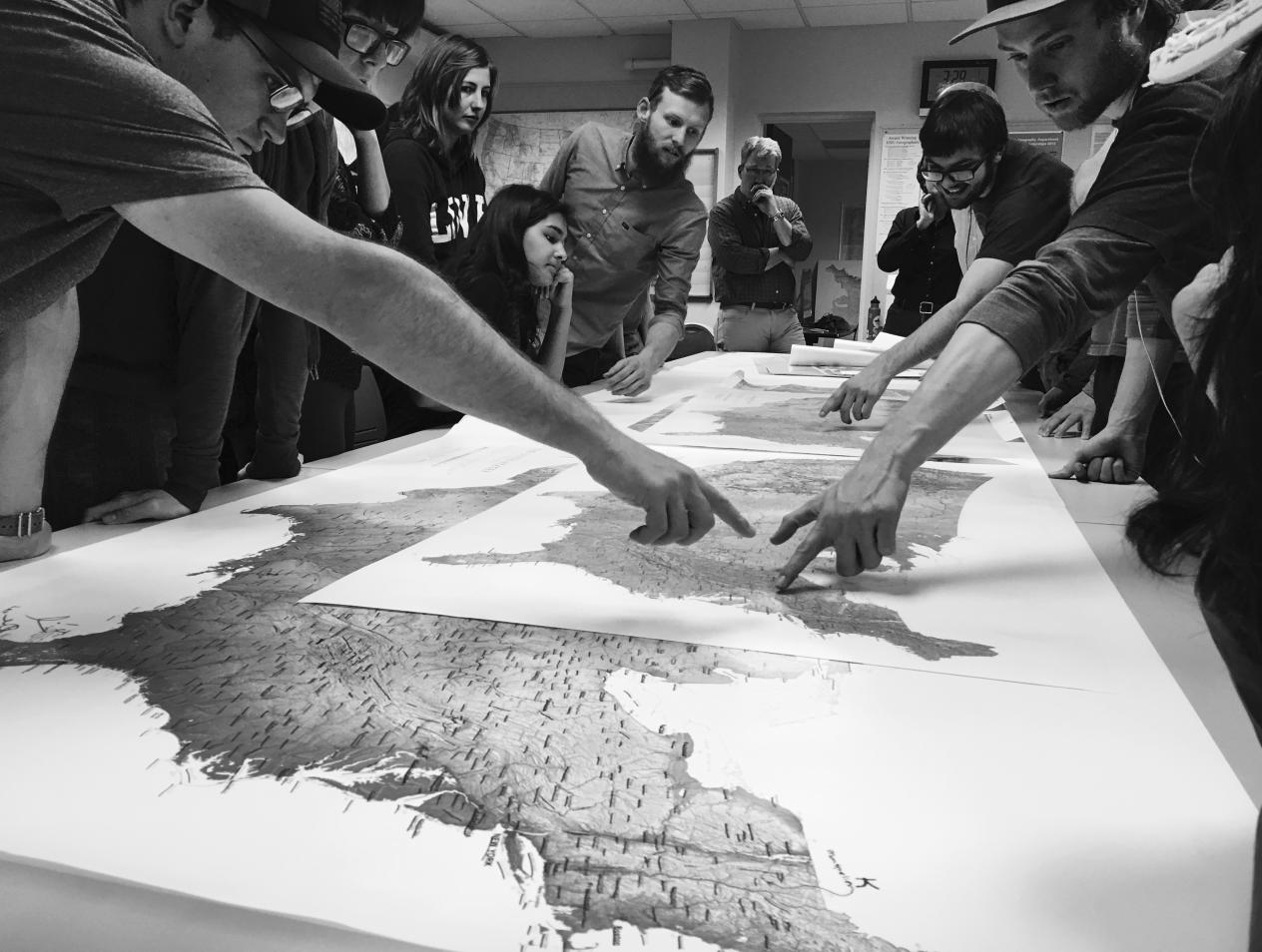
Whether you're collecting environmental samples, learning new spatial analysis software, or collaborating with local organizations, you’ll learn by doing—both in the classroom and out in the world. Our students gain practical experience through local fieldwork, lab training, and community partnerships that bring geography and geospatial science to life.

Research Experience & Career Prep
Our seniors complete self-designed research projects that build critical thinking, technical fluency, and a portfolio of work for graduate school or employment. The department also supports student travel to conferences, publishing opportunities, and research collaborations with faculty mentors.

Small Classes, Big Support
Our small class sizes foster close connections with professors and peers who know you by name. You'll grow intellectually while sharpening your analytical and technical skillset, all within a supportive community that guides you from your first semester through graduation and beyond.

Place-Based Learning Community: People & Planet
As a freshman, you’ll participate in hands-on geographic and community activities with your peers before classes even start, and in some cases, have the opportunity to live in the same residence halls with your peers. Geography students will join four other departments for People & Planet, which focuses on learning how sustainability is both local and global, while addressing specific case studies in fields such as agriculture, clean energy, and climate justice.
Achievements
Find out what our students, faculty, and staff are being recognized for.
Elam Bender
Geography, Environment & Spatial Analysis
Elam Bender has received an Agricultural Research Institute (ARI) NextGen Fellowship for his work using UAVs to apply precision agriculture techniques to small-scale sustainable farms. Through this research, Elam is exploring how high resolution aerial imaging and data collection techniques can help small farms improve efficiency, sustainability, and resource management. The USDA-funded ARI NextGen Fellowship Program provides 421 paid fellowships for California State University students pursuing careers in food, agriculture, natural resources, and human sciences.
Gabi Kirk, Levi Humphrey, Zachary Knight, Liam Blackburn, Sterling Russell, and Corra Houtermans
Geography, Environment & Spatial Analysis
Levi Humphrey (GESA '25), Zachary Knight (GESA '26), Liam Blackburn (GESA '26), Sterling Russell (GESA/Religious Studies '26), and Corra Houtermans (ENST '26) with Professor Gabi Kirk (GESA) published "People's Guides to California" in you are here: the journal of creative geography based at University of Arizona. The 2026 issue is themed "Weaving Alter-Worlds" and "explores the act of weaving as a metaphor for crafting interconnected futures that resist colonial domination and hegemonic space." This student-faculty piece explores lesser-known histories and presents of California through Indigenous geography, Black history, and other cultural geographies through creative methods including maps, zines, and even a board game. The publication is on display in front of Founders Hall 109 or can be purchased at the journal's website.
Gabi Kirk
Geography, Environment & Spatial Analysis
Dr. Gabi Kirk was awarded a American Association of University Women (AAUW) American Postdoctoral Research Leave Fellowship for 2026-27 to support the writing of her first scholarly monograph, Cultivating Sustainable Sovereignty: Palestinian Agrarian Lives in Transnational Focus.
AAUW’s largest funding program began in 1888, making it one of the world’s oldest and most prestigious fellowship programs exclusively for women. This fellowship supports women scholars who are completing doctoral dissertations, conducting postdoctoral research, or finishing research for publication. AAUW (American Association of University Women) is the nation’s leading organization for equity in higher education and women’s economic empowerment. Founded in 1881 by women who defied society’s conventions by earning college degrees, AAUW has since worked to increase women’s access, opportunity, and equity in higher education through advocacy and philanthropy of more than $146 million, supporting thousands of women scholars. Learn more at aauw.org.