

Sarah Schooler
Breadcrumb

Advisor
William "Tim" BeanSarah Schooler, 2019
Thesis:
Cara Appel
Breadcrumb
Advisor
William "Tim" BeanNathan Alexander
Breadcrumb
Advisor
William "Tim" BeanSharon Dulava
Breadcrumb
Advisor
William "Tim" BeanAlyssa Semerdjian
Breadcrumb
Advisor
William "Tim" BeanAlyssa Semerdjian, 2019
Thesis:
After graduating from Cal Poly, SLO I worked for a couple of animal behavior studies before turning my attention to small mammal trapping projects. Small mammals make appealing study subjects due to their relatively large numbers and trapability. They play very important but understated roles in their environments and a multitude of ecological questions can be answered using them as subjects (plus they’re totally cute). I am thrilled to be working the giant kangaroo rats (GKR), an important ecosystem engineer in California’s central valley. For my Masters I will be re-mapping GKR’s species range and hopefully investigating the some of the factors that influence GKR populations and the surrounding small mammal community.
Ivy Widick
Breadcrumb
Advisor
William "Tim" BeanIvy Widick, 2018
Thesis:
Pairsa Belamaric
Breadcrumb
Advisor
William "Tim" BeanPairsa Belamaric, 2019
Thesis:
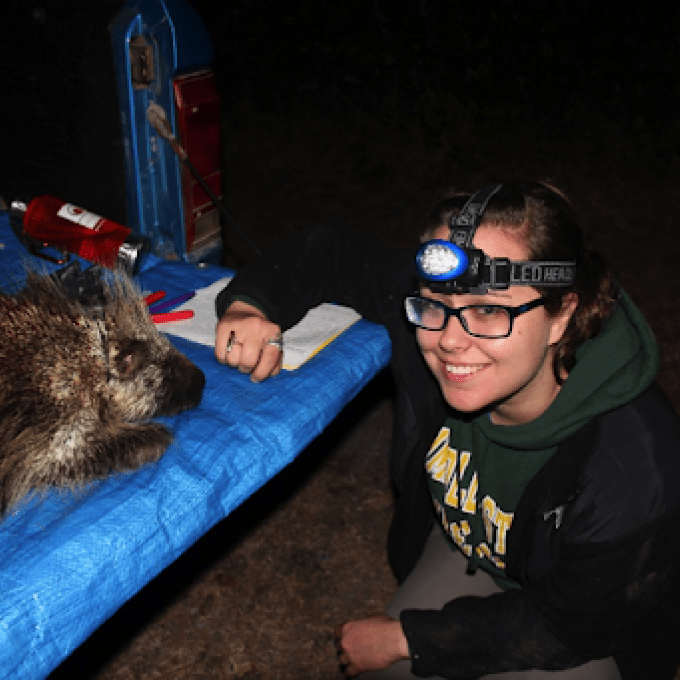
California’s north coast has long been home to the North American porcupine, but anecdotal evidence tells us populations are declining in this region. Being an understudied species in western coastal areas – very little is known about how porcupines use local resources or how extirpation may affect coastal dune systems. Previous work in the Bean lab has focused on resource selection and seasonal diet patterns of porcupines in Tolowa Dunes State Park. My research interests are broadly focused on the interactions between mammalian herbivores and plants. Specifically, what drives selection in herbivores and how foraging decisions shape plant community structure and composition. So moving forward in the Tolowa Dunes State Park study system, I hope to apply these interests and contribute to a better understanding of the direct and/or indirect effects porcupine foraging may have on coastal dune forest ecosystems.
Alyssa Marquez
Breadcrumb
Advisor
Micaela GuntherAlyssa Marquez, 2019
Thesis:
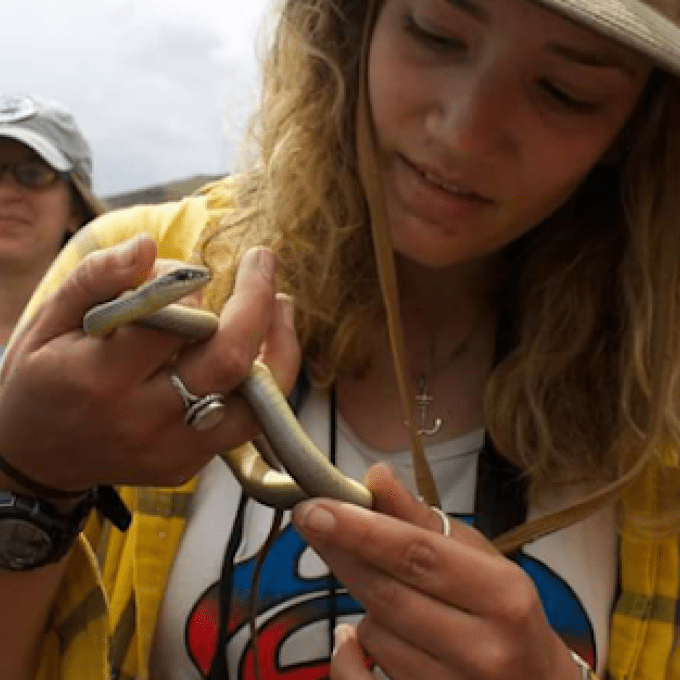
Alyssa is studying the long-term impacts of logging on headwater amphibian populations, specifically occupancy. Her research takes place in two adjacent watersheds in the Redwood National and State Parks in Northern California. One watershed is highly degraded from historic logging practices and the other is a pristine late-seral watershed untouched by logging. Her field work, in combination with various other student and park employee-run studies, will form the baseline for a restoration project aimed at restoring the logged watershed.
Claire Nasr
Breadcrumb
Advisor
Daniel BartonClaire Nasr, 2019
Thesis:Identifying spatial overlap and seasonal variation between human and seabird use along the Trinidad Coast to better predict timing and location of potential disturbance events
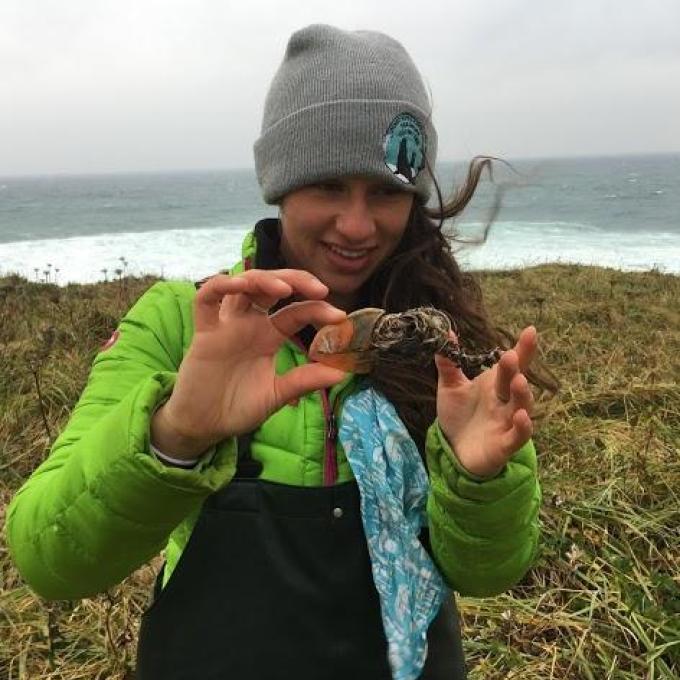
Claire graduated in 2012 from UC Santa Cruz, where she earned a B.S. in marine biology. She has participated in a variety of projects concentrated in marine mammal demography, research and conservation. Claire has also dedicated many years serving as an education specialist, leading diverse groups of K-12 students outside, instilling concepts in marine ecology and natural history. Much of her work has involved living and working on remote islands and international field stations researching marine vertebrates including leopard sharks, humpback whales, pinnipeds (seals and sea lions) and seabirds. Some locations have included the Southeast Farallon Island, the Pribilof Islands in the Bering sea, Maui Hawaii, Aсo Nuevo State Park, Santa Cruz island in the Channel Islands, and Corsica in the Mediterranean. Claire's thesis is focused on identifying spatial overlap and seasonal variation between human and seabird use along the Trinidad Coast to better predict timing and location of potential disturbance events. She additionally works with the Seabird Protection Network and The California Coastal National Monument - part of the Bureau of Land Management’s National Landscape Conservation System.
Katrina Smith
Breadcrumb
Advisor
Daniel BartonKatrina Smith, 2018
Thesis:
Katrina’s research focused on the use of habitat selection and species distribution modeling in conjunction with underlying ecological theory to improve a population monitoring program of Townsends’ big eared bats (Corynorhinus townsendii) in a volcanic landscape. She explored the relationship between the internal microclimate of volcanic caves where bats hibernate and the cave morphology characteristics that influence the cold, stable conditions necessary for optimal metabolic rates of torpor. These predictive variables of bat abundance were assessed in an effort to prioritize caves for hibernacula surveys and increase the power of bat population monitoring at Lava Beds National Monument. Katrina worked as an intern, field tech, and program manager in the National Park Service for five years after finishing her B.S. in Ecology and Environmental Biology at the University of Wisconsin-Eau Claire. Her research was supported by the White-Nose Syndrome Response Program of the National Park Service.