





Breadcrumb
History
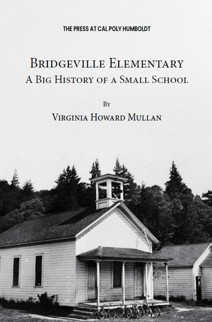
Bridgeville Elementary: A Big History of a Small School
Virginia Howard Mullan
Bridgeville Elementary: A Big History of a Small School is not a work of writing that is meant to be read from the beginning to the end. It is for those of us who only attended Bridgeville School for a short time but wanted to recapture those years. It is for teachers and students bitten by the nostalgia bug that want to revisit the school, (like Sean Byrd in 2024 or Mary Brandenburg (Jardin) in 1999) but don’t have the time or means to make a trip to the remote northwest.
Northern Humboldt Indians: History of Humboldt County People and Places
Jerry Rohde
In what is now Humboldt County and southern Klamath County, seven Indian tribes made their home: the Mawenok, Whilkut, Tsnungwe, Hupa, Karuk, Yurok, and Wiyot. They arrayed themselves upon the land and sent their roots down into the earth, so that they had become as one with the place. Their villages were of long standing, and even their individual houses could sometimes be traced back, by name, for hundreds of years. In 1850, whites arrived on the shores to rage like a gale across the land. For 15 years the gale would sweep up the rivers and over the ridges and tear loose much of what the Indians had established in their homelands. And still the wind continued to blow, as the desire for gold was replaced by other desires—for ranchland, for timber, and even for the salmon. The wind blows yet. This is the story of what happened when the people of the wind met the people of the land.

Southwest Humboldt Hinterlands
Jerry Rohde
A history of southwest Humboldt County, covering the years from 1850 to 1964, illustrated with over 200 full-color historical photographs and maps. Includes accounts of the oil “boom” in Petrolia, the building of the Redwood Highway, and the race to protect the redwoods of the Bull Creek and Dyerville flats, stories about “sheriff” Ulysses S. Grant Myers, early- day environmentalist Laura Perrott Mahan, and Indian survivor George Burtt, and images, in words and pictures, of once-important but now nearly forgotten places such as Capetown, Dyerville, Briceland, and Bull Creek.
All of this and more will recall the rich history of the 24 places that make up this remote corner of the country.

Southeast Humboldt Hinterlands
Jerry Rohde
A history of southeast Humboldt County, covering the years from 1850 to 1964, illustrated with over 175 full-color historical photographs and maps. Includes stories about the sheep ranchers who gambled and drank their days away in Blocksburg, the rescue party that took “High Rock” Gordon across the snowy wastes of Showers Pass, and the shootout on the Bridgeville bridge. The book also includes accounts of the governors from Michigan who collected redwoods on the Van Duzen; the “second largest city in Humboldt County,” whose businesses failed to fill a single street; and the navy that removed the pepperwoods from Pepperwood.
From Iaqua to Harris, from Carlotta to Dinsmore, this historic work covers the 28 towns and places that make up this remote corner of the country.
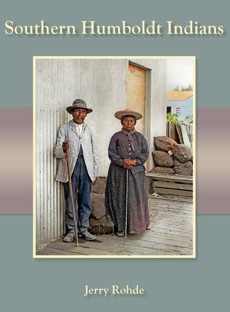
Southern Humboldt Indians
Jerry Rohde
More than a century after they had spoken, these early day Indians will be heard. All of us who make Humboldt County our home deserve to have access to this information. We deserve to know the many, many names of the tribal groups that were once here and to learn the story of these groups. And we deserve to know the names of the Indian elders who transmitted these names and told these stories, just as we deserve to know the stories about the elders themselves.

Toyon: Seven Decades of Student Driven Publishing
Erika Andrews, Asha Galindo, and Sarah Godlin
This book is meant to capture the history and spirit of Toyon literary journal from its origin in 1954 to the future that surely will exist beyond these pages. The aim of this book is to inform future Toyon staffers of the unique history of the publication, to stress the importance of maintaining archives, and to provide insight into the inner workings of book/magazine production over the last 60+ years.
This book is also a place to tell the story of a student-run publication from the perspective of the student. We, Erika and Asha, are two former Toyon staff members who worked on issues 65 and 66, in the years of 2019 and 2020, respectively. We hope that these pages will entertain as well as educate—and that it truly honors the passionate and dynamic voices of the student editors, contributors, and volunteers that have published this magazine year after year.
We have striven to include many details and first-hand accounts and to properly interpret the information archived in the Humboldt State University library special collections. As with any archive, gaps remain in the history of Toyon that we’ve been able to access; for some periods we had very little information other than the finished magazine. In these instances, we worked hard to summarize what we could and fill in gaps using course catalogues and other materials from the archives to properly capture the era.

The History of Congressional Apportionment
Charles M. Biles
NEW REVISED SECOND EDITION.
The Congressional apportionment problem is deceptively easy to state: How many seats in the U. S. House of Representatives does each state get? To answer that question, Charles Biles, award-winning Professor Emeritus of Mathematics at Humboldt State University, examines the math and politics that has shaped government and power from the founding of the country to the modern day.
Employing an interdisciplinary approach that stems from his research in mathematical modeling and the modeling of natural resource systems, Biles tells a flowing evolutionary tale of how slight changes in calculating apportionment has wrought massive shifts in political power and even decided presidents. Bile’s work adds another chapter to the rich story of American history and the people, politics, and debates that continuously shape the political system we have today.
This second edition includes a detailed account of the reapportionment based on the 2020 census, the impact of extreme partisanship, and an account of the precarious road ahead for the electoral college. This is an essential read for anyone who wants to understand the past and future of our representative democracy.

Humboldt Bay Shoreline, North Eureka to South Arcata: A History of Cultural Influences
Jerry Rohde
In 1850 the area east of Arcata Bay was a tapestry of wetlands and sloughs, fringed by conifer-clad hillsides. Canoe channels and trails connected a string of Wiyot villages that nearly encircled the bay.
Then white settlers arrived, establishing towns at Eureka and Union (Arcata). With them came profound changes in the landscape. Rock quarries. Log drives. “Reclaimed” ranchland. An airport. Four and a half railroads. In 170 years the area was transformed into a web of structures and infrastructures that connected what became the two largest cities in Humboldt County.
Recently a new period of change has begun, promising far greater effects. Global warming has created sea level rise, and Humboldt Bay will be the most severely affected area on the California coast. In response, elected officials, agency experts, and the general public need to make informed decisions about how to deal with the resultant rising water levels. We need to recognize that preparing for the bay’s future requires gaining knowledge of the bay’s past. This book will help start that process.

Y.E.S.: 50 Years of Community Building
Erika Andrews and Amanda Ramirez-Sebree
Youth Educational Services (Y.E.S.) is more than just an easily acronymed program title. It’s a piece of Humboldt State University history. What started as an off-the-cuff idea has grown into a formidable force on campus and the community.
Y.E.S. provides community engagement programs for HSU students to volunteer in local school and community sites. Y.E.S. programs are student-initiated and student-led and directly serve local community needs. By creating a collaborative, inclusive and safe environment, Y.E.S. volunteers become active creators of their own learning.
Thousands of volunteers and community members have benefited from Y.E.S. programs. These are the threads that weave together the contributions of five decades of Y.E.S. community members, a quilt created by hands and hearts of all ages. This book honors all the voices and perspectives shared, and those yet to be shared, that together form the powerful legacy of Y.E.S.
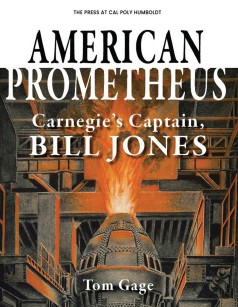
American Prometheus: Carnegie's Captain, Bill Jones
Tom Gage
American Prometheus: Carnegie’s Captain, Bill Jones presents a compelling historical memoir of the illustrious life of rebellious steel genius and inventor, Captain Bill Jones.
Hero of the Civil War and Johnstown Flood, Captain Bill Jones built and supervised the Edgar Thomson Steel Works, which in its first five years advanced to the rank of the world’s most productive and profitable steel mill. His “hands-on, all over” style solved Carnegie’s production problems on the spot, enlisted baseball teams from the Works’ departments to defuse ethnic strife, promoted the eight-hour work day, and patented inventions, including the Jones Hot Metal mixer, which revolutionized the steelmaking industry, all while turning down Carnegie’s offers of partnership.
A deft blend of historical narrative and family memoir, this absorbing account of Jones’ dynamic life as a founding key figure in post-Civil War America’s Second Industrial Revolution and as a philanthropist in his own right, is told by none other than his great-grandson. Tom Gage moves beyond the role of biographer and storyteller to delve into research that traces Jones’ relationship to the steel magnate and explores the mysteries posed by family lore.
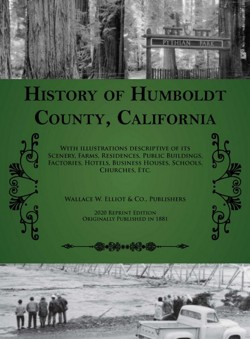
History of Humboldt County, California : with Illustrations Descriptive of its Scenery, Farms, Residences, Public Buildings, Factories, Hotels, Business Houses, Schools, Churches, etc., from Original Drawings, including Biographical Sketches
W. W. Elliott & Co.
"We have the pleasure of presenting to our patrons one of the largest and most elegant County Histories yet issued on this Coast. Not only ample in the number and beauty of its illustrations, and quality of paper and binding, but also in the extent and accuracy of its historical matter. We hope our efforts to represent the important features of this county may lead its inhabitants to understand and appreciate more fully its varied resources. We hope we have furnished information to the traveler, the tourist, or the emigrant who is seeking a location."
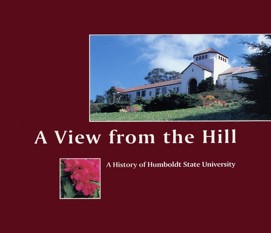
A View from the Hill: A History of Humboldt State University
William R. Tanner
A View from the Hill: A History of Humboldt State University is an attempt to record a social memory for former students, faculty, staff, and, administrators. This volume is not meant to be a comprehensive institutional history. Thus, the reader will discover an emphasis on the people of Humboldt State.

Vietnamese Perspectives on the War in Vietnam
John C. Schafer
An annotated bibliography of works in English