


Breadcrumb
Economics, B.A.
Want a degree that opens doors and makes an impact? Economics at our polytechnic university is all about solving real-world challenges—whether it’s shaping sustainable policies or driving local economic growth. Our program stands out with a strong focus on Environmental Economics and Regional Economic Development, offering experiential learning through research, internships (many of them paid!), and projects that connect you directly with industry and community partners. Small class sizes mean your professors know you by name, and you can customize your degree by choosing an emphasis and adding a minor in business, environmental policy, psychology, and more. If you’re looking for a dynamic, career-focused education that prepares you for the future, Economics is the way to go.
Why this program
Real-World Connections in a Small, Urban Setting
Our location gives you access to top business and government leaders through service-learning internships. In our small city, entrepreneurs and policymakers are eager to connect with and hire Cal Poly Humboldt Economics majors, giving you hands-on experience that stands out.
A Close-Knit Learning Community
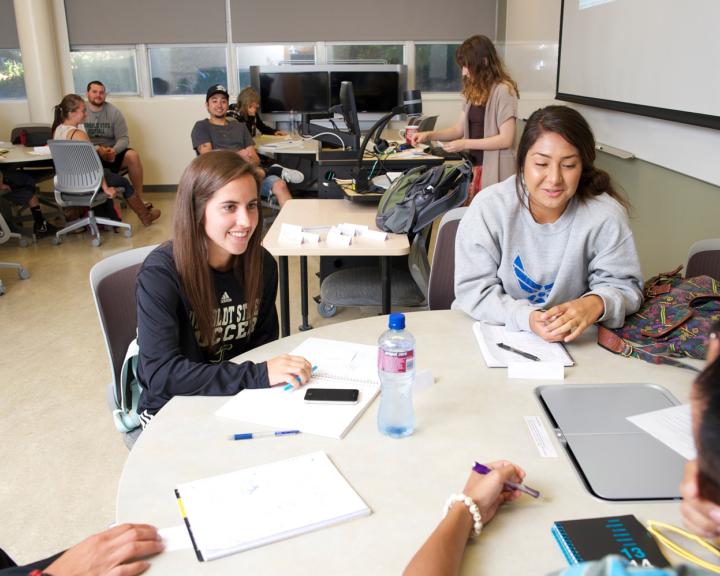
At Cal Poly Humboldt, the strong connections between students and professors create a supportive learning environment. Senior students lead the Econ Forum for casual discussions outside class, and our new study lounge is the perfect place to grab coffee and collaborate.
Opportunities That Pay Off
Economics students don’t just study research—they conduct it. The Ruprecht Research Assistantship provides stipends for students to work with faculty or pursue independent projects, gaining practical knowledge in data analysis, policy evaluation, and economic modeling for future careers or graduate studies.

Emphases
At Cal Poly Humboldt, you customize your own path. You can go for a traditional economics focus or mix it up with one of our interdisciplinary emphases. You choose the emphasis that’s right for you!
Applied & Quantitative Economics
Turn data into decisions
- Learn how to analyze data, build models, and solve real-world problems using economics and statistics. This pathway prepares students for careers in data analysis, finance, policy, and tech.
- Customize your path
Statistics Track: Focus on statistical modeling, regression analysis, and data interpretation
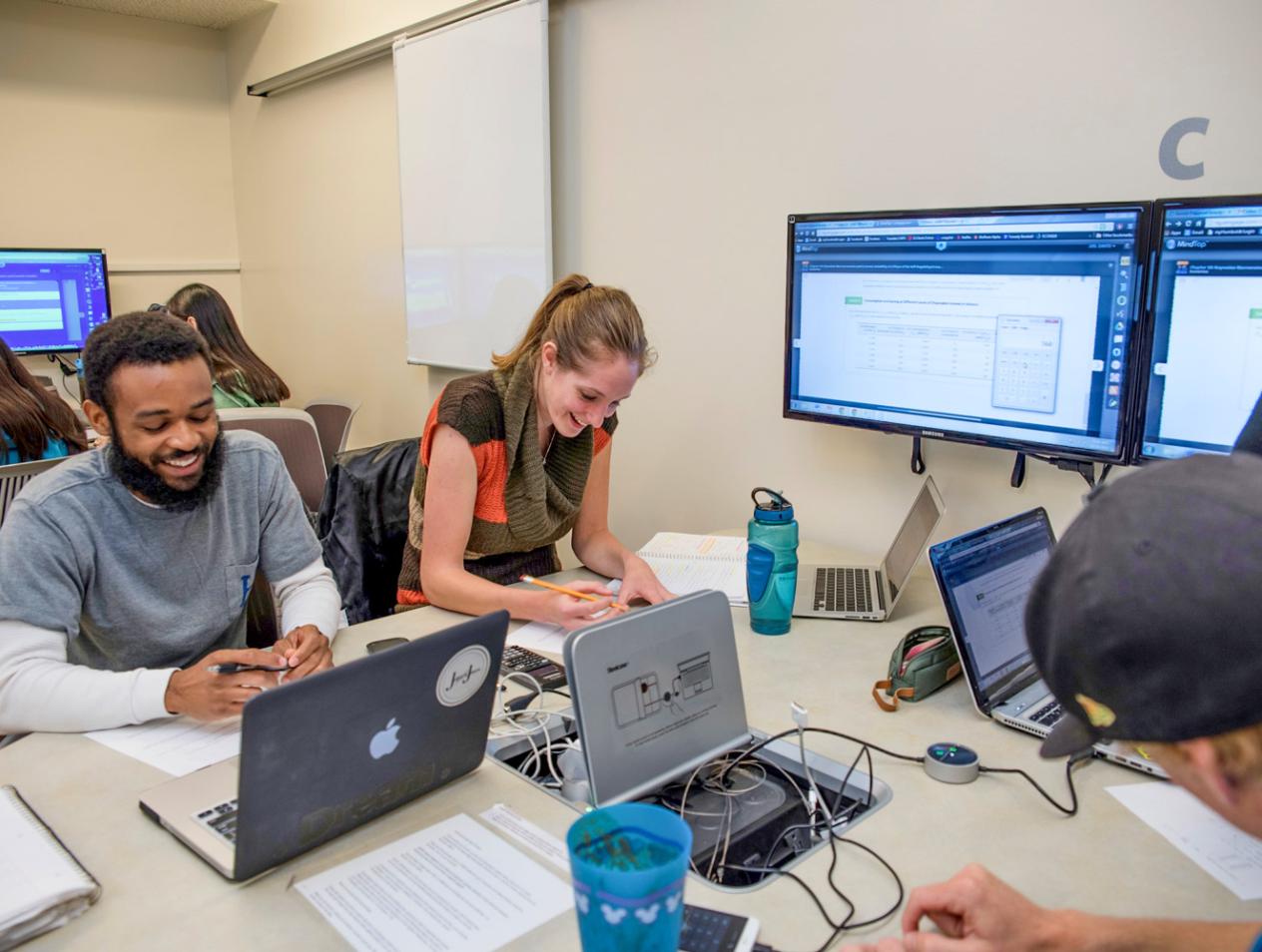
Data Science Track: Learn programming, databases, and how to work with large datasets
Mathematics Track: Strong preparation for graduate school and advanced economic theory
GIS Track: Apply economics using geographic and spatial data analysis
What You'll Learn
- Economic Foundations
Understand how markets work, how economic decisions are made, and how policy impacts the economy - Data & Statistics
Learn regression analysis, statistical modeling, and how to interpret real-world data - Technical Skills
Develop experience with programming (R or Python), data visualization, and working with datasets
Environmental & Sustainability Economics
Apply economics to environmental challenges
- Learn how economic tools can be used to address climate change, resource use, and sustainability. This pathway prepares students for careers in policy, consulting, and environmental planning.
- Embed an Environmental/Sustainability oriented minor into your Economics degree. Common minors include:
Environmental Policy: Explore environmental regulation, law, and public policy
Sustainability: Study sustainable systems, energy, and environmental solutions
Environmental and Natural Resources Planning: Examine land use, development, and environmental design
What You'll Learn
- Environmental Economics
Analyze ecosystem services, market failures, & sustainable resource allocation using environmental economics tools - Policy & Analysis
Evaluate policies, regulations, and trade-offs in sustainable decision making - Data & Decision-Making
Use cost-benefit analysis and data to solve environmental problems
General Economics
Economists solve critical problems
- Learn how to solve real-world problems using economics. This pathway prepares students for a wide range of careers.
- Take seven economics electives
Explore sustainability in classes like Economics of a Sustainable Society
Analyze development in classes like Economics of the Developing World
Examine entrepreneurship & small business development in our Service-Learning course
Study finance in classes like Financial Institutions and Capital Markets
What You’ll Learn
- Economic Foundations
Understand how markets work, how economic decisions are made, and how policy impacts the economy - Broad Range of Economics Electives
Learn about development, sustainability, financial institutions, history, etc. - Real-World Analysis
Apply economic tools to analyze a wide variety of real-world issues and decisions
Interdisciplinary Economics
Combine economics with your passion
- Learn how economics interacts with other academic fields. Students with an interest in interdisciplinary learning have the flexibility to choose their own learning path. For example:
Minor (or double major) in Business: focus on finance, marketing, accounting, or prep for MBA
Minor in International Studies: focus on int’l business, policy/advocacy, or do a study abroad
Minor (or double major) in History: prep for careers in law, diplomacy, journalism, or secondary education
Minor (or double major) in Political Science: prep for careers in government/public affairs, non-profit organizations, diplomacy, or law
What You’ll Learn
- Economic Foundations
Understand how markets work, how economic decisions are made, and how policy impacts the economy - Synergies with a Related Discipline
Choose secondary fields from business, political science, international studies, history, etc. - Applied Problem-Solving
Connect economics to real-world social, historical, political, and/or international challenges
Skills You’ll Graduate With
In addition to general skills like communication, critical thinking, and problem-solving, graduates will acquire specific skills related to each emphasis.
Applied & Quantitative Economics
- Data analysis
- Economic forecasting
- Data visualization
- Statistical modeling
Environmental & Sustainability Economics
- Environmental analysis
- Energy analysis
- Cost-benefit analysis
General Economics
- Market analysis
- Policy evaluation
- Strategic thinking
Interdisciplinary Economics
- Interdisciplinary connections
- Market analysis
- Policy evaluation
Reasons to Choose a Path
Applied & Quantitative Economics
- High-demand, high-paying careers
- Combines economics with real-world data
- Strong data and analytical skillset
- Excellent preparation for graduate school
Environmental & Sustainability
- Real-world environmental impact
- Combine economics with sustainability
- Strong policy and government career paths
- Focus on climate and resource challenges
General Economics
- Classic economics curriculum
- Explore multiple areas of economics
- Prepare for a wide range of careers
- Excellent preparation for graduate school
Interdisciplinary Economics
- Flexible and customizable degree
- Embed a minor into your economics degree
- Apply economics across disciplines
- Strong preparation for diverse careers
Did you know?
“The Short Run" newsletter was first created by senior capstone students over ten years ago. Alumni, students, and faculty loved reading it so much that we continue to produce it today. Students who write newsletters gain valuable experience in designing and editing a professional publication. Plus, it's fun!
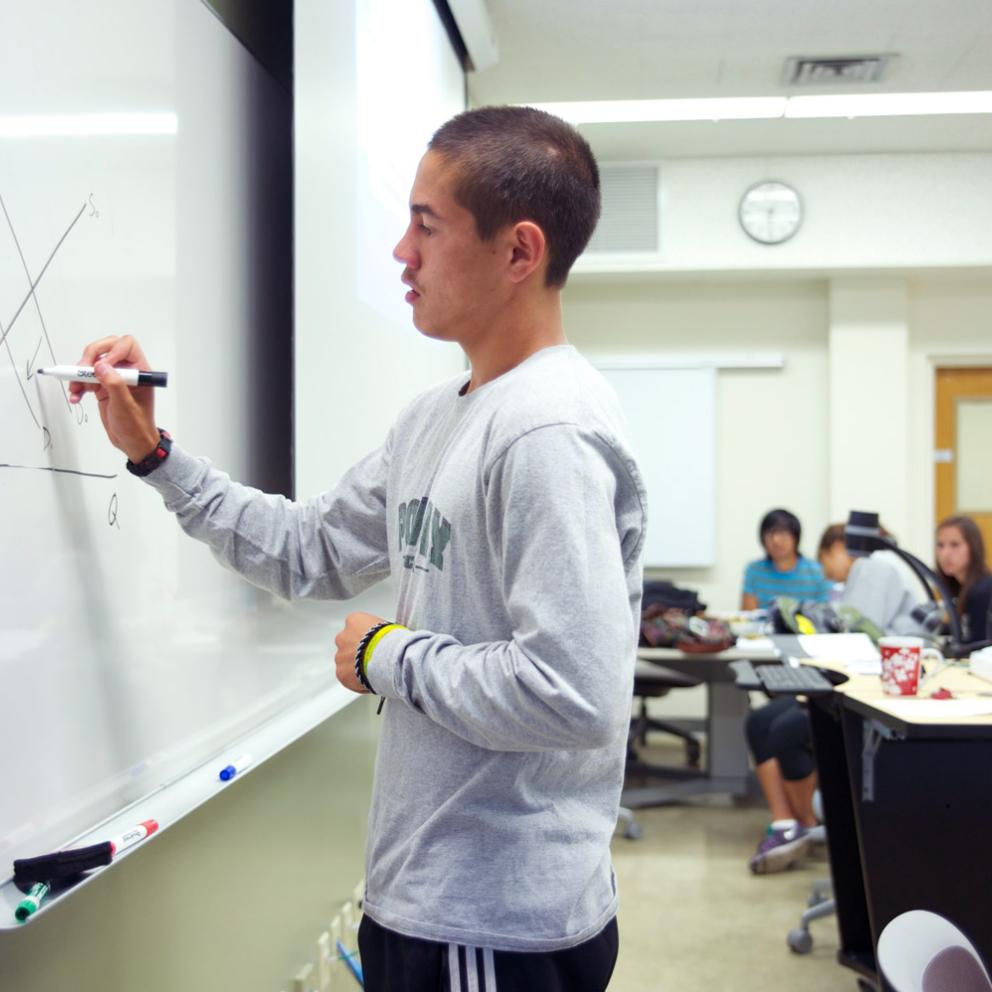
There are lots of hands-on opportunities for Cal Poly Humboldt Economics students outside of the classroom. Some students become Student Instructors and gain concrete teaching experience while helping other students succeed.
One of the best-known, ongoing, community-based research projects at Humboldt is the Humboldt Economic Index. Students gather local business data and provide analysis in a report published online each month. Working on the Index gives students invaluable experience. Plus, the positions are paid!
Careers
Economics majors are in demand everywhere and get among the very highest starting salaries. Economics teaches you skills you can use every day and in every job. It's sometimes difficult for students to imagine what they can do with an Economics degree—that's because Economics majors are hired everywhere! You'll find our recent graduates working in tech, as environmental consultants, at banks, in investment and wealth management, for state and local government, as utility analysts and city planners, and running their own businesses.