




Breadcrumb
Computing & Sustainability
Cal Poly Humboldt encourages the campus community to consider the social, environmental and ethical implications of computing practices, including the use of Artificial Intelligence (AI).
"A.I. is neither artificial nor intelligent. Rather, artificial intelligence is both embodied and material, made from natural resources, fuel, human labor, infrastructures, logistics, histories and classifications."
Crawford, K. (2021). Atlas of AI. Yale University Press
The content of this webpage was last updated in May 2026. The computing and AI landscapes are constantly evolving. If you see something out of date or missing, please use the comment form at the bottom of the page.
[No AI was used to develop this resource]
Meta's Hyperion AI data center is 4 times the size of Central Park in New York City (Source: Consumer Reports 2026, link).
Gallons of water consumed each day by a large data center, equivalent to the water use of a town of 10 - 50,000 people (Source: EESI 2025, link)
Percentage of all of Virginia's electricity consumption in 2024 that was by data centers in that state (Source: Consumer Reports 2026, link).
Metric tons of e-waste generated by AI hardware by 2030 (Source: Scientific American 2024, link)
Why is the Impact so Large? Data Centers!
Data centers are built for purposes like cloud storage for work documents or streaming videos. Certain data centers are built specifically for training, deploying and delivering AI services. Data centers are massive buildings that house the IT infrastructure (GPU's and servers) for running, delivering and storing data. AI - and its need for lots of data - is driving much of the growth in the number and size of data centers. See below for more information on data centers and their environmental/social impacts:
Massive Energy Consumption:
- Data center campuses are getting bigger and bigger, up to 100,000-250,000 square feet, or roughly 2-4 football fields. It’s not uncommon for them to house 100,000 servers. A typical data center consumes as much electricity as 100,000 households, but the largest ones under construction today will consume 20 times as much (IEA, Energy and AI 2025 [link]).
- As of 2026 U.S. data centers use 176 terawatt hours (TWh) per year — enough to power 16 million homes. Global electricity consumption from data centers is more than 415 TWh, and is expected to exceed 945 TWh by 2045. (IEA).
- U.S. data centers currently consume 4-5% of total U.S. electricity, and by 2030 their energy demand is expected to more than double (Rebecca Leppert, Pew Research Center 2025 [link]).
- Why do data centers consume so much energy? A lot of it has to do with cooling - keeping the servers cool enough to operate. 40% of data center energy consumption goes to cooling.
Massive Water Consumption:
- When we talk about a data center's water footprint, about ⅓ of it goes to evaporative cooling, and the other ⅔ is indirect usage from electricity generation.
- Data centers could consume more than a trillion liters annually by 2028. That’s the annual per capita consumption of almost 2.5 million people in the U.S., or more than the entire population of Uganda (WHO/UNICEF, JMP 2023 for Water Supply, Sanitation and Hygiene [link]).
- And more and more of these campuses are being constructed in water stressed areas. For example, outside of Reno, Nevada, the nation’s driest state, a new data center campus is being constructed that will have a larger water footprint than the city next door. Nevada already has 60 data centers, and at least a dozen more are planned in the coming years (Kaleb Roedel, NPR, Dec 2025 [link]).
- Some companies are trying to use less water-intensive methods for cooling, such as closed-loop water systems (which require more electricity), and recycled or reclaimed water. But much of this water still evaporates and does not get discharged back into rivers and streams. Washington, DC, for example will still lose water supply if Northern Virginia data centers use recycled or reclaimed water, because that water won't make it back into the Potomac River [Jon Gorey, Data Drain: The Land and Water Impacts of the AI Boom, Lincoln Institute of Land Policy, Oct 2025 [link]).
Massive Carbon Emissions driving Climate Change:
- Using renewable energy to power data centers can help, but it is not sufficient to meet data center power needs. This is why we are seeing new, giant fossil fuel power plants coming online and a resurgence in nuclear power. For example, Google is planning a gas-fired power plant for one of its data centers in Texas that could generate up to 4.5 million tons of carbon dioxide annually, more than the city of San Francisco (Dara Kerr, The Guardian, Apr 2026 [link]).
- The embodied carbon from constructing data centers is often goes unreported. Data centers can have 10-50x the energy consumption per square foot of a typical commercial building (DOE [link]).
- At a time when we are reaching global climate tipping points, and climate-driven disasters like droughts are exacerbating a global water crisis, there is a growing concern that society should be focused on reducing emissions.
Electronic Waste
- Data center hardware like GPUs (graphic processing units) and servers become e-waste when disposed of in a manner not for reuse.
- E-waste includes hazardous materials, like lead and mercury (both neurotoxicants), contaminating air, water and soil when improperly discarded.
- We are not doing a good job of recycling e-waste. 78% of global e-waste winds up in landfills or unofficial recycling sites, where laborers risk their health to scavenge rare earth metals (UNITAR, Global E-Waste Monitor 2024, [link]).
- Electronic Waste is increasing roughly 2.6 million metric tons annually, five times faster than e-waste recycling (UNITAR).
- Only 1% of rare earth element demand is met by e-waste recycling, meaning we are destroying more land, communities and biodiversity to mine it (UNITAR).
- By 2030, it is estimated that generative AI hardware alone could add 2-5 million metric tons of e-waste (Saima Iqbal, Scientific American, Nov 2024 [link].
Climate Justice and Data Centers
- 1 in 4 people on the planet live without access to safe drinking water (WHO/UNICEF Joint Monitoring Program 2025 [link] ). Data centers are being built in water stressed areas around the world, exacerbating water scarcity for the most vulnerable (Miguel Yañez-Barnuevo, Data Centers and Water Consumption, EESI 2025 [link]).
- 2.5 billion people (⅓ of global population) lack internet access so will never directly benefit from computing and AI (World Economic Forum 2024 [link]), yet they may have to deal with its consequences, like water shortages.
- Local utility grids are strained under the stress of new data centers, driving up energy costs and causing energy insecurity (Nicole Greenfield, AI Data Centers: Big Tech's Impact on Electric Bills, Water and More, Consumer Reports 2026 [link]).
- Is AI leading to the marginalization of human labor? In some cases it may lead to the replacement of human workers, and in others it may lead to the theft or misattribution of human output.
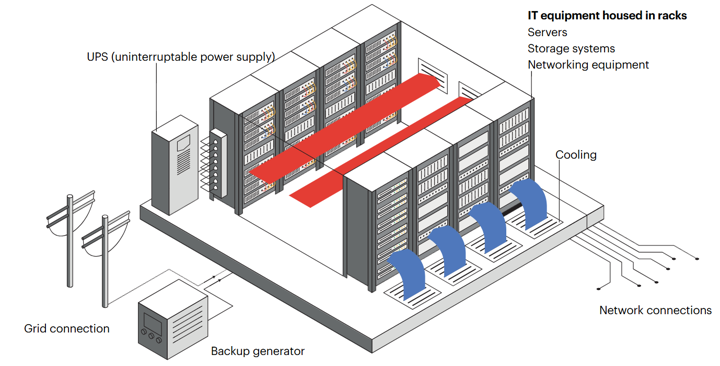
Data Center Graphic. Source: IEA (2025), Energy and AI, IEA, Paris, License: CC BY 4.0 [link]
The term Artificial intelligence (AI) is used to describe machine-based systems that can carry out complex tasks, make predictions, deliver a range of outputs, and otherwise make decisions that influence real or virtual environments, including human behavior and decision making. These systems analyze vast datasets, recognize patterns and make predictions and decisions, or generate output like art, music, or essays, with unprecedented speed.
Generative Artificial Intelligence, or Generative AI, is a class of computer algorithms able to create digital content – including text, images, video, music and computer code. These work by deriving patterns from large sets of training data that become encoded into predictive mathematical models, a process commonly referred to as ‘learning’. Generative AI models do not keep a copy of the data they were trained on, but rather generate novel content entirely from the patterns they encode. People can then use interfaces like ChatGPT to input prompts – typically instructions in plain language – to make generative AI models that produce new content.
Learn more about AI at the Center for Teaching & Learning's Generative AI Tool Hub
Responsible computing means considering the resource intensity (e.g., energy, water, and waste streams) of online activities like streaming or Generative AI use and making intentional choices when using them.
Computational tools like AI, when used responsibly and under the appropriate circumstances, can do good for humanity. The issue isn't with the tool per se, but how it is generated and how it is used.
AI isn't some magical thing on the internet or 'In the Cloud'. It takes hardware, energy, water, land, human labor and other tangibles to generate the AI tools we see on our devices.
Consider these practical strategies when using Generative AI:
- “Think twice, type once”: Write specific prompts that are less likely to require follow-ups. Use precise, direct language instead of vague questions to avoid long, rambling answers from the AI tool and inefficient back and forth chats. Also, you can
- Tell it to give you its response in bullet points
- Use phrases like 'keep it brief'
- Break complex tasks into steps and set explicit output limits to avoid long responses
- Combine related queries at the outset to avoid repeated context-building, which consumes additional compute
- Input previous results (e.g., by uploading a file) instead of repeating the same query anew
- “Slow the slop”: AI should enhance effort, not replace it. Weigh whether you are using Generative AI to support your work or whether it might be considered “AI slop” and unrelated to your research, studies or work.
- "Text over images": Studies show that generating images, videos, and other media with AI are more resource-intensive than simpler text-based tasks.
- “The right tool for the job”: While AI can be an excellent tool for many complex tasks, consider whether your task or question might be simple enough to effectively and efficiently accomplish by other means.
- "Narrow vs General": While general AI platforms like ChatGPT may have multi-task functionality, they can consume far more energy and water than AI platforms designed for specific tasks.
- An example of a narrow AI model is Grammarly for proofreading.
- An example of a narrow AI model is Grammarly for proofreading.
Sometimes you can get what you need by simply calling a colleague, meeting in person or doing a traditional web search. Thinking critically about when stream content, host a video meeting or use Generative AI can help sharpen our skills, boost mental health and improve our productivity.
Questions to Ask Yourself before turning to AI:
- What is the reason for turning to AI? Is it to save time? Is it something I could do myself? Is it essential to my health, education/work or society, or is is it frivolous or for fun?
- What will I miss out on if I remove myself from the process and ask a machine to do it for me?
- What are the pros/cons of using AI in this instance? are the energy/water/labor harms that will come from it worthwhile?
- is this something that can be solved another way? what other efforts have been taken to get the information for which you are prompting (have you tried all other avenues?)
Other Things You Can Do:
- Talk to a human
- Librarians are available 24/7 to help you with research, projects and other needs! Drop in to the Research Help Desk, go to the library during regular hours or try their 24/7 chat service!
- If you need counseling or mental health support, please contact Counseling & Psychological Services.
- Hold meetings in person whenever possible instead of videoconferencing.
- Use non-AI tools for art/design projects
- Draw or take your own photos
- Collaborate with people who have different skills than you
- Check out sites like Smithsonian Open Access and Unsplash for image sources
- Join a non-digital community
- Get involved with one of the many clubs and student organizations on campus! This is a great way to share experiences, make friends, form study groups, plan community service projects, and develop professional skills.
- Disconnect and go outside!
- Touch grass!

Pool Balls by Bug Devoll (2024)
For gathering information and other simple requests, you can use an internet search engine instead of an AI tool.
Google automatically generates AI responses, even if you do not want or need them, unless you use a different search engine or change your settings. Here's are some things you can do:
- Try using other search engines like Marginalia, Mojeek (which currently does not include an AI feature), Ecosia (which plants trees and restores biodiversity around the world), or DuckDuckGo for AI-free searches.
- Use '-AI' in your Google search query to eliminate AI Overviews. In the search bar, type your search term (e.g., "how to prune peach tree"), adding the '-AI' modifier at the end so that it reads "how to prune peach tree -AI".
Turn off Gemini in Gmail, Google Docs, Photos, Chrome, and more
- Go to Gmail and log in with your Google account.
- Click on the Settings cog (gear icon).
- Click on "See all Settings."
- Under the General tab, scroll down until you see "Google Workspace smart features."
- Click "Manage Workspace smart feature settings." This will open controls for Google's smart features.
- Disable the "Smart features in Google Workspace." This prevents Gemini from summarizing content, creating drafts, etc. Then click 'Save'.
- The Gemini icon may still appear, but but if you click on it Google will ask you to turn smart features back on to enable Gemini.
Cal Poly Humboldt's Center for Teaching and Learning offers resources and guidelines to help faculty address artificial intelligence in their courses.
AI Resources for Syllabi and Instruction >>>
The CSU has published guidelines for faculty on AI in instruction.
Guidelines for Faculty Regarding AI in Instruction>>>
AI does have the potential to optimize many of the things modern society depends on, which could lead to emissions reductions and climate protection. For example, machine learning models are being used for the following:
- Methane emissions reductions in oil and gas operations – a large source of this sector’s methane emissions come from leaks; AI could potentially facilitate detection so that repairs can happen sooner, for example through better identification using satellite monitoring systems.*
- Transport emissions reductions through more efficient vehicle operations and utilization; for example, improved route choice or driving characteristics could lead to efficiency gains of 5-10%.*
- Buildings emissions reductions by optimizing energy consumption in buildings equipped with management systems; for example, an optimized heating, ventilation and air conditioning control could save around 10% in energy consumption.*
- Climate disaster predictions to better prepare governments, communities and businesses before a climate disaster hits.^
- Reforestation by pairing AI with drones to disperse seed in hard-to-reach areas.^
- Ocean Plastics cleanup using AI to detect ocean litter.^
- Assisting in medical diagnoses. Large language models scanning medical records can lead to greater accuracy at diagnosing patients, reducing uneccesary treatments and waste.'
- Conservation of species in decline. For example, Project CETI is using advanced machine learning to listen to and translate the communication of sperm whales, helping scientists identify protection strategies.+
*Source: IEA (2025), Energy and AI, IEA, Paris, License: CC BY 4.0
^Source: Victoria Masterson, 9 ways AI is helping tackle climate change, World Economic Forum 2024
'Source: Peter G. Brodeur, et. al (25). Performance of a large language model on the reasoning tasks of a physician, Science Vol 392, Issue 6797 April 2026
+Source: Project CETI, www.projectceti.org
AI Ethics: Issues that should be considered by governments and corporations to ensure that AI is developed and used responsibly, such as safety, security, bias and environmental impacts.
Algorithm: set of instructions or rules to follow in order to complete a specific task. Algorithms are used to organize or analyze data, and to make predictions or build models.
Big Data: Massive amounts of complex data (large data sets) collected and analyzed to identify patterns and trends.
Chatbot: a software application that is designed to imitate human conversation through text or voice commands.
Data Mining: Refined data analytics to identify key patterns and to glean insights.
Deep Learning: Machine learning technique utilizing artificial neural networks.
Extractivism: The removal of natural resources for profit without consideration for long-term environmental or social consequences.
Generative AI: Systems that are trained using vast amounts of data to find patterns for generating new content. Generative AI is used to create text, video, code, and images.
Hallucination: False information that is presented as fact by the AI system.
Large Language Model (LLM): AI model that has been trained on vast amounts of text. These work by forecasting word sequences, and are able to hold dialogues, write prose, and scrutinize enormous amounts of text from the internet.
Machine Learning: algorithms and models that help machines learn from data to predict behaviors and trends and to make classifications.
Prompt: An input that a user enters into an AI system to seek a desired output or result.
Token: Unit of text (entire word or parts of a word) used by an LLM to understand and generate language.
Training Data: Information fed into an AI system to enable it to find patterns and create new content.
Are you interested in learning more about the intersection of computing and sustainability? The Appropriate Computing Discussion Group meets weekly to better understand how tools like AI work, to study their effects on society and the environment, and to collaborate on projects that use these powerful tools responsibly in agriculture, environmental studies, medicine, and other areas. To learn more about the group, click on the link below:
https://sites.google.com/humboldt.edu/acdg
Please share any questions, comments or feedback you have on AI and/or the resources in this webpage:
AI & Sustainability Comment Form >>>