



Breadcrumb
Slice of AI & Pie
Conversations with AI: A CTL and Library Monthly Series
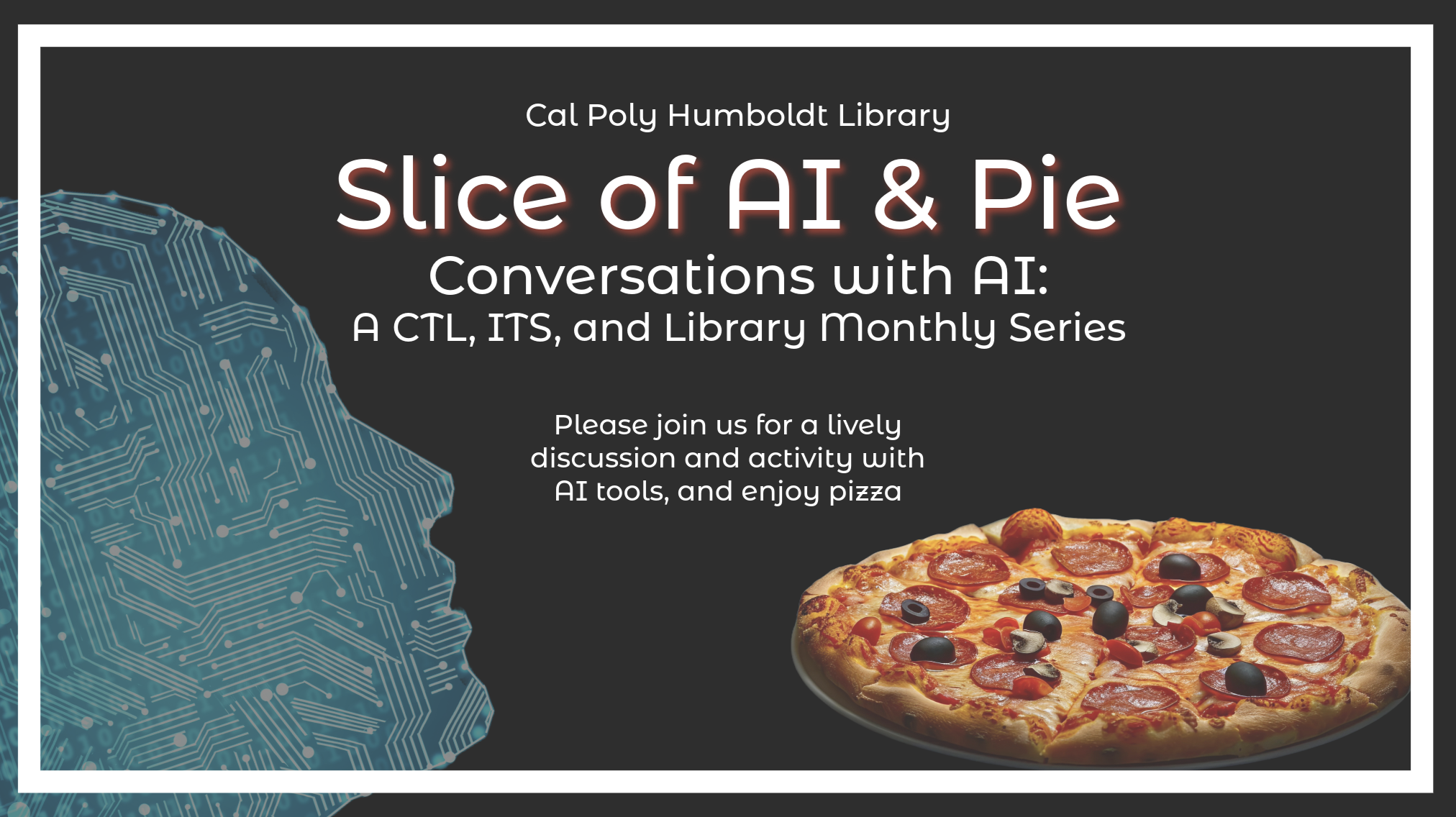
Join us for this lively discussion about artificial intelligence in Higher Education.
We see great interest in utilizing Artificial Intelligence (AI) tools for various purposes with promises to transform work, while also raising many ethical concerns and questions. The Library and Center for Teaching & Learning organizes A Slice of AI & Pie to explore and discuss artificial intelligence in Higher Education. This lively pizza lunchtime discussion serves an AI tool once a month, to explore, discuss, and evaluate. Together, we will participate in shaping this monthly series, create space for community conversations about AI to develop a better understanding of AI, and effectively leverage AI tools. Everyone is welcome to participate in learning more about AI in higher education, and exploring possibilities for co-curricular and curricular activities, learning and tutoring, research and scholarship, and services, as well as understanding the ethical, equity, and academic integrity implications of AI in higher education.
Our goal is to explore artificial intelligence tools while also providing a broader context to understand the various forms and foundations… AI is not one thing, it’s a large landscape covering; computer vision, deep learning, expert systems, image recognition, machine learning, machine translation, neural networks, predictive analytics, robotics, speech to text & text to speech, text generation, etc. Generative artificial intelligence is a type of web-based AI tool, primarily trained chatbots, that use algorithms, data, and statistical models to reasonably make inferences, create text, image, sound, and other content.
An extensive list of generative AI tools are listed from Center for Teaching & Learning Generative AI Tools and the Dean of Students office maintains a page on Student Rights: AI & Academic Dishonesty.
Up Next!
Past Conversations
Kubernetes on Nautilus
By Brian Campbell & Ravi Chalasani, Cal Poly Humboldt ITS
12pm- 2pm, Library Learning Lab, Library Room 308
Things taking too long on your laptop? Get off your laptop and into the cluster! We will teach you everything you need to know to get started with Kubernetes on Nautilus, the National Research Platform's HyperCluster. No experience required and beginners especially welcome.
Working with AI Partners: How Multi-Agent Systems Can Support Teaching and Learning
By Liang Zhang, Postdoctoral Research Associate at the University of Georgia
12pm- 1pm, Hybrid Scholars Lab, Lib. 302 and Zoom
The rapid rise of generative AI has brought both excitement and concern to higher education, particularly for faculty and students adapting to these new tools in their daily work. Beyond simple chatbots, emerging research highlights the potential of multi-agent AI systems—teams of AI “partners” that collaborate to support essential educational practices such as tutoring, feedback, and assessment. This keynote explores how multi-agent AI agents, powered by large language models (LLMs), can enhance teaching excellence while addressing the needs of both students and instructors. Drawing on case studies, I will demonstrate how AI agents can (1) co-design multimodal lesson materials in physics, combining text explanations with automatically generated images to clarify misconceptions; (2) engage in peer-style dialogue to model collaborative problem solving in mathematics, where improving accuracy is fundamental for reliable assessment; and (3) participate in trialogue systems that enable conversation-based evaluations of student knowledge and skills. Findings from a systematic review of LLM-based AI agents in education will also be shared, highlighting both promising opportunities and ongoing challenges related to evaluation, equity, and ethics. For educators, the message is clear: AI agents should not replace human teachers or diminish human faculty expertise. Instead, when thoughtfully integrated, they can serve as trusted partners that save time, enrich pedagogy, support student learning, and reimagine what teaching excellence can look like in the age of AI.
Google Gemini & NotebookLM AI Tools
By Anne Goldmann, West Region Manager
12:00pm, Scholars Lab, Lib. 302
A believer that Technology (AI) is the Future; With it we can do so much more!
By Kal El, Environmental Science Management Student, Entrepreneur and Creator
12:30pm, Library Learning Lab, Lib. 308
AI & the Climate Impact
By Alana Chin, Assistant Professor of Plant Physiology Cal Poly Humboldt - Read Alana's full bio here.
12pm - 1pm, Library Learning Lab, Lib. 308
In this session, we discussed choosing methods in machine learning to minimize computational complexity for greener modeling. How do we get the job done with the smallest footprint? Our choices in machine learning have real world implications for resource use. A discussion of machine learning in biological sciences and how we can optimize our methods to minimize climate impact. We talked through the wide range of ML choices in biology and how to pick based on functionality and minimalist approaches.
Co-Pilot, Microsoft AI services available to campus
By Cade Webb, Acting CIO, Dr. Enoch Hale, & Cyril Oberlander
12:30pm - 1:30pm, Library Learning Lab, Lib. 308
Co-Pilot, Microsoft AI services available to campus
By Cade Webb, Acting CIO, Dr. Enoch Hale, & Cyril Oberlander
4pm - 5pm, Library Learning Lab, Lib. 308
Reading Critically with AI (While Reading AI Critically)
By Dr. Jessica Citti, Dr. Enoch Hale, & Cyril Oberlander
Noon - 1pm, Library Learning Lab, Lib. 308
Generative AI Tools for Reading Scholarly Articles (Supplemental document)
Inaugural Slice of AI & Pie
By Dr. Enoch Hale & Dean Cyril Oberlander
Noon - 1pm, Library Learning Lab, Lib. 308