

Breadcrumb
Ghvtlh-k’vsh shu'-srnelh-'i (Kelp Guardians)
How to Say Ghvtlh-k'vsh shu'-srnelh-'i~ in the Tolowa Dee-ni’ Wee-ya' (Language)
![How to Say Ghvtlh-k'vsh shu'-srnelh-'i~ in the Tolowa Dee-ni’ Wee-ya' (Language) (image has artwork, QR code [link to QR code below] and FSL logo with the Great Seal of the Tolowa Dee-Ni' Nation)](/sites/default/files/food-sovereignty/2025-08/How%20to%20Say%20Ghvtlh-k%26%23039%3Bvsh%20shu%26%23039%3B-srnelh-%26%23039%3Bi~%20in%20the%20Tolowa%20Dee-ni%E2%80%99%20Wee-ya%26%23039%3B%20%28Language%29.jpg)
Spoken by Loren Me'lash-ne Bommelyn
Project Number: R/HCEOPC-44
Project Date Range: 2024-02 - 2026-01
Funding Agency: California Ocean Protection Council (OPC), National Oceanic and Atmospheric Administration (NOAA)
Focus Area(s): Healthy Coastal Ecosystems
PROJECT HIGHLIGHT
The recent decline of California's ghvtlh-k'vsh (kelp) forests directly affects the cultural lifeways and, thus, health of the Tolowa Dee-ni' Nation, prompting this project to train and certify up to ten Natural Resources Staff and Tribal Citizens to conduct kelp monitoring and restoration efforts.
PROJECT SUMMARY
The Ghvtlh-k'vsh shu'-srnelh-'i~ (Kelp Guardians) project represents a collaboration between the Tolowa Dee-ni' Nation (TDN) and three key partners: Reef Check Foundation, Sunken Seaweed and the Rou Dalagurr Food Sovereignty Lab and Traditional Ecological Knowledges Institute at Cal Poly Humboldt. Ghvtlh-k'vsh (kelp) forests hold profound ecological and cultural significance to the TDN and other coastal Indigenous communities in Northern California. As first stewards of the land and sea since time immemorial, the Nation has been and always will be conservationists grounded in a holistic perspective towards stewardship, restoration and understanding nature's intricate interconnectedness and balance.
This initiative addresses a critical gap, as TDN's Marine Division does not currently have the knowledge or training to monitor and restore ghvtlh-k'vsh forests. The project brings intensive training for TDN Natural Resources staff to acquire critical monitoring skills, such as scientific diving and kelp monitoring protocols. In partnership with Sunken Seaweed, TDN is piloting the use of tumble culture for production of lat (Pyropia spp.) to be used in cultural practices and in fostering tribal food sovereignty. The work also engages Indigenous youth in kelp restoration workshops rooted in community-based participatory methodologies.
The project has already achieved substantial progress across multiple areas. Nine Tolowa citizens have completed Open Water SCUBA certification through Reef Check's Dive into Science program, with more advanced Scientific Diver training planned to develop the Nation's capacity for independent kelp monitoring. Sunken Seaweed has established groundwork for kelp farming and restoration, developing informational materials, conducting site assessments, designing a land-based seaweed farm and submitting permitting paperwork for ocean-based kelp farming in Humboldt Bay. The Food Sovereignty Lab has created a credit-bearing internship program at Cal Poly Humboldt, and community engagement efforts have reached approximately 2,500 people through various outreach activities. These practices can serve as a template for other Indigenous communities seeking to develop culturally relevant kelp forest monitoring and restoration within their ancestral territories, promoting sustained representation of tribal coastal community stakeholders in policy and management of marine resources.
Principal Investigator
Rosa Laucci - Tolowa Dee-ni’ Nation
Co-principal Investigators
Cutcha Risling Baldy - Cal Poly Humboldt
Jan Freiwald - Reef Check Foundation
Torre Poizzi - Sunken Seaweed LLC
Morgan V. Murphy-Cannella - Reef Check Foundation
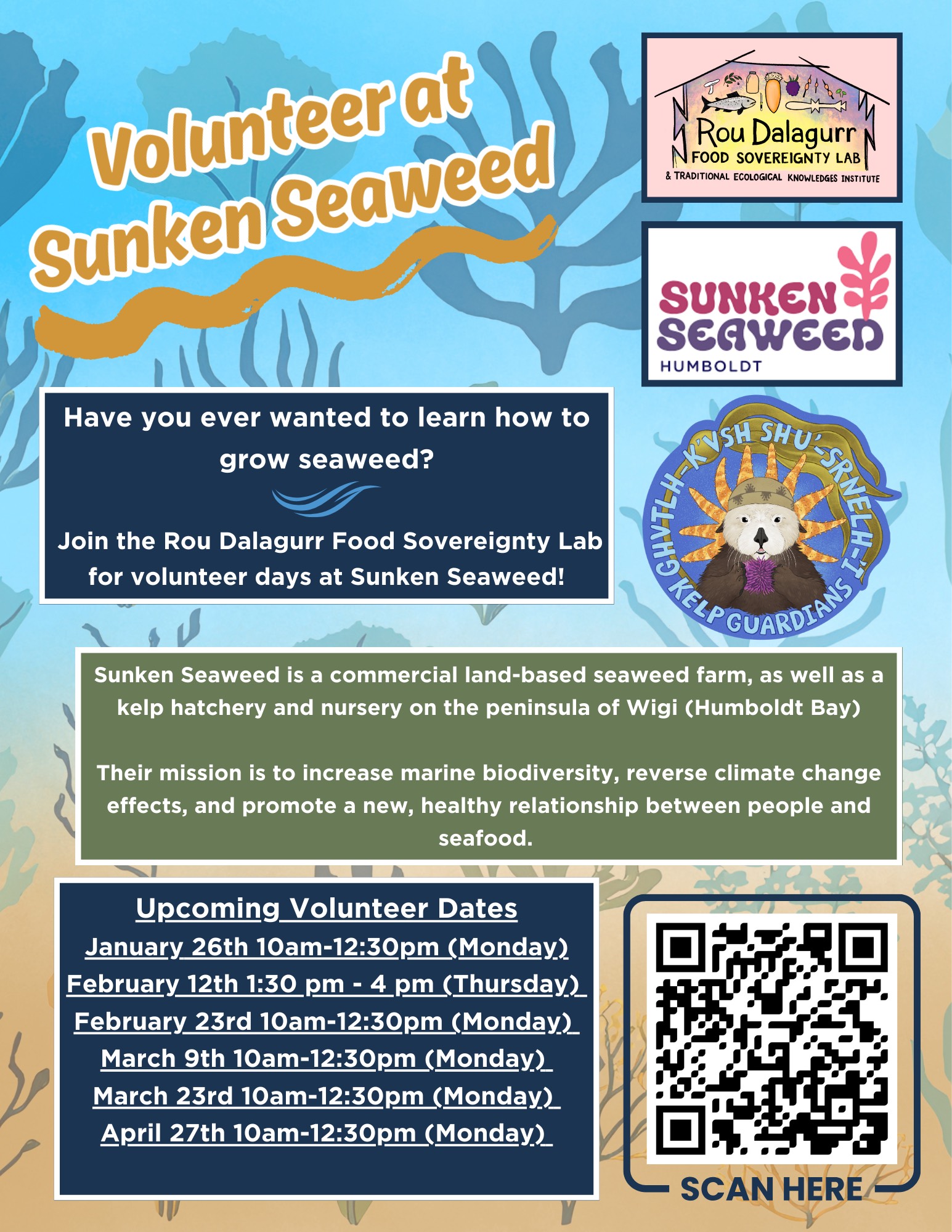
Volunteer at Sunken Seaweed
Have you ever wanted to learn how to grow seaweed? Join the Rou Dalagurr Food Sovereignty Lab for volunteer days at Sunken Seaswed!
Sunken Seaweed is a commercial land-based seaweed farm, as well as a kelp hatchery and nursery on the peninsula of Wigi (Humboldt Bay). Their mission is to increase marine biodiversity, reverse climate change effects, and promote a new, healthy relationship between people and seafood.
Upcoming Volunteer Dates:
- January 26, 2026 (Monday) 10AM-12:30PM
- February 12, 2026 (Thursday) 1:30PM-4PM
- February 23, 2026 (Monday) 10AM-12:30PM
- March 9, 2026 (Monday) 10AM-12:30PM
- March 23, 2026 (Monday) 10AM-12:30PM
- April 27, 2026 (Monday) 10AM-12:30PM
See link for sign up form!
Community Recipes
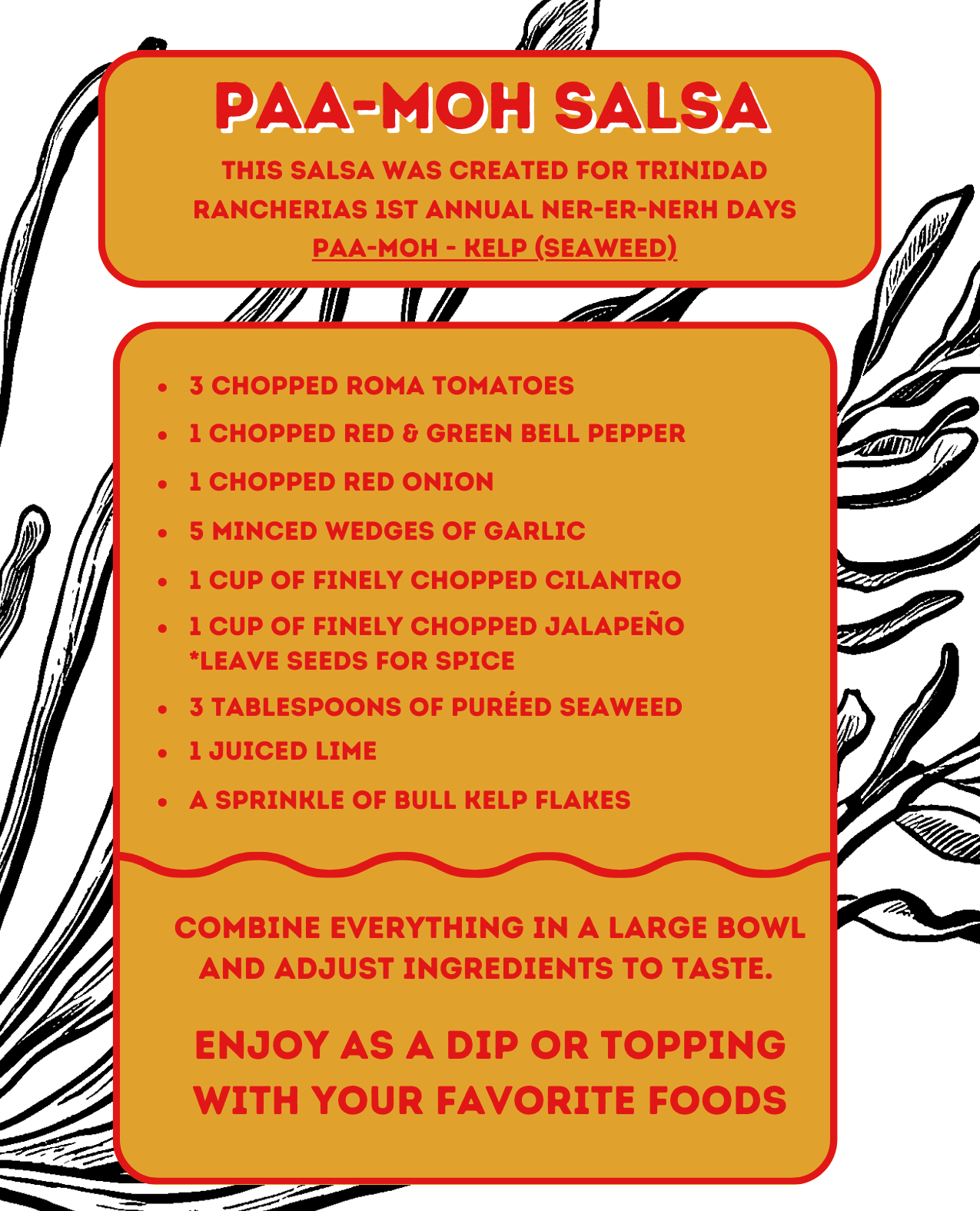
This Salsa was Created for Trinidad
Rancherias 1st Annual Ner-er-nerh Days
Paa-moh - kelp (seaweed)
- 1 cup of finely chopped cilantro
- 3 chopped roma tomatoes
- 1 chopped red & Green Bell pepper
- 1 Chopped Red onion
- 5 minced wedges of garlic
- 1 cup of finely chopped jalapeño
*Leave seeds for spice - 3 Tablespoons of puréed Seaweed
- 1 juiced lime
- A sprinkle of Bull kelp flakes
Combine everything in a large bowl
and adjust ingredients to taste.
Enjoy as a dip or topping
with your favorite foods!
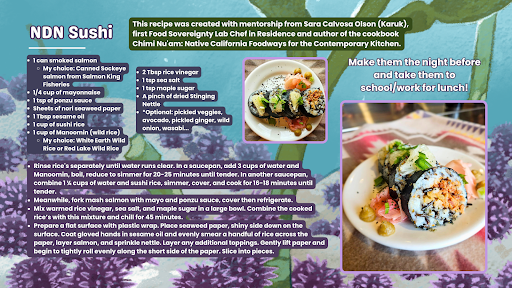
This recipe was created with mentorship from Sara Calvosa Olson (Karuk), first Food Sovereignty Lab Chef in Residence and author of the cookbook Chími Nu'am: Native California Foodways for the Contemporary Kitchen.
Make them the night before and take them to school/work for lunch!
Ingredients
- 1 can smoked salmon
- My choice: Canned Sockeye salmon from Salmon King Fisheries
- 1/4 cup of mayonnaise
- 1 tsp of ponzu sauce
- Sheets of nori seaweed paper
- 1 Tbsp sesame oil
- 1 cup of sushi rice
- 1 cup of Manoomin (wild rice)
- My choice: White Earth Wild Rice or Red Lake Wild Rice
- 2 Tbsp rice vinegar
- 1 tsp sea salt
- 1 tsp maple sugar
- A pinch of dried Stinging Nettle
- *Optional: pickled veggies, avocado, pickled ginger, wild onion, wasabi…
Instructions
- Rinse rices separately until water runs clear. In a saucepan, add 3 cups of water and Manoomin, boil, reduce to simmer for 20-25 minutes until tender. In another saucepan, combine 1 ¼ cups of water and sushi rice, simmer, cover, and cook for 16-18 minutes until tender.
- Meanwhile, fork mash salmon with mayo and ponzu sauce, cover then refrigerate.
- Mix warmed rice vinegar, sea salt, and maple sugar in a large bowl. Combine the cooked rice with this mixture and chill for 45 minutes.
- Prepare a flat surface with plastic wrap. Place seaweed paper, shiny side down on the surface. Coat gloved hands in sesame oil and evenly smear a handful of rice across the paper, layer salmon, and sprinkle nettle. Layer any additional toppings. Gently lift paper and begin to tightly roll evenly along the short side of the paper. Slice into pieces.
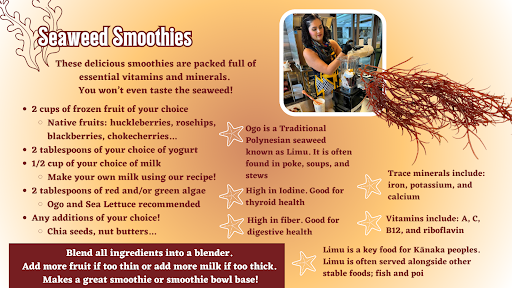
These delicious smoothies are packed full of essential vitamins and minerals.
You won’t even taste the seaweed!
Ingredients
- 2 cups of frozen fruit of your choice
- Native fruits: huckleberries, rosehips, blackberries, chokecherries...
- 2 tablespoons of your choice of yogurt
- 1/2 cup of your choice of milk
- Make your own milk using our recipe!
- 2 tablespoons of red and/or green algae
- Ogo and Sea Lettuce recommended
- Any additions of your choice!
- Chia seeds, nut butters…
Blend all ingredients into a blender. Add more fruit if too thin or add more milk if too thick. Makes a great smoothie or smoothie bowl base!
- Ogo is a Traditional Polynesian seaweed known as Limu. It is often found in poke, soups, and stews
- High in Iodine. Good for thyroid health
- High in fiber. Good for digestive health
- Trace minerals include: iron, potassium, and calcium
- Vitamins include: A, C, B12, and riboflavin
- Limu is a key food for Kānaka peoples. Limu is often served alongside other stable foods; fish and poi
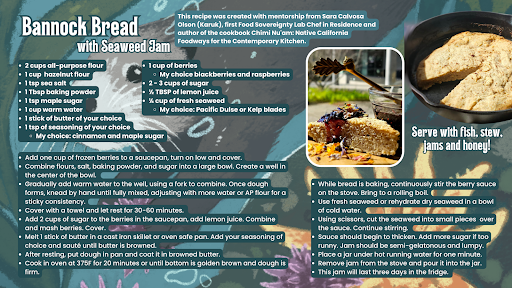
This recipe was created with mentorship from Sara Calvosa Olson (Karuk), first Food Sovereignty Lab Chef in Residence and author of the cookbook Chími Nu'am: Native California Foodways for the Contemporary Kitchen.
Serve with fish, stew, jams and honey!
Ingredients:
- 2 cups all-purpose flour
- 1 cup hazelnut flour
- 1 tsp sea salt
- 1 Tbsp baking powder
- 1 tsp maple sugar
- 1 cup warm water
- 1 stick of butter of your choice
- 1 tsp of seasoning of your choice
- My choice: cinnamon and maple sugar
- 1 cup of berries
- My choice blackberries and raspberries
- 2 - 3 cups of sugar
- ½ TBSP of lemon juice
- ¼ cup of fresh seaweed
- My choice: Pacific Dulse or Kelp blades
Instructions:
- Add one cup of frozen berries to a saucepan, turn on low and cover.
- Combine flours, salt, baking powder, and sugar into a large bowl. Create a well in the center of the bowl.
- Gradually add warm water to the well, using a fork to combine. Once dough forms, knead by hand until fully mixed, adjusting with more water or AP flour for a sticky consistency.
- Cover with a towel and let rest for 30-60 minutes.
- Add 2 cups of sugar to the berries in the saucepan, add lemon juice. Combine and mash berries. Cover.
- Melt 1 stick of butter in a cast iron skillet or oven safe pan. Add your seasoning of choice and sauté until butter is browned.
- After resting, put dough in a pan and coat it in browned butter.
- Cook in the oven at 375F for 20 minutes or until the bottom is golden brown and the dough is firm.
- While bread is baking, continuously stir the berry sauce on the stove. Bring to a rolling boil.
- Use fresh seaweed or rehydrate dry seaweed in a bowl of cold water.
- Using scissors, cut the seaweed into small pieces over the sauce. Continue stirring.
- The sauce should begin to thicken. Add more sugar if too runny. Jam should be semi-gelatinous and lumpy.
- Place a jar under hot running water for one minute.
- Remove jam from the stove and pour it into the jar.
- This jam will last three days in the fridge.
Meet the Kelp Guardian Interns
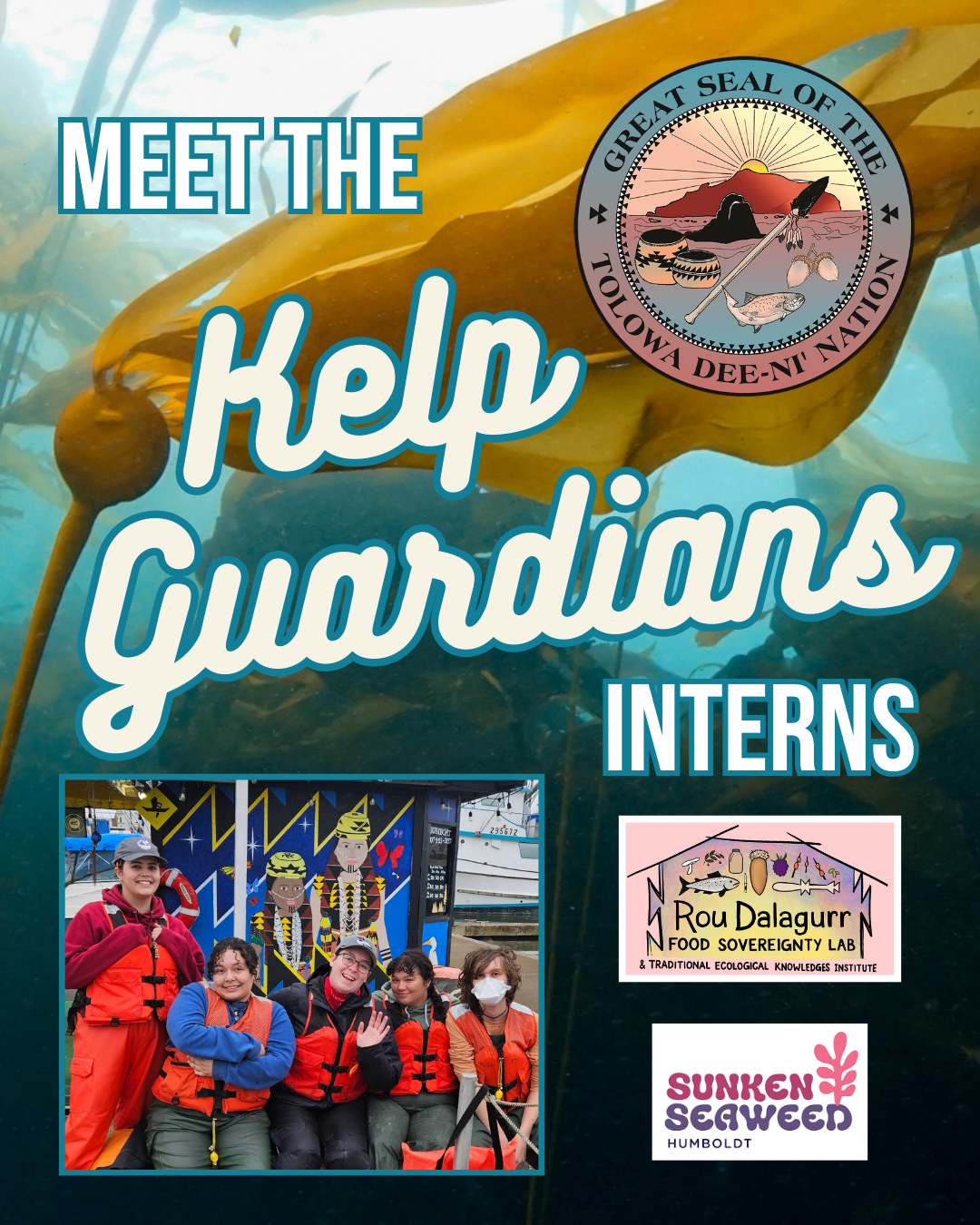
But wait! What is a Kelp Guardian?

Ghvtlh-k’vsh (kelp) forests hold a profound ecological and cultural significance to the Tolowa Dee-ni’ Nation (TDN) and other coastal Indigenous communities in Northern California. As first stewards of the land and sea since time immemorial, the Nation has been and always will be conservationists grounded in a holistic perspective towards stewardship, restoration and understanding nature's intricate interconnectedness and balance.
GHVTLH-K'VSH SHU'-SRNELH-'I~ means Kelp Guardian in the Tolowa Dee-ni’ Language
California's ghvtlh-k'vsh (kelp) forests directly affects the cultural lifeways and, thus, health of the Tolowa Dee-ni' Nation, prompting this project to train and certify up to ten Natural Resources Staff and Tribal Citizens to conduct kelp monitoring and restoration efforts.
To Learn More, Visit www.caseagrant.ucsd.edu
Meet the Interns:
Annette Moulay
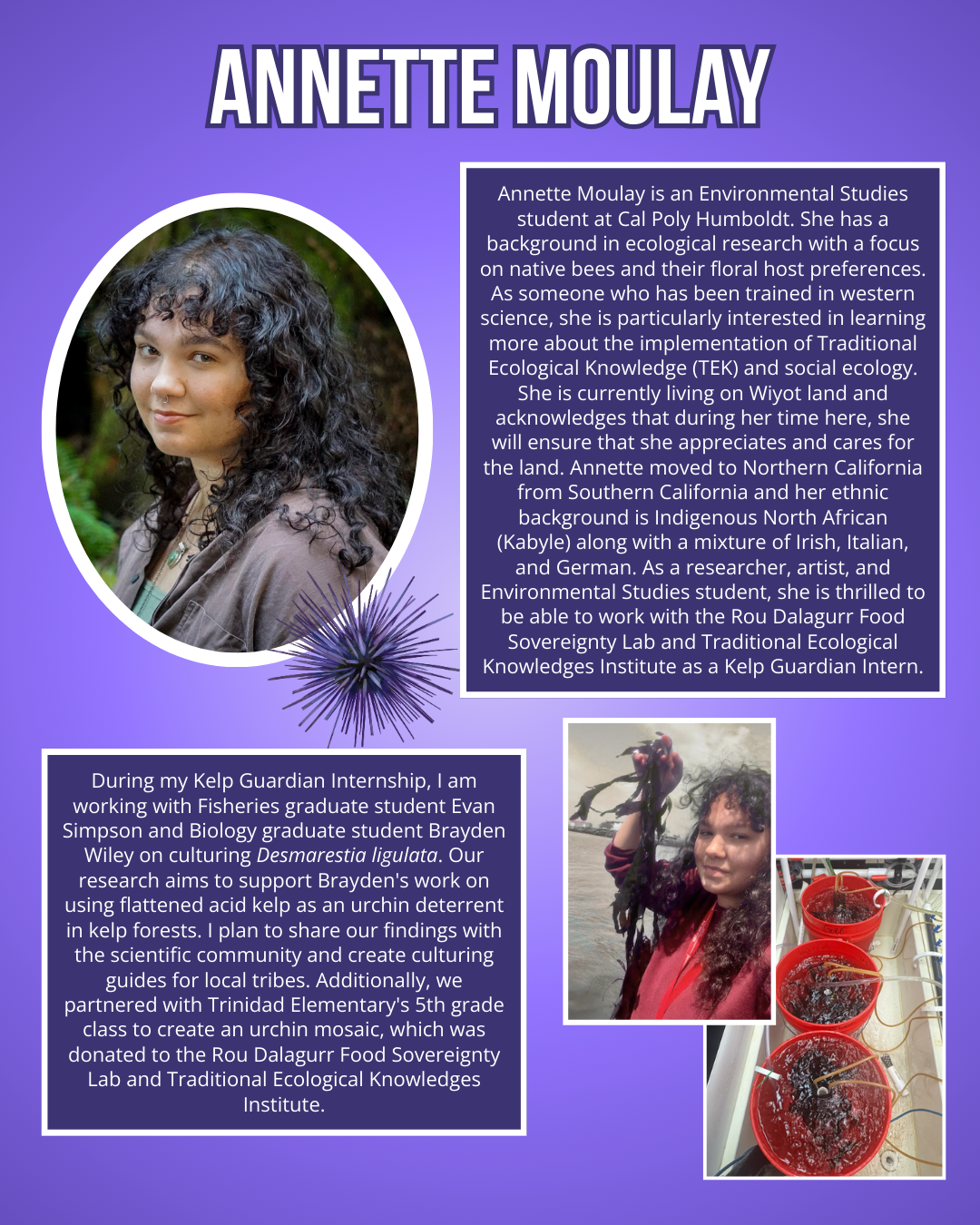
Annette Moulay is an Environmental Studies student at Cal Poly Humboldt. She has a background in ecological research with a focus on native bees and their floral host preferences. As someone who has been trained in western science, she is particularly interested in learning more about the implementation of Traditional Ecological Knowledge (TEK) and social ecology. She is currently living on Wiyot land and acknowledges that during her time here, she will ensure that she appreciates and cares for the land. Annette moved to Northern California from Southern California and her ethnic background is Indigenous North African (Kabyle) along with a mixture of Irish, Italian, and German. As a researcher, artist, and Environmental Studies student, she is thrilled to be able to work with the Rou Dalagurr Food Sovereignty Lab and Traditional Ecological Knowledges Institute as a Kelp Guardian Intern.
During my Kelp Guardian Internship, I am working with Fisheries graduate student Evan Simpson and Biology graduate student Brayden Wiley on culturing Desmarestia ligulata. Our research aims to support Brayden's work on using flattened acid kelp as an urchin deterrent in kelp forests. I plan to share our findings with the scientific community and create culturing guides for local tribes. Additionally, we partnered with Trinidad Elementary's 5th grade class to create an urchin mosaic, which was donated to the Rou Dalagurr Food Sovereignty Lab and Traditional Ecological Knowledges Institute.
Isaac Kinney

Isaac (He/Him/Theirs) (Yurok/Chicano) is a first year graduate student working as a Kelp Guardians intern supporting the Rou Dalagurr Food Sovereignty Lab.
Isaac grew up all his life on the Trinity and Klamath Rivers with the only exception of four years at the University of California Davis; coming home with a degree in Native American Studies. Isaac has experience working in philanthropy, transportation systems and Tribal governance.
Isaac aims to help build local and regional trails for non-motorized travel as well as waterways projects that build resilient infrastructure for climate change adaptation.
Isaac is excited to work on inter-Tribal projects with regional positive impacts.
Roslyn Gilbert

Roslyn Gilbert is a settler in Goudi'ni on stolen Wiyot Land. She is a pathogen realist, and loves to mask and educate others to play her part in protecting her community from deadly and life altering viruses. Roslyn has spent a lot of her time in college studying and learning about the ongoing structures of genocide, and hopes to be able to orient herself against these structures while interning at the FSL by acting as an accomplice to Native people through mutual aid and striving towards food sovereignty.
I am working on a bullkelp tumble culture project at Sunken Seaweed with the intention of making a soral bank. This soral bank will be used to share bullkelp spores and starts with tribes and other local actors engaging in restoration efforts. An important feature of this project is a technique called “crowing”, in which the pneumatocyst/bulb of the bull kelp is cut equatorially to prevent floating in the tumble culture tank. Growing bull kelp in tumble culture can also make its blades available to eat and be shared through the FSL, although it is not a traditional relationship with bull kelp.
Publications & Free Curriculum
Kelp Can Save the World
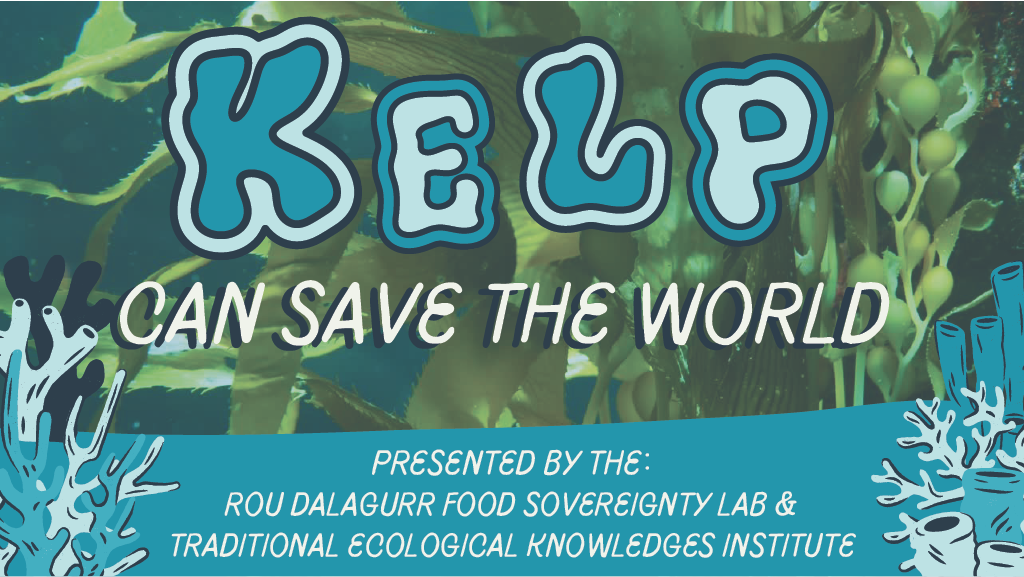
Kelp Can Save the World: Free Curriculum on Kelp and Seaweeds
The Kelp Guardians Project has developed a free curriculum presentation for educators and youth programs in Northwestern California. This slideshow includes youth centered education about the importance of red, green, and brown algae's in the fight against climate change. We at the Food Sovereignty Lab know how important our youth are to the future of our planet and traditions. We know that youth engagement is key to creating long lasting stewardship relations between us and our world. We encourage our community to use this fun and interactive slideshow to teach the next generations of marine stewards. Slideshow includes colorful designs, cute characters, videos, and photos of seaweeds and kelp forest habitats. We have also included an interactive game called “Where’s Larry the Leopard Shark?”. Larry is our adorable leopard shark mascot who makes an appearance in the slideshow. Much like an I Spy activity, educators are encouraged to offer a prize or incentive to whoever can find Larry first. This has been a highly successful way to encourage youth to focus attention and have fun while learning. Just have them yell out “Larry!” when they see him. This is a living curriculum, which means it can be updated. Making it extremely useful for educators to continue to use overtime. The Kelp Guardians Team has presented this at Arcata Elementary and Trinidad Elementary schools with youth ages 6-12 years old. For questions, comments, and feedback on this presentation, please email Delaney (das21@humboldt.edu)
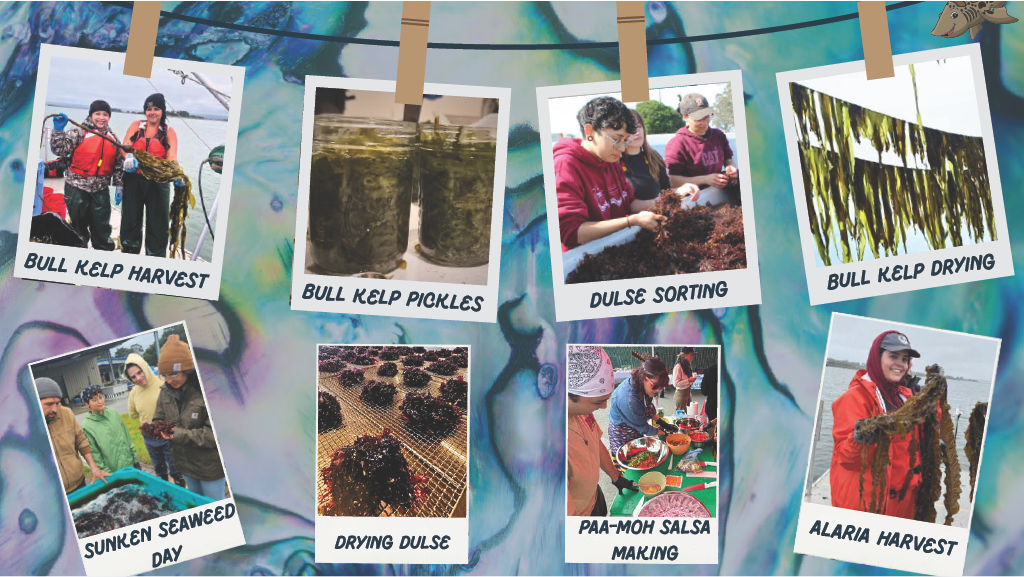
Rou Dalagurr Kelp Guardians Outcomes Report 2024-2025
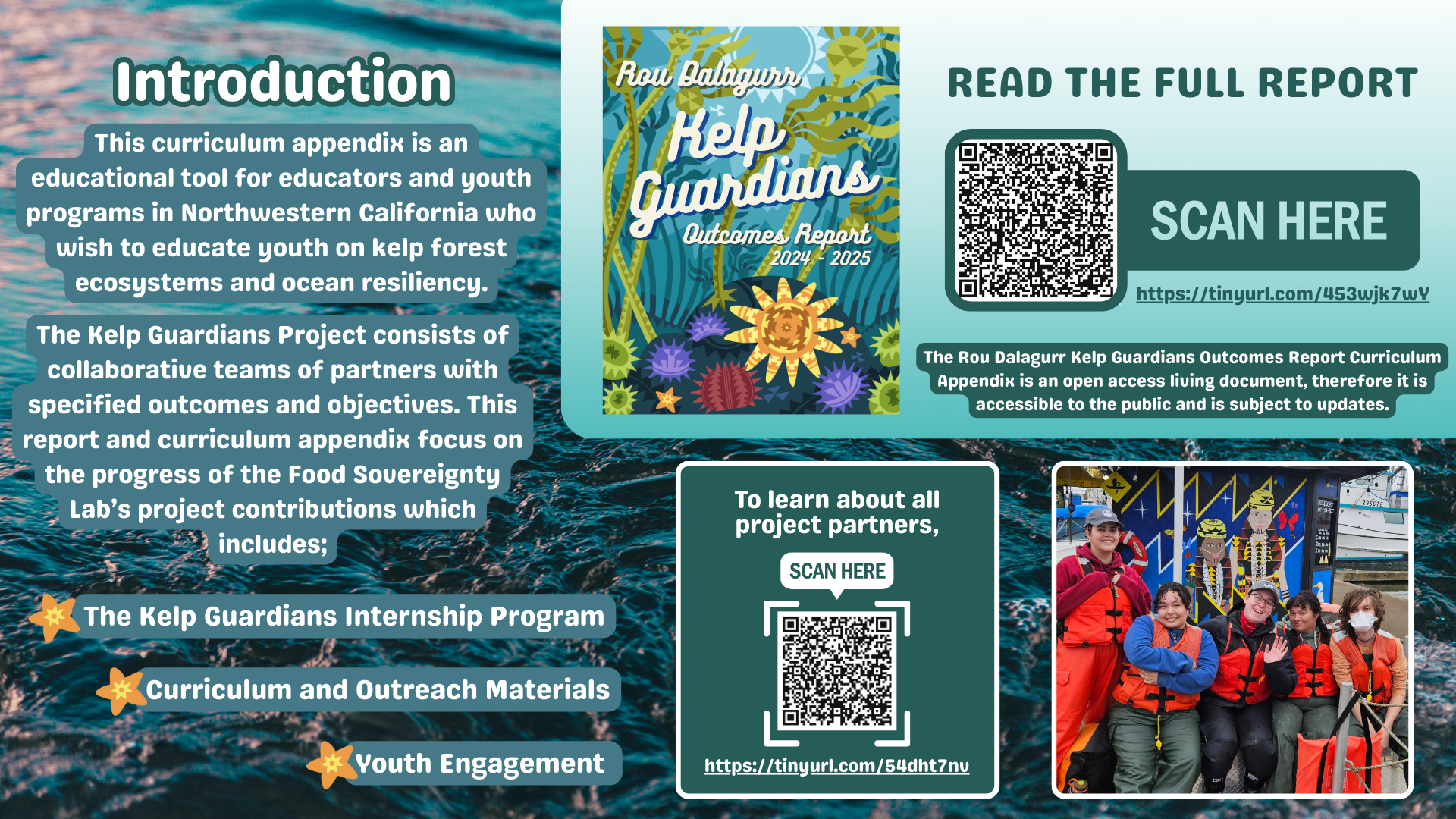
The Kelp Guardians Project consists of collaborative teams of partners with specified outcomes and objectives. This report and curriculum appendix focus on the progress of the Food Sovereignty Lab’s project contributions which includes;
- The Kelp Guardians Internship Program
- Curriculum and Outreach Materials
- Youth Engagement
This curriculum appendix is an educational tool for educators and youth programs in Northwestern California who wish to educate youth on kelp forest ecosystems and ocean resiliency.